L-1 A more comprehensive formula for the shape coefficient for multilevel roofs than that given in 6.4.2 is as follows:
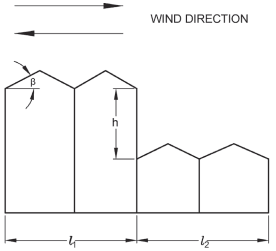
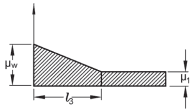
(h and in m)
Restriction:
where
is in kilopascals (kilonewtons per square metre). is in newtons per cubic metre.
Values of for the higher (lower) root depend on its profile and are taken as equal to:
0.5 for plane roofs with slopes and vaulted roofs with
0.3 for plane roofs with slopes and vaulted roofs with
The coefficient and may be adjusted to take into account conditions for transfer of snow on the roof surface (that is wind, temperature, etc).
NOTE — The other condition of loading shall also be tried.
PART 6 STRUCTURAL DESIGN — SECTION 1 LOADS, FORCES AND EFFECTS
(Clause 7.7)
Vibrations in Buildings
M-1 General
In order to design the buildings safe against vibrations, it is necessary to identify the source and nature of vibration. Vibrations may be included in the buildings due to various actions, such as,
a) human induced vibrations, for example, the walking or running or a single person or a number of persons or dancing or motions in stadia or concert halls;
b) machine induced vibrations;
c) wind induced vibrations;
d) blast induced vibrations;
e) traffic load, for example, due to rail, fork-lift, trucks, cars, or heavy vehicles;
f) airborne vibrations;
g) crane operations; and
h) other dynamic actions such as wave loads or earthquake actions.
The dynamic response of buildings for the above mentioned causes of vibration of buildings may have to be evaluated by adopting standard mathematical models and procedures.
The severity or otherwise of these actions have to be assessed in terms of the limits set for dynamic response (frequencies and amplitude of motion) of the buildings related to (a) human comfort, (b) serviceability requirements such as deflections and drifts and separation distances to avoid damage due to pounding, and (c) limits set on the frequencies and amplitude of motion for machines and other installations.
In order to verify that the set limits are not exceeded, the actions may be modelled in terms of force-time histories for which the structural responses may be determined as time histories of displacements or accelerations by using appropriate analytical/numerical methods.
M-2 Serviceability Limit State Verification of Structure Susceptible to Vibrations
M-2.1 While giving guidance for serviceability limit state verification of structure susceptible to vibrations, here it is proposed to deal with the treatment of the action side, the determination of the structural response and the limits to be considered for the structural response to ensure that vibrations are not harmful or do not lead to discomfort.
M-2.2 Source of Vibrations
Vibrations may be included by the following sources:
a) By the movement of persons as in pedestrian bridges, floors where people walk, floors meant for sport or dancing activities, and floors with fixed seating and spectator galleries;
b) By working of machines as in machine foundations and supports, vibrations transmitted through the ground, and pile driving operations;
c) By wind blowing on buildings, towers, chimneys and masts, guyed masts, pylons, bridges, cantilevered roofs, airborne vibrations;
d) Induced by traffic on rail or road bridges and car park structures and exhibition halls; and
e) By earthquakes.
M-2.3 Modelling of Actions and Structures
For serviceability limit states, the modelling of these actions and of the structure depends on how the serviceability limits are formulated. The serviceability limit states may refer to,
(a) human comfort;
(b) limits for the proper functioning of machines and other installations; and
(c) maximum deformation limits to avoid damage or pounding.
In order to verify that these limits are not exceeded, the actions may be modeled in terms of force-time histories, for which the structural responses may be determined as time histories of displacements or accelerations by using appropriate analytical/numerical methods. Where the structural response may significantly influence the force-time histories to be applied, these interactions have to be considered either in modeling a combined load-structure vibration system or by appropriate modifications of the force time histories. In addition to the levels of vibration for which presently limits have been specified, the possible deformations of structural members and systems using different clauses in the relevant codes have to be evaluated by adopting standard mathematical models and procedures.
M-2.4 Force-Time Histories
The force-time histories used in the dynamic analysis
should adequately represent the relevant loading situations for which the serviceability limits are to be verified. The force-time histories may model,
a) human induced vibrations, for example the walking or running of a single person or a number of persons or dancing or motions in stadia or concert halls;
b) machine induced vibrations, for example by force vectors due to mass eccentricities and
frequencies, that may be variable with time;
c) wind induced vibrations;
d) blast induced vibrations;
e) traffic load, for example rail, fork-lift, trucks, cars, or heavy vehicles;
f) airborne vibrations;
g) crane operations; and
h) other dynamic actions such as wave loads or earthquake actions.