A hearing enhancement system fitted at an information point can significantly assist communication for a person with a hearing impairment who uses a personal hearing aid, or has a cochlear implant. Hearing aids or cochlear implants may have a Telecoil (T-switch) which
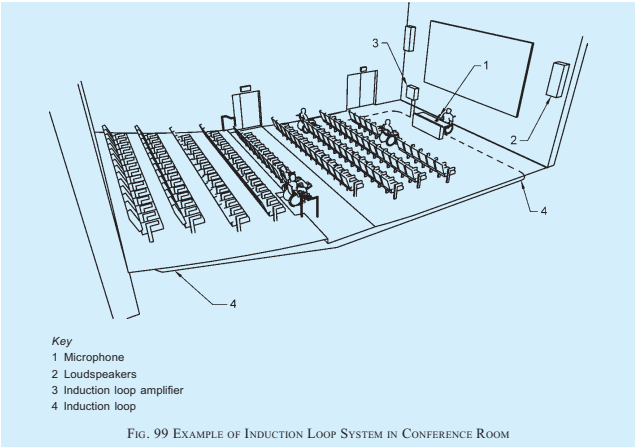
Key 1 Microphone 2 Loudspeakers 3 Induction loop amplifier 4 Induction loop
allows the listener to receive the sound signal directly.
NOTE — Hearing enhancement systems amplify audible communication and can be helpful to people who have a hearing impairment. They include a direct wire system, an inductive loop system, an infrared system, or a radio frequency system. All of these systems transmit a signal. Special purpose receivers are required for infrared and radio frequency systems, while hearing aids equipped with a T-switch are capable of receiving the signal from an induction loop system. Receivers can be equipped to be compatible with hearing aids.
Hearing enhancement systems, for example induction loops and infrared signal transmitting systems, shall be provided in conference and meeting areas. All seats, including the front scene, should be covered by hearing enhancement systems like induction loops (see Fig. 99). Portable hearing enhancement systems may be an alternative.
B-22 Lighting
B-22.1 General
The planning of artificial lighting should be co-ordinated with the planning of natural lighting, the choice of surfaces and colours. Lighting can be used to accentuate interior colour, tone and texture schemes, and to facilitate orientation. The lighting should not lead to glare or excessive contrast.
B-22.2 External Lighting
The routes to and around a building shall have sufficient
artificial lighting to facilitate awareness of changes of level or gradient. The positioning of lights should not cause glare, reflection or shadows. Ramps, entrances, steps, signage, etc, to the building should be well lit artificially, with an illuminance of at least 100 lux.
B-22.3 Natural Lighting
It should be possible to shade windows from bright light.
B-22.4 Artificial Lighting
Lighting should provide visual conditions consistent with the visual task, orientation and safety. Key factors are,
a) level of illumination of horizontal and vertical surfaces;
b) limitation of glare from a light source or reflections;
c) uniformity and luminance distribution;
d) direction of lighting and shading; and
e) colour rendering.
NOTE — Good artificial lighting where needed is crucial for everyone, ensuring that vision impaired people are able to use buildings safely and conveniently, and that people with hearing impairments are able to lip read.