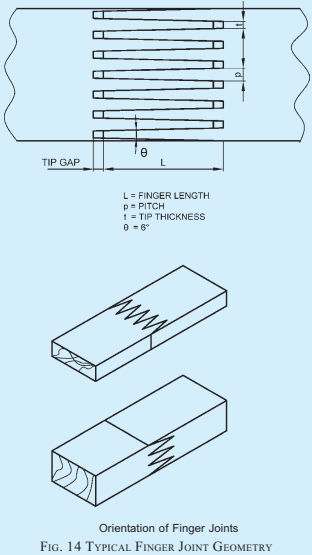
13.1 Finger joints are glued joints connecting timber members end-to-end (see Fig. 14). Such joints shall be produced by cutting profiles (tapered projections) in the form of v-shaped grooves to the ends of timber planks or scantling to be joined, gluing the interfaces and then mating the two ends together under pressure. Finger joints provide long lengths of timber, ideal for upgrading timber by permitting removal of defects, minimising warping and reducing wastage by avoiding short off-cuts.
13.1.1 In finger joints the glued surfaces are on the side grain rather than on the end grain and the glue line is stressed in shear rather in tension.
13.1.1.1 The fingers can be cut from edge-to-edge or from face-to-face. The difference is mainly in appearance, although bending strength increases if several fingers share the load. Thus a joist is slightly stronger with edge-to-edge finger joints and a plank is stronger with face-to-face finger joint.
13.1.1.2 For structural finger jointed members for interior dry locations, adhesives based on melamine formaldehyde cross linked polyvinyl acetate (PVA) are suited. For high humid and exterior conditions, phenol formaldehyde and resorcinol formaldehyde type adhesives are recommended. Proper adhesives should be selected in consultation with the designer and adhesive manufacturers and assessed in accordance with accepted standard [6-3A(11)].
13.1.2 Manufacturing Process
In the absence of sophisticated machinery, the finger joints shall be manufactured through intermediate technology with the following steps:
a) Drying of wood
b) Removal of knots and other defects
c) Squaring the ends of the laminating planks
d) Cutting the profile of finger joint in the end grain
e) Applying adhesives on the finger interfaces
f) Pressing the joint together at specified pressure
g) Curing of adhesive line at specified temperature
h) Planing of finger-jointed planks for smooth surface
13.1.3 Strength
Strength of finger joints depends upon the geometry of
PART 6 STRUCTURAL DESIGN — SECTION 3 TIMBER AND BAMBOO: 3A TIMBER
the profile for structural purpose; this is generally long, pitch.
13.1.3.1 The strength properties of glued finger joints are given in Table 21 for information and guidance in design.
13.1.3.2 Tip thickness shall be as small as practically possible.
14 STRUCTURAL USE OF PLYWOOD
Unlike sawn timber, plywood is a layered panel product comprising veneers of wood bonded together with adjacent layers usually at right angles. As wood is strongest when stressed parallel to grain, and weak perpendicular to grain, the lay up or arrangement of veneers in the panel determines its properties. When the face grain of the plywood is parallel to the direction of stress, veneers parallel to the face grain carry almost all the load. Some information/guidelines for structural use of plywood which should be manufactured in accordance with accepted standards are given in 14.1 to 14.3.