10.1 Manufacture of Precast Concrete Elements
10.1.1 A judicious location of precasting yard with concreting, initial curing (required for demoulding), storage facilities, suitable transporting and erection equipments and availability of raw materials are the crucial factors which should be carefully planned and
provided for effective and economic use of precast concrete components in constructions.
10.1.2 Manufacture
The manufacture of the components can be done in a factory for the commercial production established at the focal point based on the market potential or in a site precasting yard set up at or near the site of work.
10.1.2.1 Factory prefabrication
Factory prefabrication is resorted to in a factory for the commercial production for the manufacture of standardized components on a long term basis. It is a capital intensive production where work is done throughout the year preferably under a closed shed to avoid effects of seasonal variations. High level of mechanization can always be introduced in this system where the work can be organized in a factory-like manner with the help of a constant team of workmen.
10.1.2.2 Site prefabrication
In this scheme, prefabricated components are produced at site or near the site of work as possible.
This system is normally adopted for a specific job order of large scale that will continue over a long period. This option provides definite economy with respect to cost of transportation thereby improving productivity. Even though temporary, the factory established should be comparable to high capacity permanent factory with equivalent state-of-the-art degree of mechanization and quality control. Under this category there are two types, that is, semi-mechanized and fully-mechanized.
10.1.2.2.1 Semi-mechanized
The work is normally carried out in open space with locally available labour force or skilled labour force depending on project complexity. The equipment machinery used may be minor in nature and moulds are of mobile or stationary in nature.
10.1.2.2.2 Fully-mechanized
The work is carried out under a shed with skilled labour. The equipments used are similar to one of factory production. This type of precast yards will be set up for the production of precast components of high quality, high rate of production.
10.1.3 The various processes involved in the manufacture of precast elements may be classified as follows.
10.1.3.1 Main process
a) Providing and assembling the moulds, placing reinforcement cage in position for reinforced concrete work, and stressing the wires in the case of prestressed elements;
b) Putting concealed service conduits/pipes;
c) Fixing of inserts and tubes, where necessary (for handling);
d) Pouring the concrete (designed properly under strict quality control) into the moulds;
e) Vibrating the concrete and finishing;
f) Curing (steam curing, if necessary); and
g) Demoulding the forms and stacking the precast products.
10.1.3.2 Auxiliary process
Process, such as the following, necessary for the successful completion of the processes covered by the main process:
a) Mixing and manufacture of fresh concrete (done in a mixing station or by a batching plant);
b) Prefabrication of reinforcement cage (done in a steel yard or workshop);
c) Manufacture of inserts and other finishing items to be incorporated in the main precast products;
d) Finishing the precast products; and
e) Testing of products.
10.1.3.3 Subsidiary process
All other work such as the following, involved in keeping the main production work to a cyclic working:
a) Storage of materials;
b) Transport of cement and aggregates;
c) Transport of green concrete and reinforcement cages;
d) Transport of and stacking the precast elements;
e) Repairs and maintenance of tools, shackles and machines;
f) Repairs and maintenance of moulds;
g) Maintenance of curing yards; and
h) Generation of steam, etc.
10.1.4 For the manufacture of precast elements all the above processes shall be planned in a systematic way to achieve the following:
a) A cyclic technological method of working to bring in speed and economy in manufacture;
b) Mechanization of the process to increase productivity and to improve quality;
c) The optimum production satisfying the quality control requirements and to keep up the expected speed of construction aimed;
d) Better working conditions for the people on the job; and
PART 6 STRUCTURAL DESIGN — SECTION 7 PREFABRICATION, SYSTEMS BUILDING AND MIXED/COMPOSITE CONSTRUCTION: 7A PREFABRICATED CONCRETE
e) Minimizing the effect of weather on the manufacturing schedule.
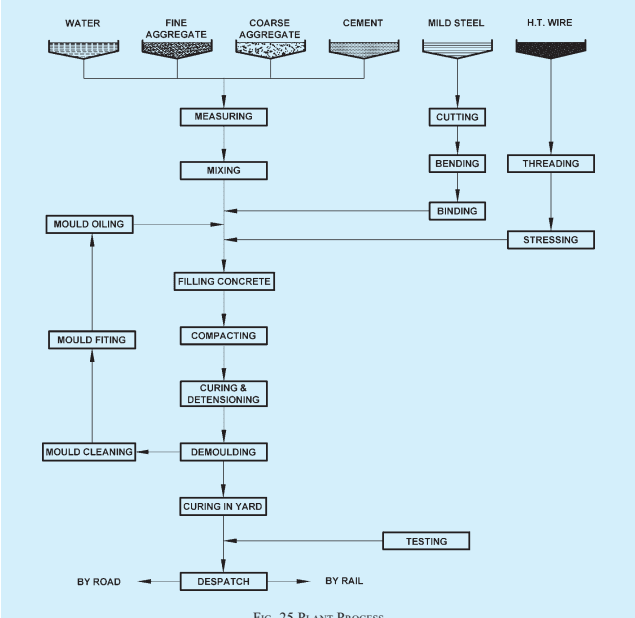
10.1.5 The various stages of precasting can be classified as in Table 2 on the basis of the equipment required for the various stages. This permits mechanization and rationalization of work in the various stages. In the precasting, stages 6 and 7 given in Table 2 form the main process in the manufacture of precast concrete elements. For these precasting stages there are many technological processes to suit the concrete product under consideration which have been proved rational, economical and time saving. The technological line or process is the theoretical solution for the method of planning the work involved by using machine complexes. Figure 25 illustrates diagrammatically the various stages involved in a plant process.
10.1.6 The various accepted methods of manufacture
of precast units can be broadly classified into two methods:
a) The ‘Stand Method’ where the moulds remain stationary at places, when the various processes involved are carried out in a cyclic order at the same place, and
b) The ‘Flow Method’ where the precast unit under consideration is in movement according to the various processes involved in the work which are carried out in an assembly-line method.
The various accepted precasting methods are listed in Table 3 with details regarding the elements that can be manufactured by these methods.