The requirements shall be met by the choice of suitable materials, by appropriate design and detailing and by specifying control procedures for production, construction and use.
PART 6 STRUCTURAL DESIGN — SECTION 3 TIMBER AND BAMBOO: 3B BAMBOO
4.1 Species of Bamboo
More than 100 species of bamboo are native to India and a few of them are solid but most of them are hollow in structure. In all 20 species have been systematically tested so far. Sixteen species of bamboo are recommended for structural usages in round form. Some physical and mechanical properties of the same are given in Table 1 both for air-dry conditions and green conditions.
4.1.1 Matured bamboo of at least 4 years of age shall be used. The bamboo shall be used after at least six weeks of felling period.
4.1.2 Bamboo shall be properly treated in accordance with the good practice [6-3B(1)].
4.1.3 Solid bamboos or bamboos whose wall thickness is comparatively more and which are generally having nodes very closer are often considered good for structural purposes.
4.1.4 Broken, damaged or collapsed bamboo shall be rejected. Dead and immature bamboos, bore/Ghoon holes, decay, collapse, checks more than 3 mm in depth, shall be avoided.
4.2 Grouping
4.2.1 Sixteen species of bamboo recommended for structural applications are classified in three groups on the basis of their strength properties, namely, modulus of elasticity (E) in bending in green condition and modulus of rupture (R) (extreme fibre stress in bending). For structural use in piles and mines' components, an additional criterion of compressive strength is considered in classification. The limits in ultimate strength values of these groups shall be as given in Table 2 (these are corresponding to the spread of properties in structural timber).
4.2.2 Bamboo species may be identified using suitable methods.
NOTE — Methods of identification of bamboo through anatomical characters have not been perfected so far. Identification through morphological characters could be done only on full standing culm by experienced sorters.
4.2.3 Species of bamboo other than those listed in the Table 3 may be used, provided their strength characteristics are determined and found more than the limits specified in Table 2.
4.3 Moisture Content in Bamboo
Normally only dry or seasoned bamboo shall be used otherwise special attention shall be given to dimensional changes occurring during the drying process in the joints, assemblies.
With decrease of moisture content, the strength of bamboo increases exponentially and bamboo has an intersection point (fibre saturation point) at around 25 percent moisture content depending upon the species. A typical moisture strength relationship is given at Fig. 1. The moisture content of bamboo shall be determined in accordance with method given in the accepted standard [6-3B(2)]. Matured culms shall be seasoned to about 20 percent moisture content before use.
Freshly felled bamboo with shoots and leaves intact, dry fairly well in the open sun with lesser surface cracking, etc, and reduced starch contents. Rapid drying in the open can control degrades.
4.4 Grading of Structural Bamboo
4.4.1 Bamboo shall be graded to ensure that the properties of bamboo are satisfactory for use particularly the strength and stiffness properties.
4.4.1.1 Grading is sorting out bamboo on the basis of characteristics important for structural utilization as under:
a) Diameter and length of culm;
b) Taper of culm;
c) Straightness of culm;
d) Inter nodal length and distribution of nodes;
e) Wall thickness;
f) Density and strength; and
g) Durability and seasoning.
One of the above characteristics or sometimes combination of two or three characteristics form the basis of grading. The culms shall be segregated species-wise.
4.4.2 Diameter and Length
4.4.2.1 Gradation according to the mean outer diameter
For structural Group A and Group B species, culms shall be segregated in steps of 10 mm of mean outer diameter as follows:
a) Special grade : 70 mm < Diameter ≤ 100 mm
b) Grade I : 50 mm < Diameter ≤ 70 mm
c) Grade II : 30 mm < Diameter ≤ 50 mm
d) Grade III : Diameter ≤ 30 mm
For structural Group C species culms shall be segregated in steps of 20 mm of mean outer diameter as follows:
-
Grade I : 80 mm < Diameter ≤ 100 mm
-
Grade II :
-
Grade III : Diameter ≤ 60 mm
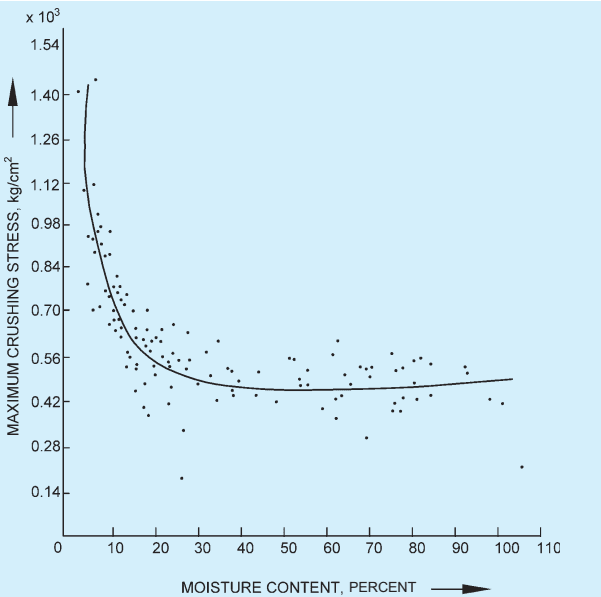
FIG. 1 MOISTURE STRENGTH RELATIONSHIP BAMBUSA NUTANS (BAMBOO)
4.4.2.2 The minimum length of culms shall be preferably for facilitating close fittings at joints, etc.
4.4.3 Taper
The taper shall not be more than 5.8 mm per metre length (or 0.58 percent) (1 in 170) of bamboo in any grade of bamboo.
4.4.4 Curvature
The maximum curvature should not be more than in a length of of any grade of bamboo.
NOTE — Due to the constraint of preferential selection of straighter material out of a lot, more bent material may be accommodated to avoid high cost. Following remedial options may be helpful:
a) Adopt component assembly method to take care of some degree of curvature (bunching done after holding components straight).
b) Cut longer bamboo components with less curvature out of taller bamboo and use cambered ones for shorter length components.
4.4.5 Wall Thickness
Preferably minimum wall thickness of 8 mm shall be used for load bearing members unless calculations and the availability dictate otherwise.
4.5 Durability and Treatability
4.5.1 Durability
The natural durability of bamboo is low and varies between 12 months and 36 months depending on the species and climatic conditions. In tropical countries the bio-deterioration is very severe. Bamboos are generally destroyed in about one to two years' time when used in the open and in contact with ground; while a service life of two to five years can be expected from
PART 6 STRUCTURAL DESIGN — SECTION 3 TIMBER AND BAMBOO: 3B BAMBOO
bamboo when used under cover and out of contact with ground. The mechanical strength of bamboo deteriorates rapidly with the onset of fungal decay in the sclerenchymatous fibres. Split bamboo is more rapidly destroyed than round bamboo. For making bamboo durable, suitable treatment for preserving bamboo shall be given in accordance with the good practice [6-3B(3)]. However, special attention shall be given to environmental impact and to the health aspects of labour and the users.
4.5.2 To ensure an adequately durable structure, bamboo shall be treated in accordance with the good practice [6-3B(1)] and the following inter-related factors shall be considered:
a) Expected service life of the bamboo;
b) Use of the structure and expected environmental conditions;
c) Required performance criteria; and
d) Quality of workmanship.
4.5.3 Fire safety of bamboo structures shall be ensured, for which the treatment prescribed in 7.3.4 may be followed.
5 PERMISSIBLE STRESSES
5.1 Ultimate stress values of different species and groups of bamboo shall be determined according to
the accepted standard [6-3B(2)]. These values shall then be divided by appropriate factors of safety to obtain permissible stresses to cover the effects of variability, long term loading, grade, location of use and expected dynamic loading.
NOTE — As an information, it may be noted that the method of test for split bamboos is covered in the accepted standard [6-3B(4)].
5.1.1 The strength factors for deriving safe working stresses of bamboo shall be as under :
Extreme fibre stress in beams : 4
Modulus of elasticity : 4.5
Maximum compressive stress parallel to : 3.5 grain/fibres
5.2 The available data for the safe working stresses for 16 species of bamboos are given in Table 3.
5.3 For change in duration of load other than continuous (long-term), the permissible stresses given in Table 3 shall be multiplied by the modification factors given below:
For permanent loads : 1.0
For imposed or medium term loading : 1.25
(permanent + temporary load)
For short term loading (permanent + : 1.50
temporary load + wind load)
| Sl No. | Species | Properties | |||||||
| In Green Condition | In Air Dry Conditions | ||||||||
| Density kg/m3 | Modulus of Rupture N/mm2 | Modulus of Elasticity × 103N/mm2 | Maximum Compressive Strength N/mm2 | Density kg/m3 | Modulus of Rupture N/mm2 | Modulus of Elasticity × 103N/mm2 | Maximum Compressive Strength N/mm2 | ||
| (1) | (2) | (3) | (4) | (5) | (6) | (7) | (8) | (9) | (10) |
| i) | Bambusa auriculata | 594 | 65.1 | 15.01 | 36.7 | 670 | 89.1 | 21.41 | 54.3 |
| ii) | B. balcooa | 783 | 65.4 | 7.31 | 46.7 | — | — | — | 60.6 |
| iii) | B. bambos (Syn. B. arundinacea) | 559 | 58.3 | 5.95 | 35.3 | 663 | 80.1 | 8.96 | 53.4 |
| iv) | B. burmanica | 570 | 59.7 | 11.01 | 39.9 | 672 | 105.0 | 17.81 | 65.2 |
| v) | B. glancescens (Syn. B. nana) | 691 | 82.8 | 14.77 | 53.9 | — | — | — | — |
| vi) | B. nutans | 603 | 52.9 | 6.62 | 45.6 | 673 | 52.4 | 10.72 | 47.9 |
| vii) | B. pallida | 731 | 55.2 | 12.90 | 54.0 | — | — | — | — |
| viii) | B. tulda | 658 | 51.1 | 7.98 | 40.7 | 722 | 66.7 | 10.07 | 68.0 |
| ix) | B. ventricosa | 626 | 34.1 | 3.38 | 36.1 | — | — | — | — |
| x) | B. vulgaris | 626 | 41.5 | 2.87 | 38.6 | — | — | — | — |
| xi) | Cephalostachyum pergracile | 601 | 52.6 | 11.16 | 36.7 | 640 | 71.3 | 19.22 | 49.4 |
| xii) | Dendrocalamus longispathus | 711 | 33.1 | 5.51 | 42.1 | 684 | 47.8 | 6.06 | 61.1 |
| xiii) | D. strictus | 631 | 73.4 | 11.98 | 35.9 | 728 | 119.1 | 15.00 | 69.1 |
| xiv) | Melocanna baccifera | 817 | 53.2 | 11.39 | 53.8 | 751 | 57.6 | 12.93 | 69.9 |
| xv) | Oxytenanthera abyssinicia | 688 | 83.6 | 14.96 | 46.6 | — | — | — | — |
| xvi) | Thyrsostachys oliveri | 733 | 61.9 | 9.72 | 46.9 | 758 | 90.0 | 12.15 | 58.0 |
NOTE — The values of stress in have been obtained by converting the values in by dividing the same by 10.
| Table 2 Properties of Structural Bamboo(Clause 4.2.1) | ||||
| Sl No. | Group | Modulus of Rupture (R) | Modulus of Elasticity in Bending (E) | Maximum Compressive Strength ( ) |
| (3) | (4) | (5) | ||
| i) | A | |||
| ii) | B | |||
| iii) | C | |||
| Sl No. | Species | Extreme Fibre Stress in Bending N/mm2 | Modulus of Elasticity × 103N/mm2(4) | Allowable Compressive Stress N/mm2(5) |
| (1) | (2) | (3) | ||
| i) Group A: | ||||
| a) | Bambusa glancescens (Syn.B.nana) | 20.7 | 3.28 | 15.4 |
| b) | Dendrocalamus strictus | 18.4 | 2.66 | 10.3 |
| c) | Oxytenanthera abyssinicia | 20.9 | 3.31 | 13.3 |
| ii) Group B: | ||||
| a) | Bambusa balcooa | 16.4 | 1.62 | 13.3 |
| b) | B.pallida | 13.8 | 2.87 | 15.4 |
| c) | B.nutans | 13.2 | 1.47 | 13.0 |
| d) | B.tulda | 12.8 | 1.77 | 11.6 |
| e) | B.auriculata | 16.3 | 3.34 | 10.5 |
| f) | B.burmanica | 14.9 | 2.45 | 11.4 |
| g) | Cephalostachyum pergracile | 13.2 | 2.48 | 10.5 |
| h) | Melocanna baccifera (Syn.M.bambusoides) | 13.3 | 2.53 | 15.4 |
| j) | Thyrsotachys oliveri | 15.5 | 2.16 | 13.4 |
| iii) Group C: | ||||
| a) | Bambusa arundinacea (Syn.B.bambos) | 14.6 | 1.32 | 10.1 |
| b) | B.ventricosa | 8.5 | 0.75 | 10.3 |
| c) | B.vulgaris | 10.4 | 0.64 | 11.0 |
| d) | Dendrocalamus longispathus | 8.3 | 1.22 | 12.0 |
| NOTE — The values of stress in N/mm2 have been obtained by | ||||
NOTE — The values of stress in N/mm² have been obtained by converting the values in kgf/cm² by dividing the same by 10.
The values given pertain to testing of bamboo in green condition.