12.4.1 General
a) Grouting shall be carried out as early as possible but not later than 2 weeks of stressing a tendon. Whenever this stipulation cannot be complied with for unavoidable reasons, adequate temporary protection of the steel against corrosion by methods or products which will not impair the ultimate adherence of the injected grout should be ensured till grouting. The sealing of the anchorage ends after concreting is considered to be a good practice to prevent ingress of water. For structures in aggressive environment, sealing of the anchorage ends is mandatory.
b) Any traces of oil if applied to steel for preventing corrosion should be removed
before grouting operation.
Ducts shall be flushed with water for cleaning as well as for wetting the surfaces of the duct walls. Water used for flushing should be of same quality as used for grouting. It may, however, contain about 1 percent of slaked lime or quick lime. All water should be drained through the lowest drain pipe or by blowing compressed air through the duct.
d) The water in the duct should be blown out with oil free compressed air.
Blowing out water from duct for cables longer than 50 m draped up at both ends by compressed air is not effective, outlet/vent provided at or near the lowest point shall be used to drain out water from duct.
e) The connection between the nozzle of the injection pipe and duct should be such that air cannot be sucked in.
f) All outlet points including vent openings should be kept open prior to commencement of injection grout.
g) Before grouting, all air in the pump and hose should be expelled. The suction circuit of the pump should be air-tight.
12.4.2 Injection of Grout
a) After mixing, the grout shall be kept in continuous movement.
b) Injection of grout be continuous and should not be interrupted.
c) For vertical cable or cables inclined more than 60∘ to the horizontal injection shall be effected from the lowest anchorage or vent of the duct.
d) The method of injection shall ensure complete filling of the ducts. To verify this, it is advisable to compare the volume of the space to be filled by the injected grout with the quantity or grout actually injected.
e) Grouting should be commenced initially with a low pressure of injection of up to 0.3 MPa increasing it until the grout comes out at the other end. The grout may be allowed to flow freely from the other end until the consistency of the grout at this end is the same as that of the grout at the injection end. When the grout flows at the other end, it should be closed off and buildup of pressure commenced. Full injection pressure of about 0.5 MPa shall be maintained for at least 1 min before closing the injection pipe. It is a recommended practice to provide a stand pipe at the highest point of the tendon profile to hold all water displaced by sedimentation or bleeding. If
PART 6 STRUCTURAL DESIGN — SECTION 5 CONCRETE: 5B PRESTRESSED CONCRETE
there is a buildup of pressure much in excess of 1 MPa without flow of grout coming at the other end, the grouting operation shall be discontinued and the entire duct flushed with high pressure water. Also, the bypass system indicated in 12.3.2.2 is essential for further safety.
f) In the case of cables draped downwards for example, in cantilever construction simultaneous injection from both ends may be adopted (see Fig. 2).
g) Grout not used within 30 min of mixing should be rejected.
h) Disconnection is facilitated if a short length of flexible tube connects the duct and injection pipe. This may be squeezed and cut off after the grout has hardened.
12.4.3 Precautions and Recommendations for Effective Grouting
a) In cold and frosty weather, injection should
be postponed unless special precautions are taken. If frost is likely to occur within 48 h after injection, heat shall be applied to the member and maintained for at least 48 h after injection so that the temperature of the grout does not fall below 5∘ C. Prior to commencement of grout, care shall be taken to ensure that the duct is completely free of frost/ice by flushing with warm water but not with steam.
b) When the ambient temperature during the day is likely to exceed 40∘ C, grouting should be done in the early morning or late evening hours.
c) When the cables are threaded after concreting, the duct shall be temporarily protected during concreting by inserting a stiff rod or a rigid PVC pipe or any other suitable method.
d) During concreting, care shall be taken to ensure that the sheathing is not damaged.
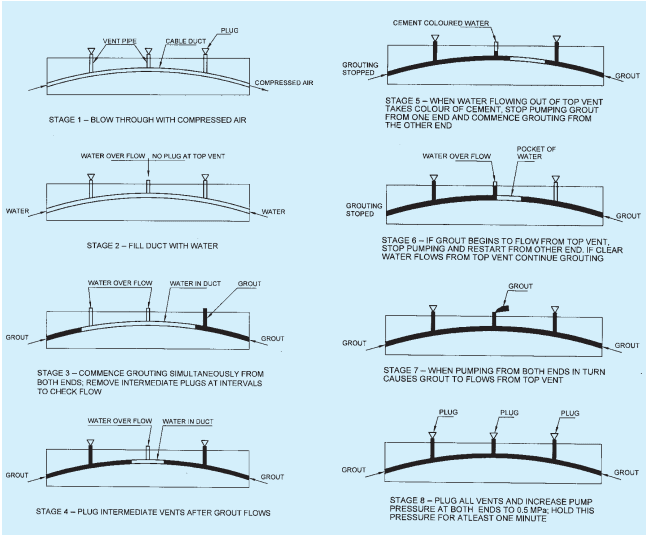
FIG. 2 PROCEDURE FOR GROUTING OF CABLES DRAPED DOWNWARDS
Needle vibrators shall be used with extreme care by well experienced staff only, to ensure the above requirements.
e) It is a good practice to move the cables in both directions during the concreting operations. This can easily be done by light hammering the ends of the wires/strands during concreting. It is also advisable that 3 h to 4 h after concreting the cable should be moved both ways through a distance of about 200 mm. With such movement, any leakage of mortar which has taken place in spite of all precautions loses bond with the cables, thus reducing the chance of blockages. This operation can also be done by fixing prestressing jacks at one end pulling the entire cable and then repeating the operation by fixing the jack at the other end.
f) The cables to be grouted should be separated by as much distance as possible.
g) In case of stage prestressing, cables tensioned in the first stage should not remain ungrouted till all cables are stressed. It is a good practice, while grouting any duct in stage prestressing, to keep all the remaining ducts filled up with water containing 1 percent lime or by running water through such ducts till the grout has set. After grouting the particular cable, the water in the other cables should be drained and removed with compressed air to prevent corrosion.
h) Care should be taken to avoid leaks from one duct to another at joints of precast members.
j) End faces where anchorages are located are vulnerable points of entry of water. They have to be necessarily protected with an effective barrier. Recesses should be packed with mortar concrete and should preferably be painted with water proof paint.
k) After grouting is completed, the projecting portion of the vents should be cut off and the face protected to prevent corrosion.