Installation of Mirrors
G-1 This annex provides general guidelines, which is to be followed during the installation of mirror. Mirrors (Piece of glass silvered on one side, with a protective paint coating) are used in shops, gymnasiums, etc, where it is predominantly used as wall cladding. The mirror panels in such application use large panel size and it is recommended to follow the installation procedure in accordance with this Section.
G-1.1 The mirror should always be mounted on a perfectly flat, clean and dry surface free from acids and aggressive substances such as acid, solvent and cement mortar.
G-1.2 The mirror shall be mounted on wall or plywood and care is taken that the mirror is never stuck over unstable support (painted paper, paint or old plaster). It is recommended that the mirror installation is not done directly on the mirror supports. In order to have good ventilation, the following spacing behind the mirror is recommended depending on the height of the mirror panel:
a) A space of for a mirror less than height.
b) A space of for a mirror greater than height.
Figure 19 gives typical details of the installation of mirrors. During the installation of mirror panels at several levels that is, one above the other, it is recommended to provide a space of at the top and at the bottom for circulation of air. The side of the mirror is designed with a minimum 1 or of interleaving space. When mirror is fixed in a profile (frame), care is to be taken to maintain perfectly dry
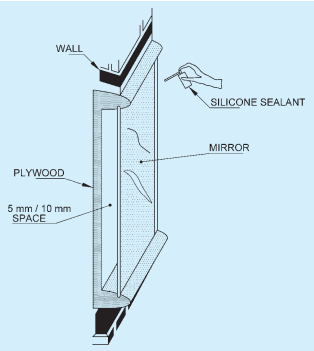
FIG. 19 INSTALLATION OF MIRRORS
and clean frame. It is recommended that mirror is supported on hard non-metallic/plastic wedges of at least 3 mm, to raise the mirror and thus avoid contact with the condensed water which could accumulate in the profile. If the mirror is screwed on, the screws of a suitable dimension is designed, with the interleaving and washers (see Fig. 20) made of plastic to avoid any direct glass-metal contact. To minimise the risk of breakage, cracks and splinters during screw-mounting the mirror, it is recommended to use synthetic protective collars.
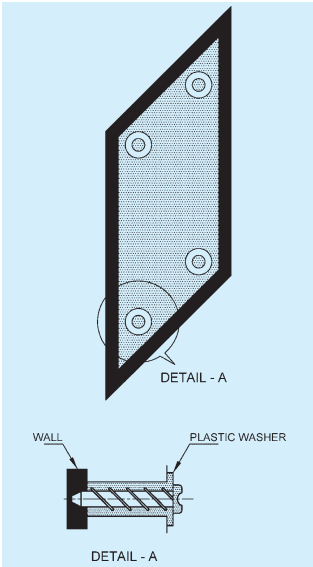
FIG. 20 DETAILS OF USE OF SCREWS AND INTERLEAVING WASHERS FOR INSTALLING MIRRORS
G-1.3 The adhesive used to mount mirrors, care should be taken to ensure that the adhesive is compatible with the protective coatings on the mirror. It is recommended to use only neutral binding agents such as alkoxy silicone, oxime silicone, etc. Avoid use of acid silicones, such as acetoxy silicones which contain acetic acid or water/rubber/polyurethane-based glues.
G-1.4 In the high humidity areas (for example bathrooms), it is recommended to seal the edges with neutral silicone to protect the backing paint from damage due to moisture and enhanced protection from moisture. It is recommended to use double sided adhesive tapes to fix the mirror on the mounting surface (see Fig. 21). The adhesive tapes used for installation shall be certified to be compatible with the mirror and the adhesive or the adhesive tapes shall always be fixed vertically.
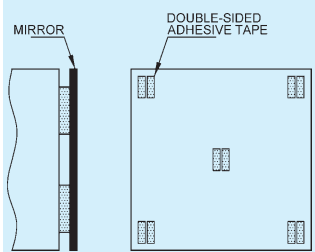
FIG. 21 DETAILS OF USE OF DOUBLE SIDED ADHESIVE TAPES FOR INSTALLING MIRRORS