Effect of a Cliff or Escarpment on Equivalent Height Above Ground ( Factor)
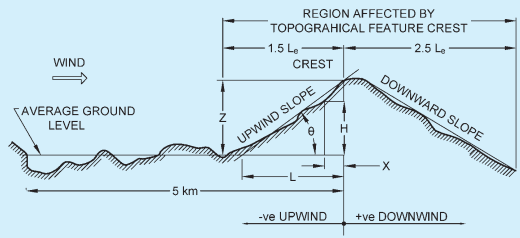
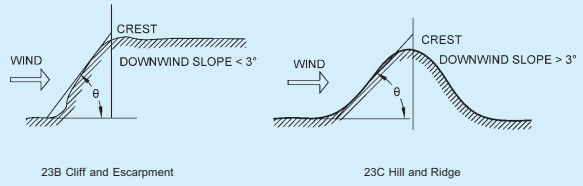
E-1 The influence of the topographic feature is considered to extend upwind and downwind of the summit of crest of the feature where is the effective horizontal length of the hill depending on slope as indicated below (see Fig. 23):
where
actual length of the upwind slope in the wind direction,
effective height of the topography feature, and
upwind slope in the wind direction.
In case, the zone in downwind side of the crest of the feature is relatively flat ( ) for a distance exceeding , then the feature should be treated as an escarpment. Otherwise the feature should be treated as a hill or ridge. Examples of typical features are given in Fig. 23.
1 No difference is made, in evaluating between a three dimensional hill and two dimensional ridge.
2 In undulating terrain, it is often not possible to decide whether the local topography to the site is significant in terms of wind flow. In such cases, the average value of the terrain upwind of the site for a distance of should be taken as the base level from wind to assess the height, , and the upwind slope , of the feature.
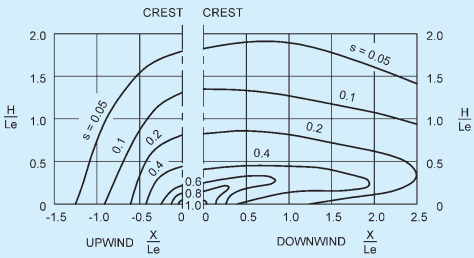
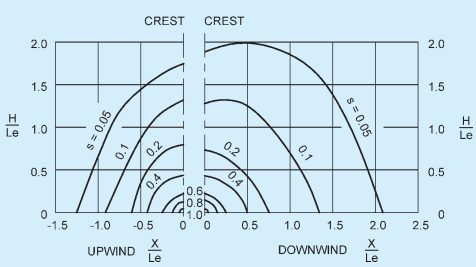
E-2 Topography Factor,
The topography factor is given by the following:
Wind Force on Circular Sections
F-1 The wind force on any object is given by:
where
force coefficient;