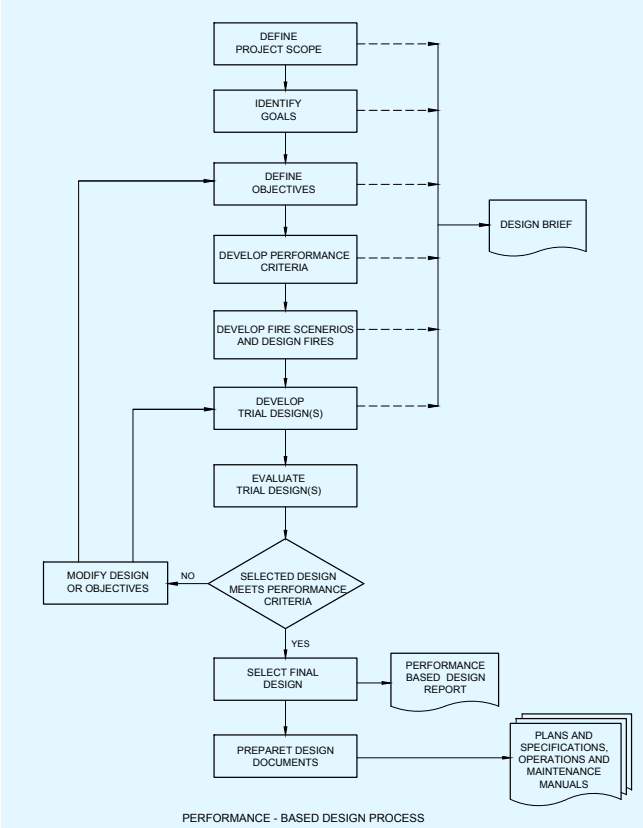
Performance Based Design
M-1 General
M-1.1 Performance based design may be applicable under following conditions to any occupancy, subject to:
a) Approval from state/local authority, where they have resource (local/shared/outsourced) to evaluate a performance-based design for any building;
b) The performance-based design should meet the goals and objectives of this Annex and should be carried out by a registered professional;
c) The local authority having jurisdiction should make the final determination whether the performance objectives have been met; and
d) All necessary documentation as per this annex pre- and post-construction should be part of the submission and should be retained during the entire life of the building.
M-1.2 The provisions of this Annex provides performance based design (PBD) which is applicable only to validate the fire safety aspects for heritage buildings (constructed well before the first version of NBC) that are either made available to public or are converted to other building occupancy (and constrained to add additional staircase/refuge that damages it heritage nature).
The Authority may exempt compliance (of such heritage buildings as above constructed before the publication of the first NBC) with the relevant requirements in this NBCS, if the alternate design(s) proposed based on performance-based solutions duly validated by engineering calculations/computational fluid dynamics (CFD)
modelling, achieve the objectives.
PBD is an engineering approach to fire protection design based on (1) agreed upon fire safety goals and objectives, (2) deterministic and/or probabilistic analysis of fire scenarios, and (3) quantitative assessment of design alternatives against the fire safety goals and objectives using accepted engineering tools, methodologies, and performance criteria.
M-1.3 The application of performance-based fire engineering is highly individualized, excluding its universal adoption across different structures. Due to its reliance on custom-built environmental and occupancy variables, any implementation should undergo a unique validation process by the relevant jurisdiction.
Implementing a performance-based approach necessitates a rigorous assessment of site-specific data to ensure all fire dynamics calculations reflect the unique hazards of the structure. The proponent is responsible for establishing safety parity with prescriptive standards through quantitative evidence. Due to the sophisticated nature of computational fluid dynamics (CFD) modelling, an independent technical audit is recommended to validate the integrity of the design’s assumptions and outcomes.
The implementation of PBD requires a multilateral agreement on risk thresholds involving all key stakeholders, including the authority having jurisdiction (AHJ). Due to the sophisticated nature of these designs, specialized fire science expertise is mandatory to ensure that the transition from a theoretical model to a specific environment is technically sound.
NOTE — Computational models, particularly CFD simulations, should be recalculated to reflect the unique spatial geometry and airflow dynamics of the site. Also, the analysis must incorporate local emergency response variables, ensuring the design aligns with the actual equipment and arrival times of the area's fire services.
M-2 Minimum Criteria
M-2.1 The minimum criteria to accept the PBD solutions should be the compliance to the following:
a) Safe egress (ASET > RSET) through validated evacuation modelling.
b) Controlled fire and smoke spread, maintaining tenable conditions; and
c) Reliable fire suppression and detection exceeding the minimum requirements of this Part.
NOTE — ASET = Available Safe Egress Time; and RSET = Required Safe Egress Time
M-2.2 Tenability refers to the conditions within a space that allow occupants to survive and potentially evacuate safely during a fire. Various factors contribute to tenability, and recommendations suggested is limiting the exposure to the most life-threatening hazards. Thus, to ensure occupant safety in fire scenarios, maintaining tenability criteria at a height of 1.8 m from the floor level is a crucial consideration.
Where possible, the toxicity effects (life threatening hazard) is arrived by obtaining the amount of fractional effective dose (FED) of asphyxiant gases (like, carbon monoxide, hydrogen cyanide); and fractional effective concentration (FEC) of the irritant gases (like, HCl, NO, SO₂). The requirements are:
a) Maintaining FED < 0.3 (recommended to prevent incapacitation of sensitive individuals); and
b) Maintaining FEC < 0.3 (recommended).
FEC is used to assess the combined effect of multiple irritant gases (present in the fire effluent) expressed as:
where
Ci = the concentration of each individual irritant gas (i).
Fi = the concentration of that specific irritant gas (i) that is expected to cause a significant reduction in the possibility of escape and survivability. These Fi values are typically based on experimental data and toxicological studies.