Power Factor is the ratio between the useful (true) power (kW) to the total (apparent) power (kVA) consumed by electrical equipment or a complete electrical installation. It is a measure of how efficiently electrical power is converted into useful work output. The definition and calculation of power factor has been discussed in detail in 7.1. The ideal power factor is unity, or one. Anything less than one means that extra power is required to achieve the actual task at hand. Inductive loads require reactive power to create magnetizing fields to perform the desired function. This reactive power causes the power factor to reduce. Increasing power factor is required to achieve energy efficiency.
As per the Code,
All 3 phases shall maintain their power factor at the point of connection as follows:
(a) 0.97 for ECBC Building
(b) 0.98 for ECBC+ building
(c) 0.99 for SuperECBC building
Power factor correction methods
Power factor correction is the process of adjusting the characteristics of electric loads in order to improve power factor so that it is closer to 1 (unity).
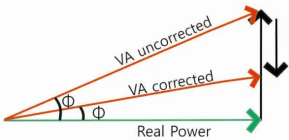
Figure 7.24 Power factor correction
It can be done by the following methods.