The absorption cycle produces cooling using heat such as steam, hot water or gas. This system is often appropriate when a source of low-cost heat is available.
The absorption refrigeration cycle works on the same principle as the compressive cycle. Additionally, there is another principle, which is:
Some liquids have a strong tendency to absorb certain vapors (e.g. water vapor is absorbed by liquid lithium bromide or ammonia).
There are no moving parts in this system. Electricity is used only to operate the pumps.
In the chamber A, water evaporates at low temperature (around 4oC) under high vacuum condition. In this process, it draws heat from the incoming chilled water and further cools it down (output). Thus, water is working as the refrigerant here. This chamber is called the evaporator. In order to keep evaporating, the water in the evaporator must be constantly supplied in order for it to keep evaporating.
The water vapour then migrates to chamber B, where it is absorbed by the lithium bromide solution. This chamber is called the absorber. Consequently, the vapor pressure is reduced in the absorber which in turn creates a vacuum in the evaporator. Due to this the water vapor can evaporate to continue the cooling process. Eventually, the lithium bromide will become too dilute to further absorb water.
In chamber C, an external heat source boils the water off the lithium bromide. This is called the generator. The heating media can be steam, hot water, gas or oil. The concentrated lithium bromide is then returned to the absorber, while the water vapor is condensed back into water in chamber D called the condenser. The last step is to return the liquid water back to the evaporator
so that the cycle can continue. Lithium Bromide - water absorption refrigeration systems have a Coefficient of Performance (COP) in the range of 0.65 – 0.70 and can provide chilled water at 6 . 7 ° C with a cooling water temperature of 3 0 ° C . Systems capable of providing chilled water at 3 ° C are also available.
Ammonia based systems operate at above atmospheric pressures and are capable of low temperature operation (below 0 ° C ) . Absorption machines of capacities in the range of 10–1500 tons are available. Although the initial cost of absorption system is higher than compression system, operational cost is much lower-if waste heat is used.
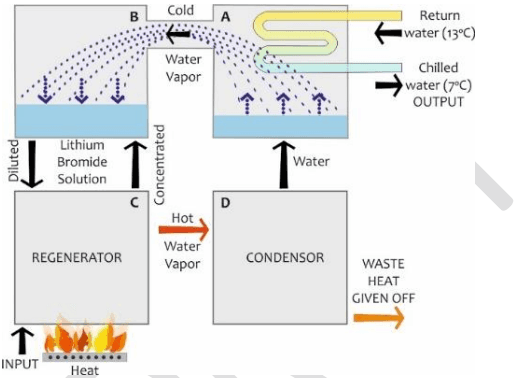
Figure 5.3 Vapor absorption cycle
The ECBC does not specify requirement for efficiency of the vapor absorption system. But requirements for components such as pumps and motors are covered in the Code. The ECBC specifies minimum equipment efficiencies for all HVAC equipment including chillers, unitary air conditioner, split air conditioner, packaged air conditioner, and boilers.