Spaces with variable and high occupant densities such as theatres, meeting rooms, auditorium and others are seldom occupied at full capacity and hence can save energy by providing demandcontrolled ventilation (DCV). Such system modulates the amount of outdoor air as per the number of people present in the space and hence save energy. A common indicator of occupancy is C O 2 concentration which increases with the number of people and also depends on their activity level. The DCV must maintain the outdoor air change rates as per the NBC
Mechanical ventilation systems shall have demand control ventilation if they provide outdoor air greater than 1,500 liters per second, to a space greater than 5 0 m 2 ] , with occupant density exceeding 40 people per 100 m 2 of the space, and are served by one or more of the following systems:
(a) An air side economizer
(b) Automatic outdoor modulating control of the outdoor air damper
It is important to locate the C O 2 sensors properly to get the maximum benefit. Few design guidelines are given below:
-
The sensors should be installed in all the densely occupied spaces
-
It should be installed at a height of 1.5m from the floor which is considered as the breathing zone
-
The C O 2 monitoring system should be configured to generate an audible or visual alarm to the system operator if the differential C O 2 concentration exceeds the setpoint by more than 10%.
Exceptions to § 5.2.1.3: Following shall be exempt from installing demand control ventilation systems:
(a) Classrooms in Schools, call centers category under Business
(b) Spaces that have processes or operations that generate dust, fumes, mists, vapors, or gases and are provided with exhaust ventilation, such as indoor operation of internal combustion engines or areas designated for unvented food service preparation, or beauty salons
(c) Systems with exhaust air energy recovering system
Minimum Space Conditioning Equipment Efficiencies
Today air conditioning is a common sight in commercial buildings. In a hot climate like India, space cooling is required for most of the year. In addition to providing cooling, the HVAC systems control humidity and ventilation. There are many different types of HVAC systems suited for different purposes. After deciding the right type of system for the project, it is important to select high efficient model also. There are many terms used to communicate the efficiency of systems as explained below.
Energy Efficiency Terms
The ratio of the rate of heat removal to the rate of energy input, in consistent units, for a complete refrigerating system or some specific portion of that system under designated operating conditions.
The ratio of the rate of heat delivered to the rate of energy input, in consistent units, for a complete heat pump system, including the compressor and, if applicable, auxiliary heat, under designated operating conditions.
Energy Efficiency Ratio (EER)
The ratio of net cooling capacity in BTU/hr to total rate of electric input in watts under designated operating conditions.
Integrated Part-Load Value (IPLV)
A single number figure of merit based on partload EER, COP, or KW/ton expressing part-load efficiency for air-conditioning and heat pump equipment on the basis of weighted operation at various capacities for the equipment
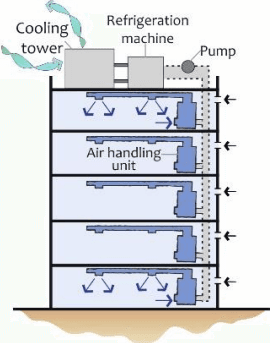
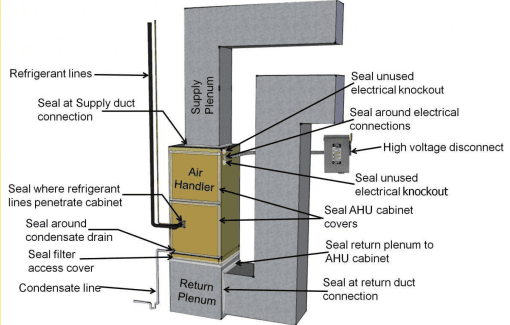
Selection of individual equipment efficiency should be considered in the context of the whole HVAC system. In a chilled-water system, for example, although the chiller is at the core of the system and typically is the single largest energy user, simply selecting a high-efficiency chiller does not guarantee high performance. Auxiliary equipment (such as fans and blowers) and design decisions (such as “approach temperatures”) can have substantial effects on overall efficiency. Thus, attention to overall system design and auxiliary components is critical to achieving optimal performance and comfort. Even in packaged air-conditioning systems, leaky
ductwork, improper sizing, refrigerant charge, and air flow rates can considerably affect energy performance.