Ampere measures electric current. Current is the measure of the flow of electricity which is comparable to water flow in a hydraulic system. Denoted by I
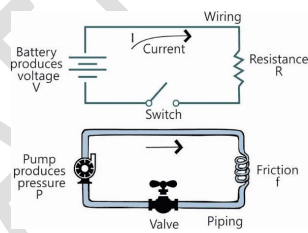
Figure 7.2 Analogy between electrical and hydraulic system
Volt measures electric potential. Electricity is fundamentally the movement of electrons through a conductor like a wire. This movement is triggered by the difference in the charge (positive and negative) created on either ends of the conductor. Voltage can be compared to a pump in a hydraulic system. Just as the pressure produced by a pump causes water to flow in a pipe, the potential (voltage) produced by a battery or a generator causes current to flow in a conductor connecting the terminals between which a voltage exists. The higher the voltage, the higher the current for a given resistance. The unit of voltage is Volt, denoted by V or v.
Ohm measures electric resistance. Just like the flow of water in a hydraulic system is resisted by friction, flow of current in an electric circuit is also resisted. In a DC (direct current) circuit, it is called resistance and is abbreviated R ; in AC (alternating current) circuit it is called impedance and is abbreviated Z. Units of resistance is Ohm and symbol is Ω
Ohm’s Law states that current I flowing in the electric circuit is proportional to the voltage V and inversely proportional to the resistance R. It is expressed in the following equation
…… Equation 7A
Thus, current flow increases if resistance decreases and voltage increases. Ohm’s Law holds true for both AC and DC circuits. For an AC circuit, Ohm’s Law is given by
Where Z is the symbol for impedance in ac circuits. Depending on the circuit load, impedance can be markedly different from the DC resistance which is discussed further in Power Factor.
Metals such as gold, silver, copper and aluminum offer least resistance and hence are called conductors. That’s why electric wires are often made of copper. Whereas, materials like glass, rubber, plastic and porcelain resist the flow of current and hence are called insulators. That’s why rubber and plastic are commonly used as wire coverings; and melamine for plug sockets and switches.