Solar Water heaters use energy from the sun’s rays to heat water for domestic & commercial purpose. This appliance consists of a collector which collects solar energy and an insulated water tank to store hot water.
The collector on receiving solar energy transfers heat to the underlying pipes containing water which in turn goes to the insulated storage tank. This water is recirculated to increase the temperature of the water.
The lifespan of a solar water heater designed as per BIS specification is between 15-20 years but a lot depends on the maintenance of the heater.
Types of solar water heaters
There are two categories of solar water heaters, namely closed loop and open loop. The closed loop system has heat exchangers for protection against hard water obtained from borewells. In the open loop system, the water is open to the atmosphere at some point in the cycle. The open loop systems are suitable for domestic as well as small industrial purposes.
Solar collectors
There are two types of solar collectors in a solar hot water system as explained below.
Flat plate collectors
It consists of a large heat absorbing plate that is dark colored to absorb solar radiation to its maximum potential. Series of thin copper tubes called risers are attached to this plate that has water circulating inside them. This assembly is enclosed in an insulated glass box.
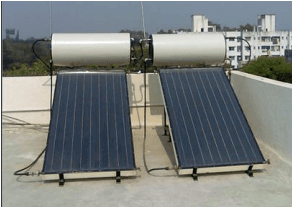
Figure 5.12 Flat plate collector
The metal plate absorbs heat and transfers it to the copper tubes to heat the water. The glass box prevents the absorbed heat from escaping.
Evacuated tube collectors
This system consists of rows of transparent glass tubes connected to a header pipe. Since the pipes are cylindrical, the angle of sunlight is always perpendicular to the tubes which enables the collector to perform well even in low sunlight.
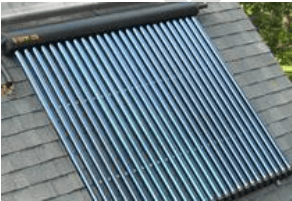
Figure 5.13 Evacuated tube collector
Each tube consists of a thick outer glass and a thin inner glass tube with a special coating that absorbs solar energy (high absorptance) but inhibits loss (low emittance). Unlike flat panel collectors, evacuated tube collectors do not heat the water directly within the tubes. Instead, air is removed or evacuated from the space between the two tubes, forming a vacuum (hence the name evacuated tubes).
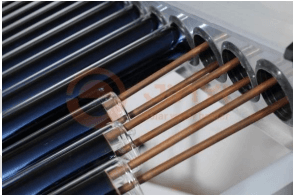
Figure 5.14 Cross section of an evacuated tube
With the assistance of this vacuum, evacuated tube collectors generally produce higher fluid temperatures than the flat plate counterparts and hence may become very hot in summer.
As per the Code,
Hotels and Hospitals in all climatic zones and all buildings in cold climate zone with a hot water system, shall have solar water heating equipment installed to provide for:
(a) at least 20% of the total hot water design capacity if above grade floor area of the building is less than 20,000 m2
(b) at least 40% of the total hot water design capacity if above grade floor area of the building is greater than or equal to 20,000 m 2
For compliance with ECBC+ and SuperECBC, Hotels and Hospitals in all climatic zones and all buildings in cold climate zone with a hot water system, shall have solar water heating
equipment installed to provide at least 40% and 60% respectively of the total hot water design capacity.
Exception to § 5.2.7.1: Systems that use heat recovery to provide the hot water capacity required as per the efficiency level or building size.