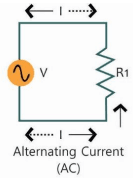
Electricity flows in two ways: either in a direct current (DC) or an alternating current (AC). The difference lies in the direction in which the electrons flow. In a DC circuit, electrons flow steadily in a single direction, or “forward”. In AC,
electrons keep switching directions, sometimes going “forward”and then going “backward”(Figure 7.3).
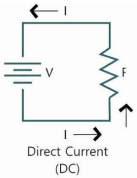
Generic symbol for any DC voltage source
2 Generic symbol for any AC voltage source
Figure 7.3 Direct and alternating current
The foundation of electricity generation is based on Michael Faraday’s law of electromagnetic induction which states - when an electrical conductor is moved in a magnetic field, a voltage is induced in the conductor.
A magnetic field near a wire causes the electrons to move in a single direction because they are repelled by the negative side of a magnet and attracted toward the positive side. This is called direct current. An ordinary dry cell supplies direct current where the positive and negative terminals are always fixed. When the terminals of a 1.5V battery are connected, electricity starts flowing from the positive to the negative side in a single direction at a constant voltage. The device of the equipment that produces the DC is called a DC generator.
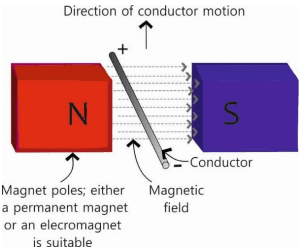
Figure 7.4 DC generator operation
When the magnet around the conductor is rotated, it produces alternating current. When the magnet is oriented in one direction, the electrons flow towards the positive, but when the magnet's orientation is flipped, the movement of electrons turn as well. An AC generator is called an alternator because it produces alternating current (Figure 7.5).
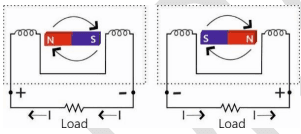
Figure 7.5 Alternator operation
In an AC circuit, the flow of current periodically varies in time which is represented as a sine wave as shown in Figure 7.6. The distance along the time axis spanned by a positive and a negative AC loop is called one cycle. The number of such cycles occurring in 1 second is known as the frequency of the AC current. Normal AC generator frequency is 50Hz in India. Most appliances and equipment used in buildings are designed to operate at 230V and 50Hz.
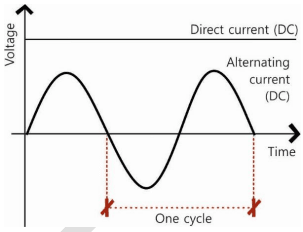
Figure 7.6 DC and AC representation
AC current is commonly used for most commercial applications. DC works well for a portable device like a battery. The common electrical plug sockets is supplied with AC current at 230V. AC can even be changed to DC. For example, a laptop or desktop computer uses a small transformer to convert the AC to DC direct current. On the other hand, DC can also be changed to AC, it is just a little more difficult. For example, inverters that provide power back up change DC to AC.