Loads can draw resistive or reactive power. For example, an incandescent lamp draws energy to convert to heat and hence is referred to as drawing resistive power. All the electrical Watts is converted to useful work as heat energy in Watts. These are called resistive loads. Whereas an induction motor, for example, draws power to convert to useful mechanical output as well as draws power to generate the magnetic field required to perform its desired function. This is called reactive power which can be considered as magnetising or wasted power since the magnetizing current does not contribute to the work output of the motor.
The reactive power drawn by an inductive load causes a phase difference between voltage and current that is given by an angle as shown in Figure 7.8. The cosine of this angle is called the Power Factor (pf).
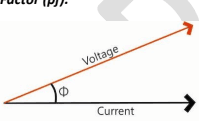
Figure 7.8 Phase difference due to reactive power
Thus, the useful power (or real power) and the reactive power has to be factored in to determine the total power (or apparent power) used by the motor.
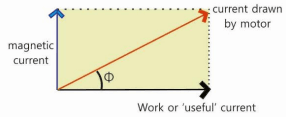
Figure 7.9 Reactive power by inductive load
Using Ohm’s Law from equation 7B, V = IR, the power equation for DC circuits is given by
P = I. (I R) = V I … Equation 7D
Where,
P = Power in Watts
V = Voltage in Volts
I = Current in Amperes
As discussed earlier, resistance in an AC circuit is called impedance which is slightly different from DC circuit. Impedance is a combination of DC resistance and AC resistance (called reactance). Reactance is accounted by the Power Factor (pf).
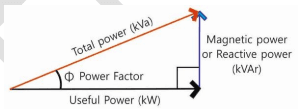
Figure 7.10 Power Factor
Thus, in AC circuits, the power equation incorporates power factor which is given by
𝑃 = 𝑉𝐼 𝑥 𝑝𝑓 ………… Equation 7E
In terms of units,
Watts = Volt.Ampere (VA) x pf
Hence, Power Factor can be expressed as
Power Factor is a measure of how efficiently electrical power is converted into useful work output. The ideal power factor is unity, or one. Anything less than one means that extra power is required to achieve the actual task at hand.
Power factor is a very important term that enables to calculate the actual power in AC circuits.
Example 7-C
The nameplate of a single-phase motor shows the following data: 2HP, 230 V, AC, 17A. Assume an efficiency of 90%. Calculate the motor (and therefore circuit) power factor.
1 HP = 746 watts
Power rating of the motor 2 HP = 2 x 746 = 1492 watts
This is the power output of the motor.
Now, Efficiency = output/input
Thus, Power Input = 1492/0.9 = 1657 W
Using power equation for AC circuit, P = Volt x ampere x power factor
1657 = 230 x 17 x power factor
Thus, power factor = 0.42