Given the fact that NIT is a ‘Special Planning Authority’ and not an urban local body will have impact on its revenue raising powers. The current provisions of the MRTP Act or the NIT Act do not have provisions that enable NIT to charge for provision of services such that costs can be recovered. The current provisions for revenue raising are limited to (a) development charges, (b) planning/building permission fees and (c) fees for premium FSI.
In case the NIT wants to move towards a cost recovery regime, it will be necessary to make policy changes that enable NIT to raise revenues. However, this will mandate the amendment of MRTP Act and NIT Act. The process of bringing about such amendments can be quite long-drawn.
The most suitable option for NIT to carry out future development and implement projects using the Improvement Scheme mechanism. Under this framework, NIT will be able to generate adequate development charges that will allow it to (a) fund capital expenditure and (b) fund operation and maintenance expenditure for a suitably longer period. In case of special projects, NIT can solicit government grants.
In its erstwhile role, the NIT had not embarked on major infrastructure creation projects since the mandate for NIT was limited to areas in and around Nagpur city. The requisite capacity to execute such projects was not developed in-house since the scale of infrastructure development was very limited. Even in its erstwhile role and limited scale, the NIT has been using the outsourcing model for creation of infrastructure services. This resulted in the relevant ‘verticals’ not being created within the NIT.
The improvement schemes (IS) is a very useful tool which can allow the planning authority to provide serviced land through a participatory approach. The area notified to be developed through the improvement schemes, is amalgamated and ownership records are collated. As a policy, a standard deduction is applied to all land parcels in order to generate land for infrastructure such as roads, sewerage, open spaces etc. The owners are allotted final plots in the same location, in majority of the cases, the shape of which is more regular in nature to provide for uniform development. Development charge is levied on developed parcels so that the planning authority can recover part of the infrastructure costs. The
15-1
private land owners stand to benefit largely from such schemes as although the area of developed parcels is less than the original parcel, the appreciation in land values is very high owing to access to better infrastructure.
NIT holds jurisdiction as the SPA for the NMA. This allows NIT to use the NIT Act 1936 to implement improvement schemes. Section 27 of the NIT Act specifically enables this. The Act in the specific case of the NMA and NIT’s SPA powers allows implementation of portions of Development Plan proposals through this model. NIT shall follow the process and the policy adopted by it under the NIT Act for implementation of an improvement scheme but it shall, at the same time follow the following policies as regards identifying, delineating and planning of improvement schemes.
The improvement scheme mechanism can allow for land pooling and reconstitution of land parcels to carve out common areas for infrastructure development thereby catalyzing development in focused areas of the NMA where development is desired.
Improvement schemes can be used to allow for higher intensity compact development where NIT is desirous of promoting various forms of urban development, and where NIT or another local government or similar agency promotes development through provision of infrastructure.
Improvement schemes can also be used as a tool to promote Transit Oriented Development (TOD) around transit stations, where land pooling and infrastructure development allows higher intensity development that would benefit transit ridership and in the process allows the creation of land banks to finance capital improvements, and for essential public amenities and infrastructure.
15.2.1 Schemes to be developed under the aegis of NIT
As improvement schemes can be carried out under the NIT Act, an improvement scheme can only be implemented by the NIT. Private land owners desirous of carrying out an improvement scheme may approach NIT for considering their request although the decision of whether or not to carry out an improvement scheme or its size, land uses etc., shall rest solely with NIT.
15.2.2 Identification and delineation policy for improvement schemes within the NMA
NIT shall identify and delineate improvement schemes as per need throughout the plan period of the Development Plan regardless of whether they have been previously identified as a part of the Development Plan.
Improvement schemes, as far as possible, shall be identified within the boundaries of the 10 urban sectors marked in the Development Plan. Improvement scheme boundaries can overlap two of more sectors, but shall not, unless specifically required and adequately justified, extend beyond the boundary of the 10 urban sectors unless they meet specific conditions laid out below.
15.2.3 Improvement Schemes in non-urban area (outside the 10 urban sectors)
Improvement schemes are permissible outside the 10 urban sectors where NIT as a SPA deems fit that development would be beneficial for the NMA. Such Improvement schemes shall be permissible in A2 Zone.
15-2
15.2.4 Minimum and recommended size of an improvement scheme
Within the 10 urban sectors, an improvement scheme shall be of a minimum size of 3 sqkm area, although larger areas of about 8 to 10 sqkm allow greater flexibility for identifying land for amenities and infrastructure. Outside of Urban Sectors, improvement schemes shall have minimum area of 7.5 sqkm.
15.2.5 Planning flexibility and land use change permissible
An improvement scheme shall be used to implement the land use proposals and the Development Plan proposals recommended in the Development Plan. NIT shall retain the flexibility to modify the land uses as it deems appropriate as long as at least 60% of the land use proposals in the Development Plan are retained. Higher density development would be encouraged within the improvement scheme and details regarding this shall be published as a part of the Development Control Regulations of that particular improvement scheme. However complete change in land use without due regard to the proposals of the development plan shall not be permissible.
(For example, an area of about 5 km is proposed to be taken up as an improvement scheme. The land use proposals in this area recommend a mix of commercial and industrial uses. In this case at least 60% of the total land area of the improvement scheme shall have uses that are basically permissible under these land use categories as per the development plan. NIT shall have the flexibility to plan and change the land uses provided they meet at least this 60% requirement. Hence, new amenities or worker housing or similar new uses can be introduced in the remaining 40% area)
Similarly DP roads proposed in the Development Plan may be altered to suit the reconstitution of plots as long as the connectivity objective the proposed DP roads as per the base Development Plan is met.
Reservations for amenities shown within the Development Plan may be altered to suit the needs of the improvement scheme. Each Improvement Scheme however will need to provide the required amenities as per the latest guidelines for amenities issued by the Government of Maharashtra.
Land use changes as per proposals of the Improvement Scheme shall come into effect only when the improvement scheme is approved by the government and such land use proposals are applicable for the Final Plot (FP) as demarcated on the final approved Improvement Scheme Plan
15.2.6 Structuring activities for undertaking improvement schemes
With the role of NIT being expanded to an SPA, the onus on NIT is to develop pan-region infrastructure projects. However, the NIT has limited internal capacity, to execute large scale infrastructure projects on its own. The policy stipulates that as part of implementing the improvement scheme, the NIT will develop the following infrastructure services:
Road development works including development of full right of way and culvert works
Water supply works – intake works, zonal works and distribution network
Sewerage works – distribution network and STP
Storm water drains network
Recycling water works and network
Development of open spaces
15-3
In order to be able to deliver the gamut of infrastructure services, several activities will need to be taken up to ensure that the design and development of infrastructure proceeds smoothly. The key activities within this task are illustrated below:
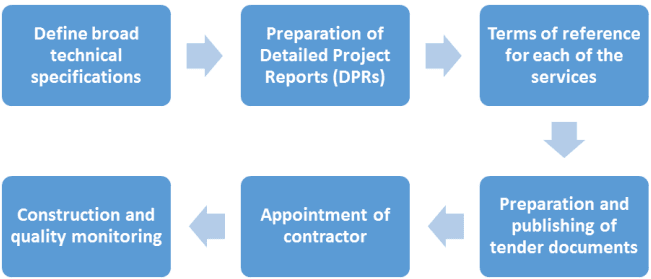
It is evident that the infrastructure design and development process is also fairly intensive and that several activities need to be undertaken. The nature of activities to be undertaken requires a wide-range of skills and expertise which may not be readily available within the current set-up of NIT.
In order to ensure that the IS infrastructure implementation progresses smoothly, it is recommended that the NIT should formulate a Special Purpose Vehicle (SPV) that will oversee the implementation of the infrastructure services. The SPV will have key technical resources that are sufficiently experienced and can handle large-scale projects.
15.2.7 Operation and maintenance of infrastructure services
The post-implementation phase of the IS involves, primarily, undertaking operation and maintenance of the infrastructure services to be developed. NIT is mandated neither by the NIT Act nor by the MRPT Act to undertake O & M of infrastructure services. Additionally, the NIT is also not mandated to collect user charges for the services to act. The operation and maintenance of the infrastructure services is mandated for NIT neither in the NIT Act nor in the MRTP Act. The legislations do not have provisions for NIT to levy user charges/taxes in order to recover costs for the O & M of the infrastructure services.
In such a scenario, there are two options available to NIT:
-
Develop the infrastructure within the IS and hand over the area to the relevant local authority for undertaking O & M
-
Undertake O & M on its own (through an SPV) and seek powers to levy user charges/taxes through legislative amendment in order to meet the O & M costs
While the first option may seem to be a logical step given the non-availability of powers to NIT for levy of user charges/taxes, it is also pertinent to note that the first option also has several issues that need careful consideration. Some of the issues have been outlined below:
15-4
The local authority will not have the technical and managerial competence to undertake O & M of such infrastructure services
The local authority’s levies may also not be significant enough to cover the O & M costs for all the services being provided
The local authority may fall back upon NIT and seek technical and financial support for undertaking O&M
Thus it is evident that the first option is likely to fail the very premises that it is based on. It is recommended that NIT should retain the O & M of infrastructure services. This can be the responsibility of the SPV proposed to be set up for infrastructure services. The SPV will thus have a bigger role and will not be confined to developing infrastructure projects alone.
However, it is imperative that if NIT plans to undertake O & M on its own (or through the SPV), powers to levy taxes and user charges should be vested in NIT/SPV. It will be critical to amend the NIT Act to provide NIT with the powers to levy such user charges/taxes.
15.2.8 Funding O & M costs
The NIT should underwrite the O & M based on the following principles:
Revenues from user charges/taxes should be adequate to cover O & M costs
Capital expenditure related to refurbishment of water and sewerage networks should also be funded through user charges/taxes
The revenue options that NIT can explore are outlined below:
Tax akin to property tax to cover services that cannot be directly charged for i.e. road, storm water drainage, open spaces
User charges for water supply & sewerage
o Sewerage tax to be levied in case of no water connection
o Sewerage connection to be made mandatory
Capital expenditure related to refurbishment of water supply and sewerage services should be funded through Benefit Tax
15.2.9 SPV’s mandate
The proposed SPV will be akin to an infrastructure utility typically seen in urban local bodies. The SPV’s mandate will be to:
Develop technical specifications for infrastructure services
Prepare Detailed Project Reports (DPRs)
Undertake execution of infrastructure projects
Levy user charges and taxes
Undertake O & M
15-5
15.2.10 Dedicated cell for Improvement Schemes
Going forward, Improvement Schemes development is the biggest agenda that the NIT is likely to pursue. The preparation, implementation and post-implementation activities are very diverse and require a set of various skills.
Given the wide-range of tasks and their inherent complexities, a concerted effort will be required in order to deliver Improvement Schemes. Recognizing the necessity of the task at hand it is proposed that a Dedicated Cell for Improvement Schemes be constituted. The Cell can be a part of the Town Planning section and will be headed by the Deputy Director of Town Planning.
The Cell will undertake all activities necessary for the purpose of preparing and implementing the improvement scheme. The cell will focus only on the physical planning aspects of the improvement scheme and will do all that is necessary in order to successfully deliver the scheme.
The Engineering section of the Metro division will continue to undertake design and implementation of infrastructure services.
