The following conclusions present the principal findings of this Existing Conditions Report. These conclusions attempt to establish some of the inter linkages and relationships between the various chapters of the report and also draw upon the results of the SWOT analysis.
- The NMA has large reserves of fertile well-irrigated land that has the potential to provide increased agricultural development. If this potential is unrecognized lands will continue to be converted into non agricultural purposes and a valuable, non renewable resource will be irrevocably lost.
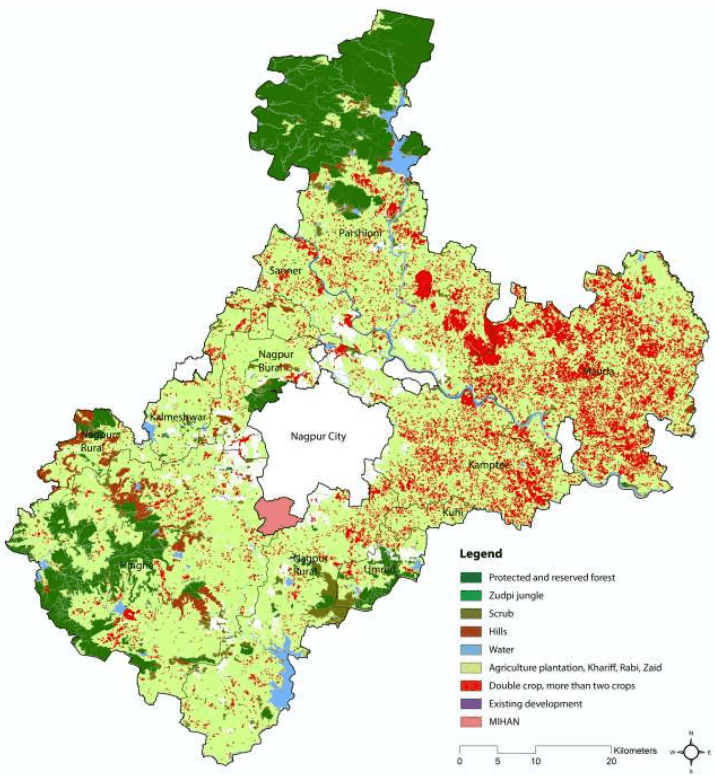
With the Pench and Vadgaon dams to the north and south of the NMA, large reserves of fertile land are today well irrigated. About 11 percent of the total land area of the NMA (3577 sq.km) falls under double cropping and about 51 percent is utilized for kharif crop plantation. The NMA is located adjacent to Gondia district (east of NMA), which is the breadbasket of the region. In addition there are three rivers (Pench, Kanhan and Venna) with a network of streams along with a good reserve of ground water.
Despite 62 percent of the land area being under active agriculture, the farming sector in the NMA shows little growth due to a lack of investment. This has two deleterious effects. Firstly farmers sell productive agriculture land to private developers who in turn get NA permissions for development. This results in urban sprawl with sporadic unplanned development, often with no access to water, sanitation, and related infrastructure. An equally serious problem is that agricultural land holdings become more scattered and the sector loses critical mass, undermining the support industries and activities that require a strong agricultural sector for their own survival.
The mapping exercise shows concentration of NAs close to the main transportation corridors and employment centers. This include two percent of the total NMA area. Concentration of NAs is also seen on the north east side of the city along NH7 in Kamptee Tehsil. It is necessary that this phenomenon needs to be assessed from an overall land demand perspective in order to check for inconsistencies with respect to future land demand.
10-4
Figure 10-2: NMA Plan showing the location of agriculture land
- The NMA has significant advantages of major infrastructure and excellent air, rail and road connectivity but has yet to capitalize on these advantages.
The NMA is located at the geographical centre of the country, with an international airport, key National Highways (NH-6, NH-7, NH-69) and a good network of railway lines connecting it to major cities of Mumbai, Kolkota, Chennai and Delhi. However transport and logistics projects have not received adequate funding and have faced institutional bottlenecks.
10-5
The power sector within NMA is well developed and has five power plants with a combined capacity of about 3400 MW. Despite this, power cuts are frequent, which adversely affects the farm sector which has to rely on diesel fuel and industrial manufacturing sectors have to resort to captive power plants.
Also, the area has rich unobstructed sunlight with a solar radiation of about 5.09 Kwh/m/day with a high potential for harnessing solar power. The NMA does not receive sufficient wind speed for it to be categorized for wind energy sites
Cities with fewer advantages have been better able to capitalize on investments and growth potential.
- The network and intersection of transport corridors in the NMA should ideally provide for better access to markets, employment, and investments. But this is hampered due to public transport in the NMA being marginal and intermediate public transport being absent. This seriously affects the mobility of people and goods.
The transport sector is an important component of the economy impacting on development and the welfare of populations. When transport systems are efficient, they provide economic and social opportunities and benefits that result in positive multiplier effects such as better accessibility to markets, employment, and additional investments.
As briefly discussed above, at a macro level the NMA is well connected to major cities and within the NMA there exists a good network of national highways, state highways, major district roads, other district roads, ring roads and village roads.
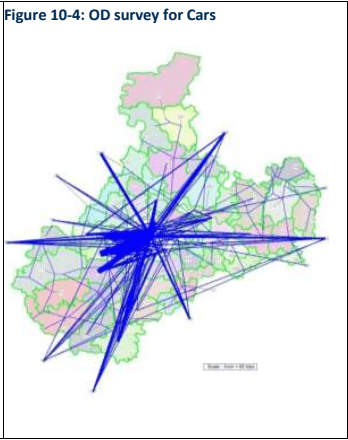
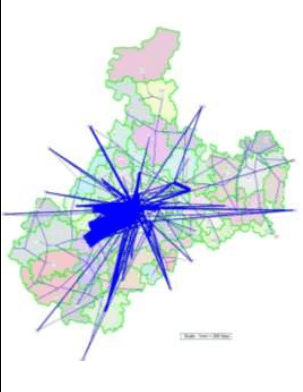
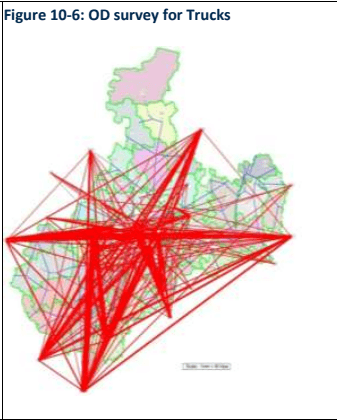
Results of detailed surveys conducted (Origin – Destination surveys, Traffic volume counts) along national and state highways suggest that much of the travel is to the main job opportunity areas (Nagpur City, MIDC Hingana, MIDC butibori and MIHAN). But there is no efficient public transport along these routes. Mode of travel is mostly 2-wheelers and cars. Although there is a public transit in the form of star bus for passenger commute, it is affected by a low fleet of buses and low frequency.
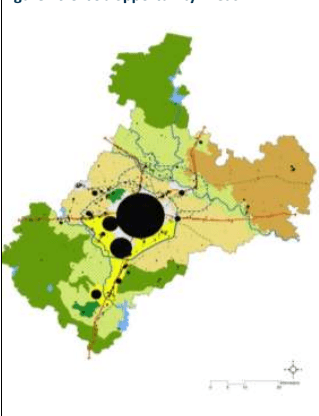
The figures below (Figure 15.2 to 15.5) provide a correlation between major job opportunity centers and travel patterns within the NMA.
10-6
Figure 10-3: Job opportunity Areas
Figure 10-5: OD survey for 2-wheelers
The NMA offers a huge potential for the provision of public transportation systems. This would require strengthening transport connections between job opportunity areas and residential areas.
10-7
- Declining population growth rates and fertility rates could allow a reallocation of resources from investing in children to investing in physical and social infrastructure. The physical quality of life in the NMA has not seen much improvement.
Nagpur Metropolitan Area has a population of 842,000, which constitutes 21 percent of the district’s population. The district population’s growth rates have been declining over the past couple of decades with a significant drop observed in 2011. Growth within the NMA area has been more or less constant at about 25 percent in the past couple of decades but it is assumed that the growth would have slowed in line with the district’s growth between 2001 and 2011.
Figure 10-7: Tehsil-wise urban population growth
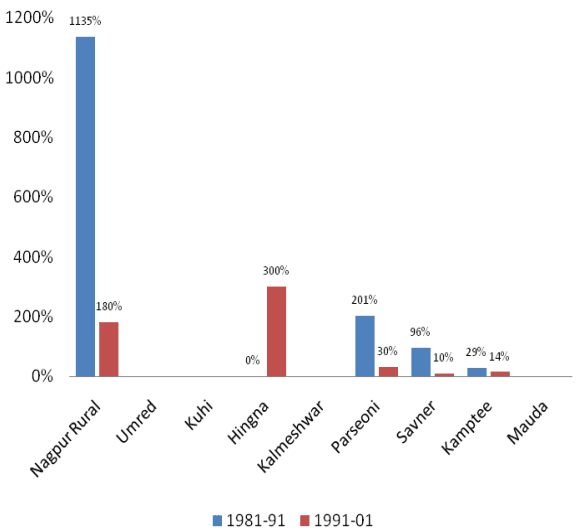
Source: Respective Census and CRIS Analysis
10-8
Figure 10-8: Rural-urban growth trends within NMA
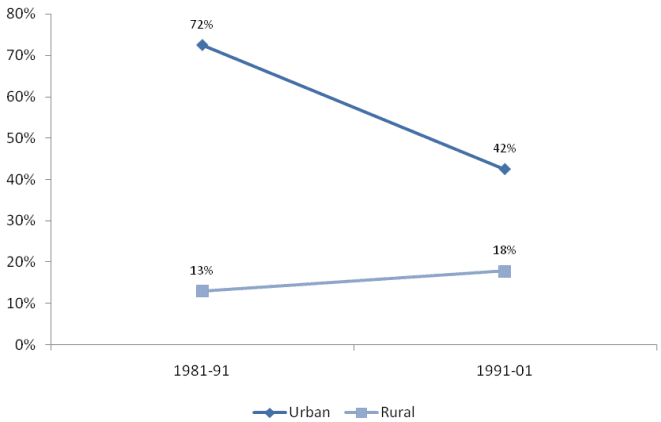
Source: 2001 Census, CRIS Analysis
Nagpur City’s population grew at 33 percent between 1981 and 1991.This growth slowed to 26 percent between 1991 and 2001. The growth has further slowed down between 2001 and 2011 at a little over 13 percent.
There has been a decline in the fertility rates of Nagpur district over the past two decades which means that the NMA now has relatively fewer children in need of support. Over time, the large “boom” cohorts of earlier years are reaching the prime ages for working and saving.
The share of the working population in Nagpur district i.e. the population in the age group of 20-59, has been increasing over the decades. As a result, the per capita productive capacity of the economy has expanded. This expansion, in potential, means that Nagpur has an opportunity to achieve more rapid economic growth if it is able to take advantage of its “demographic dividend”.
This would result in society’s reallocation of resources from investing in children to investing in physical capital, job training, technological progress, and stronger institutions coupled with a boost in savings since the working ages coincide with the prime years for savings. This advantage has to be coupled up with provision of equal opportunities for people with higher skills and the provisions for a better quality of life.
5. Many new projects, plans, and policies within the NMA were introduced to consolidate urban development. Some of these have had a contradictory effect resulting in furthering urban sprawl.
Within the NMA the residential concentrations, outside Nagpur city limits, are located along the fringes of the Nagpur municipal corporation boundary limits. Similar concentrations are located towards Kanhan-
10-9
Pipri town in the north. Dattawadi towards the east also has dense residential development due to the presence of MIDC Hingna. Since Butibori Industrial area is located towards the south of NMA this area also witnesses a concentration of residential land.
With the decision to develop MIHAN towards the south periphery of the city abutting the airport a lot of speculative development has started in this area. The maximum NA permissions have been granted for land parcels in the immediate vicinity of MIHAN.
The Government of Maharashtra as a policy measure allows residential development in a 200 m and 500 m buffer area around the village settlement depending upon the population of the settlement. This encourages small time developers to buy land in the buffer areas and develop residential townships.
The provision to develop around village settlement area along with granting NA permissions has resulted in a sprawl like growth in the NMA. It becomes increasingly difficult for municipal bodies/development authorities to service these areas with adequate physical infrastructure.
The sprawl like development also threatens the natural systems like micro water sheds, ecologically sensitive areas, and productive agriculture land which otherwise need to be preserved.
- The NMA has a multiplicity of institutions that have planning and development functions within the 3577 sq.km. As the combined jurisdiction of these institutions is considerable, they have a direct impact on the dynamics of the NMA.
Nagpur Metropolitan Area has two municipal councils and one municipality for the City. The towns which fall under the jurisdiction of Municipal councils are Kamptee and Kalmeshwar.
The NMA also has lands which are under the ownership of defense authorities, areas falling under different Special Planning Authorities (MIDC and MIHAN) and the Nagpur City Municipal Corporation area. These areas have been excluded from the jurisdiction of NIT which is the special planning authority for NMA.
The present framework of various jurisdictions and governing bodies creates overlaps and gaps in the system. This is a hindrance to the forward planning of the area since the different agencies (such as MIHAN SPA, Municipal Councils, MIDC SPA, Railway authorities, Transport authorities) have different level of development rights.
In order to have a comprehensively planned NMA, all the different planning authorities need to agree and follow a ‘common Vision for the Nagpur Metropolitan Area’ in order to avoid an unplanned and uncoordinated growth.
7. The presence of industries, mines and quarries have a direct impact on the air and water quality
The area is rich in minerals with coal being a major resource that is being mined in the area through open cast mining. The mining of coal and minerals have a direct impact on the air and water quality regime. Direct impacts include suspended particulate matter resulting in respiratory diseases. Currently the air quality monitoring station is located in Nagpur City while the sources of air pollution like industrial areas, coal mines, thermal power stations are dispersed across the NMA. Thus the impact on deteriorating air
10-10
quality through these sources is not captured adequately and there is a need to establish new air quality monitoring stations monitored by an authorized agency in these areas.
Similarly, the quality of water is being monitored in only 3 areas of the entire NMA and the data shows higher concentration of coliform indicating sewage and waste being released into the rivers from the Nagpur City without proper treatment.
The thermal power plants of Koradi and Kaparkheda located in the tehsil of Kamptee along with their ash ponds also result in the leaching of toxic metals from ash and contaminate the underlying soil and ultimately the ground water system.
- NMA has tourism potential as it shares boundaries with major national parks, tiger reserves and sanctuaries as important tourism products however it has yet to capitalise on these strengths
Tourism potential of NMA is clearly dominated by wildlife, eco and adventure tourism. To tap this potential NMA will have to improve its marketing, information decimation and transport facilities.
Lack of representation of Nagpur city and NMA as a tourist destination reduces the possibility of attracting tourists to the place. Poor information dissipation and unreliable public connectivity further reduces the potential of otherwise unique destinations within Nagpur city and NMA. While MTDC expects private investors to do the marketing for their own businesses and destinations, it will have to substantially improve on the overall marketing of the place, physical information centers, interactive web based information portals and reliable and cheaper transport services to the destination.
9. Economic growth of NMA is at slow paced but, the region also has inherent strengths that can propel economic development in future
Agriculture is the mainstay of the economy in NMA; key crops are soya bean, cotton, rice and wheat. The analysis of key economic indicators for NMA indicates that the overall economic growth within NMA is rather slow paced. The diversification of economic activities has been rather limited within the region and this has possibly led to out migration from the region which is reflected in the demographic growth of the region. The state has also acknowledged the fact of Nagpur’s rather limited growth through the classification of the district largely into “D+” category which indicates very little diversification of economy.
The key reasons for slow economic growth could be multi-faceted. Most stakeholders have attributed it to geo-political issues that have plagued Nagpur. Being a land locked region, rapid industrial development has not been witnessed. Despite being the geographic centre of the country, the logistics sector also has not taken off due to the lack of industrial concentration.
While there are issues that have plagued economic growth in Nagpur, the region also has inherent strengths that can propel economic development. The mineral resources of the region can foster industrial development of various natures. The availability of skilled manpower, roughly 11,000 engineering graduates every year, is also a major strength. Tourism could become a key growth contributor with the presence of a variety of spots of tourist interest. MIHAN is expected to be a key growth driver for NMA.
10-11
10. Social infrastructure
With regard to public healthcare institutions, the NMA tehsils have roughly 17% of the total beds available in the public domain in the district. Within private healthcare facilities, NMA has 23 hospitals, 81 clinics and 21 maternity homes. The current healthcare infrastructure both in the district as well as the NMA appears to be adequate.
Nagpur city serves as a regional centre for education, where students from surrounding regions move to Nagpur city for higher education. There are 609 colleges affiliated to Nagpur University of which approximately 200 colleges are in Nagpur city and 103 are in Nagpur rural area. The current education infrastructure both in the district as well as the NMA appears to be adequate for the population. However, if the economic growth in Nagpur district is propelled due to various reasons, the need for enhancing the education infrastructure will soon arise.