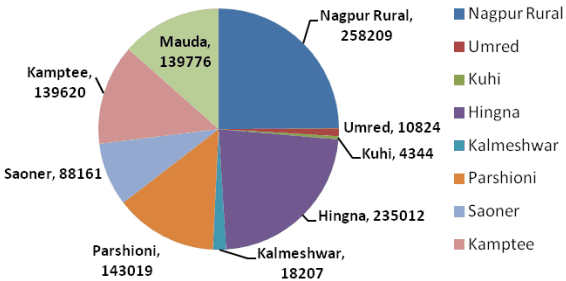
To study the population distribution at micro level, villages have been segregated across several ranges of population in each of the tehsil and at NMA level. The segregation was considered across the following ranges:
Less than or equal to 1,000
1,001 to 2,000
2,001 to 5,000
5,001 to 10,000
10,000 and above
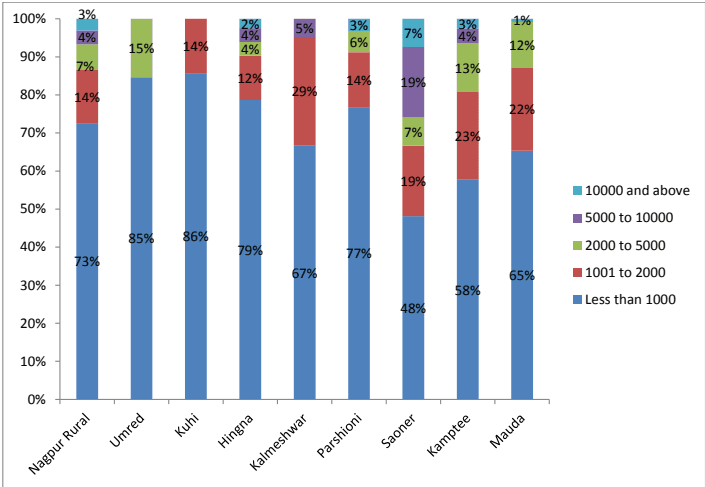
NMA has 700 habited villages and 24 urban areas. Out of the total habited villages, 73 percent (514) villages have population less than 1,000. 17 percent (117) villages have population between 1,001 and 2,000, 7 percent (51) have population between 2,001 and 5,000, 2 percent (15) have population between 5,001 and 10,000 and 3 villages have population of 10,000 and above. Analysis across tehsils reveals that, apart from Saoner, all other tehsils have more than 60 percent of villages with population less than 1,000. Only one village each in Nagpur Rural and Parshioni has population of 10,000 and above.
Of the 24 urban areas, 16 have a population of over 10,000, while 6 have a population of between 5,000 and 10,000 while 2 areas have a population of between 2,000 and 5,000.
4-2
Figure 4-2 : Population distribution across tehsils
Source: 2011 Census, CRIS Analysis
4.4 Population Densities across Villages and Tehsils
Population densities vary significantly across all nine tehsils of NMA. The teshil with the highest density is Saoner with 701 persons per km2followed by Nagpur Rural with 400 persons per km2 and Kamptee with 353 persons per km2. Hingna, the teshil that is the second highest contributor to the population of the NMA has a population density of 307 persons per km2. The lowest densities have been observed in Kuhi and Umred with 124 persons per km2 and 143 persons per km2.