Population and employment projections and distribution provide the basis for spatial allocations for land and infrastructure. The approach derives key takeaways from the macro demographic trends at national, state, district and NMA levels. Future population has been projected using the Cohort Component Method which takes into account migration rates. Four different growth scenarios – business as usual (6-8% migration), strong growth (15%), accelerated growth (30%) and staggered growth (variable rate of 6-30%, low in initial years and high later on) were examined. The approach adopted by this forward looking Plan considers that future resource planning and land use-infrastructure allocations for the NMA be made based on the highest growth scenario of 30% migration rate.
While it is expected that the growth will pick up over time it will be prudent to also appreciate that growth will not happen entirely on its own. Induced developments will be necessary in order to realize the growth path that is being envisaged for the NMA. In order to achieve the envisaged growth path, it is critical that the existing and future growth drivers are given due appreciation and their significance is underlined. The Plan recognizes six key economic sectors for which focused efforts should be made to attract investment – steel production, paper and pulp, modular/ wooden furniture, cotton and textiles, higher education and healthcare. In order to positively influence the economic climate and attract investments to boost employment opportunities, it is recommended that flagship economic zones be designated during the Plan implementation stage to ensure that the inherent strengths of the NMA are built upon.
The Plan envisions that increased investments in industry and infrastructure will attract talent and skilled technical pool in diverse economic sectors and propel future growth. Considering this it is estimated that with migration rate of 30% the population of the NMA can grow to about 17 lakhs by the Plan horizon year, 2032.
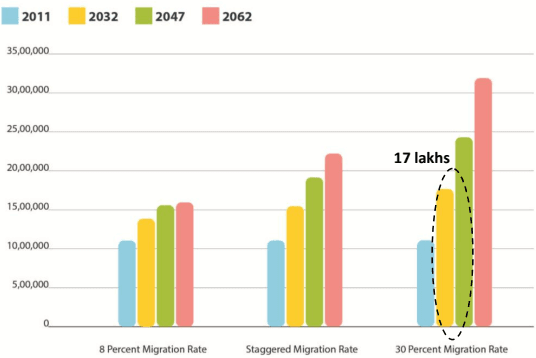
Figure 3: Population projections
The estimated number of jobs created by 2032 will be about 10.7 lakh. The share of number of employees in the tertiary sector is estimated to be about 52% and in secondary sector is over 40%. Agricultural
productivity is also expected to increase by the horizon year however share of employment in the primary sector will be relatively lower due to mechanization of processes and adoption of higher technology.