Social infrastructure comprises of the facilities and mechanisms for provision of education, health care, community development, and social welfare to the people. Its availability, gamut and sophistication is a very important measure of any region’s overall development and quality of life.
This chapter provides an overview of the social infrastructure facilities, healthcare, education and recreation, available within the Nagpur Metropolitan Area (NMA). A detailed study was done to ascertain the availability of existing social amenities in the NMA. The Census 20011 and District Statistical Abstract 2010 are the two key datasets used to determine the number of available facilities. This would eventually help assess requirement for new facilities which need to be provided under the Development Plan proposals for the future population of the NMA. Additionally, these facilities would also serve the existing population if the existing amenities are found to be deficient in number, which would be determined by the established standards for provision of social amenities described in Chapter 12.
The different categories of social infrastructure which were studied are as follows:
1. Education
Primary School
Secondary School
Colleges & Higher education
2. Medical Facilities
Anganwadi
Primary health centres and Sub centres
Hospital
Recreation Facilities
1 At the time of publishing of this document, village wise detailed information for social infrastructure was not available for Census 2011. Therefore, Census 2001 data has been used for statistics regarding existing provision of education and health infrastructure.
9-2
9.2Education
At 88.39% the Nagpur District ranks third in literacy rate2in Maharashtra after Mumbai Suburban and Mumbai City. According to the District Statistical Abstract 2010, the District has 3,337 schools (Primary, secondary, senior-secondary schools together).
The Ministry of Human Resource Development (MHRD) has specified norms for provision of different educational facilities under the ‘Sarva Shiksha Abhiyan’ (SSA) Framework for Implementation, 2003. The norms stipulate that the student-teacher ratio should be maximum of 40:1. Table 9-1 gives the number of schools and colleges, the number of students and teachers employed for each category of educational facility in Nagpur District, demonstrating the overall standards of education in the District.
Table 9-1Number of facilities, attending students and employed teachers in Nagpur District
Number
No. of Students
No. of Teachers
Student-Teacher Ratio
Primary School
2,511
4,00,039
12,397
32:1
Secondary School
577
2,18,799
5,984
37:1
Senior Secondary School
249
2,18,989
7,189
30:1
Non-Technical College
368
1,12,504
3,842
-
9.2.1 Schools
There are a total of 684 primary schools in the complete tehsils within the NMA.3 There are 3,048 teachers teaching 83,076 students which gives a very favourable 1:28 ratio. There are 169 senior and senior secondary schools in the complete tehsils (See Table 9-2).
Table 9-2Existing Schools in the NMA (for full tehsils)
Tehsil
Primary Schools
Secondary Schools
Senior Secondary Schools
No.
Students
Teachers
No.
Students
Teachers
No.
Students
Teachers
Parsheoni
121
12,538
449
20
6,948
279
6
5,251
173
Mauda
139
12,424
544
18
5,848
181
9
7,848
207
Kamptee
132
20,081
658
25
10,944
358
10
11,588
264
Nagpur (Rural)
166
20,579
777
33
7,095
235
16
16,798
483
Hingna
126
17,454
620
21
6,869
214
11
7,718
225
Kalmeshwar
16
-
-
2
-
-
1
-
-
Kuhi
6
-
-
2
-
-
0
-
-
Saoner
33
-
-
9
-
-
8
-
-
Umrer
8
-
-
5
-
-
0
-
-
Source: District statistical abstract, 2010 & Census 2001
2Source: Census 2011
3 District statistical abstract of 2010 provides tehsil wise data only. Thus the detailed data provided henceforth is available for only the complete tehsils within NMA, namely Hingna, Kamptee, Mauda, Nagpur Rural and Parsheoni. The data for part tehsils is sourced from Census 2001, namely Kalmeshwar, Kuhi, Saoner and Umred.
The total number of students passing out of 1 2 t h standard can be an indicator of the demand for college seats and technical education seats. The total students passing out of 1 2 t h standard in 2010 (in complete tehsils under NMA) were 49,203 according to the District Statistical Abstract 2010. This accounts for around 28 percent of the total students within Nagpur District. Of all the students in the District passing out of 1 2 t h standard, Nagpur City takes the share of 56 percent.
Since the break-up of students of 1 2 t h standard across disciplines of commerce, arts and science is not available, assessment of the institutional capacities across NMA cannot be made.
9.2.2 Distribution of Primary Schools in the NMA
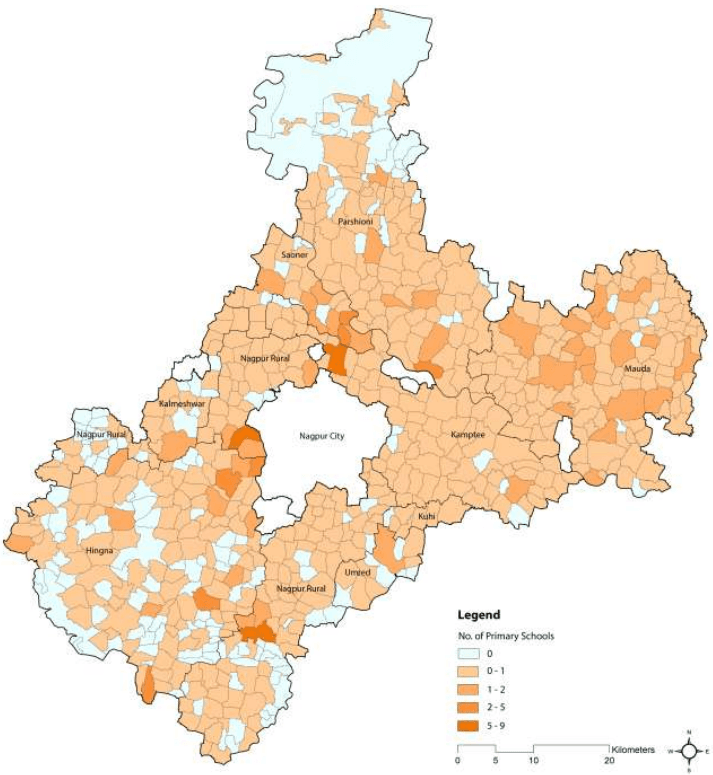
According to the census 2001 data, 554 out of 720 villages in NMA have at least one primary school. Figure 9-1 shows the distribution of primary schools within NMA. It is observed that the Census towns within NMA have more than one primary school.
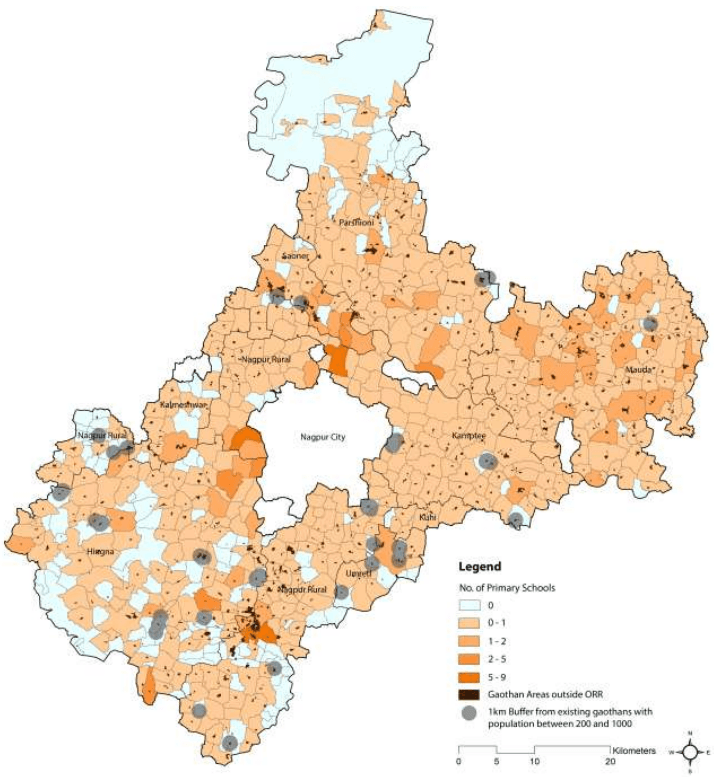
Of the 166 villages which do not have primary school, 141 have population less than 200. Only 25 villages with population in the range of 200 to 1,000 and do not have primary school. MHRD guidelines under SSA (Refer 9.2) stipulates that there should be a primary school within one kilometre of every habitation. For these 25 villages, one km buffer around the gaothan area was drawn to confirm the adherence to this standard. It was observed that there are 19 villages which do not fulfil this norm. Figure 9.2 shows 1 km radius from the gaothan area of the 25 villages. Village schools are generally located in gaothans; therefore if the 1 km buffer includes gaothan of a neighboring village, then it is assumed that direct access is available.
The villages with no primary school facility within 1km radius of its gaothan are:
Figure 9-1: Distribution of primary schools within the NMA
Figure 9-2: Populated villages with NMA which do not have direct access to a primary school
9-6
9.2.3 Distribution of Middle and Secondary Schools in the NMA
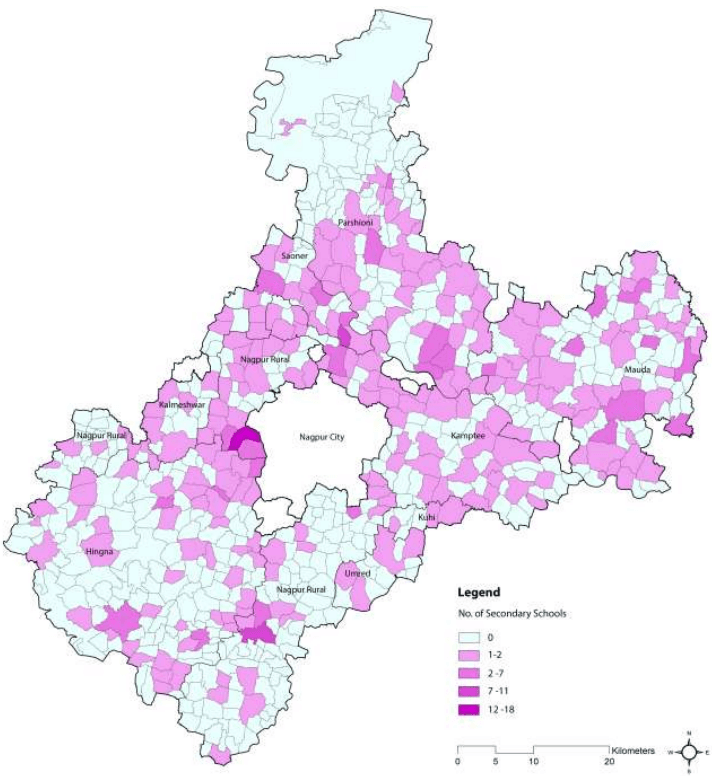
The middle, secondary and senior secondary schools were added to assess the existing provision of secondary schools in the NMA. Middle or secondary schools are available in 255 out of 720 villages of the NMA. With reference to 1979 government regulations on social amenities, population of at least 10,000 is needed to support a secondary school of capacity of 750 students. Considering that NMA population as per Census 2001 of approximately 8,70,000, there is a school for every 2,000 persons. Moreover, it was seen that the rest of the villages with no middle or secondary school, have a population of 3,700 or less. Hence, it can be reasonably concluded that the middle and secondary school facilities are sufficient in NMA at present. Figure 9-3 shows the distribution of the secondary schools over the entire NMA.
Figure 9-3: Distribution of middle and secondary schools within NMA
9-8
9.2.4 Higher education facilities
The complete tehsils under NMA have 78 colleges with the largest proportion concentrated in Nagpur (rural), Hingna, and Kamptee. Table 9.3 and 9.4 give an overview of the number of the colleges within various tehsils.
Table 9-3Colleges in NMA for full tehsils
Tehsil
No.
Students
Teachers
Technical and Professional Colleges
Engineering Colleges
Diploma
Degree
Colleges
Intake
Colleges
Intake
Colleges
Intake
Parsheoni
3
541
13
1
120
0
0
0
0
Mauda
4
854
30
0
0
1
225
0
0
Kamptee
22
5,167
195
1
120
2
660
0
0
Nagpur (R)
19
2,286
79
0
0
0
0
0
0
Hingna
12
1,680
67
1
120
4
2,200
8
3600
Total
60
10,528
384
3
360
7
3,085
8
3,600
Source: District statistical abstract, 2010
Table 9-4Colleges in NMA for part tehsils
Tehsil
Colleges
Industrial Training Centres
Kalmeshwar
0
0
Kuhi
0
0
Saoner
3
3
Umred
0
0
Total
3
3
Source: Census 2001
There are a total of 35 engineering colleges in Nagpur District with a total intake of little over 11,969. This offers a significant resource pool for the region. Of these 35 colleges, 8 colleges are within the complete tehsils under NMA with a total intake of 3,600. Besides these, there are 3 technical and professional colleges and 7 diploma colleges.
A discussion on the education infrastructure available within Nagpur City is warranted since the dependency on the city for higher education is high. It serves as a regional centre for education, where students from surrounding regions move to for higher education. There are 609 colleges affiliated to Nagpur University of which approximately 200 colleges are in Nagpur city and 103 are in Nagpur rural area.