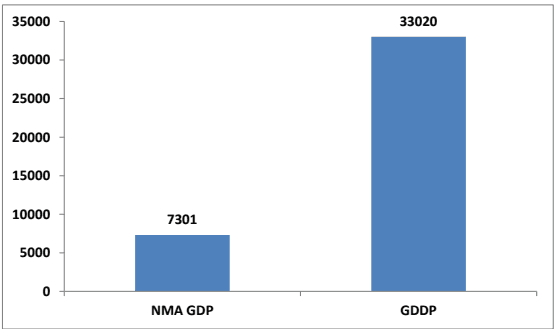
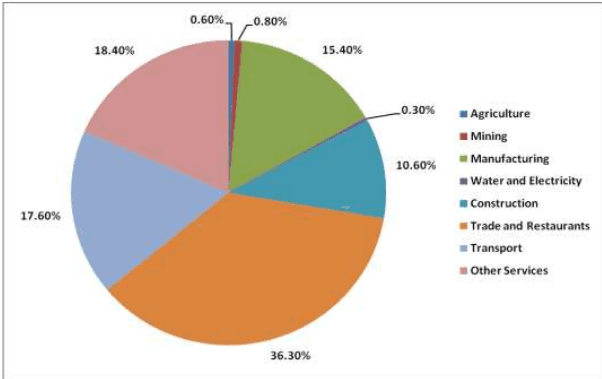
The sectoral employment is an indicator of the key economic activities that the populace is engaged in. Typically, Indian economy was dominated by the employment in primary sectors, mainly agriculture. However, over the years with the spectrum of economic opportunities has been expanding and coupled with easy education availability. Due to this, while the share of population working in agricultural may have remained higher, the secondary and tertiary sectors have started gaining importance.
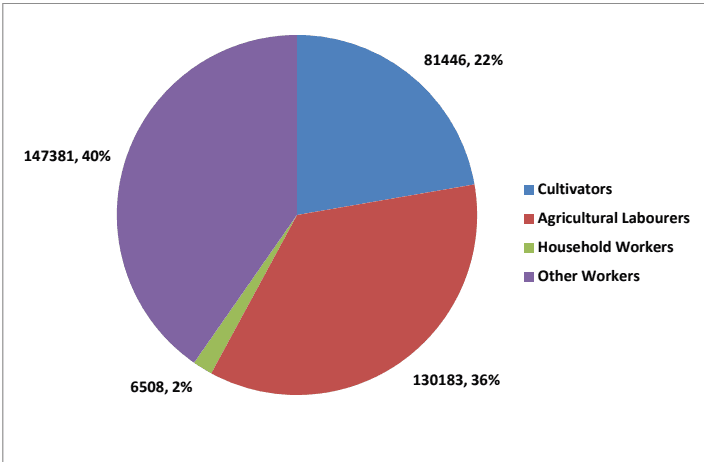
For the NMA, the sectoral employment (for total workers) indicates that agriculture still continues to dominate a people’s occupation. The total employment in the agriculture sector is close to 58 percent which constitutes of 81,466 cultivators and 130,183 agricultural labourers. However, the share of “others” (this includes all services and manufacturing and allied works) has also been substantial at 40 percent or 147,381 workers, indicating that the importance of other economic avenues is increasing. This reiterates the fact of tertiary sector’s larger contribution to the GDDP.
5-15
Figure 5-10 : Sectoral employment in NMA
Source: Census 2001, CRIS analysis
Interestingly, when a comparison with Nagpur district is attempted, it becomes evident that for the district as a whole the employment in “others” category is far higher at 63 percent. The employment in agriculture is only 34 percent, which suggests that at the district level the economy has diversified significantly and employment opportunities in activities besides agriculture are abundant.
5.4.1 Main Workers’ Composition in NMA
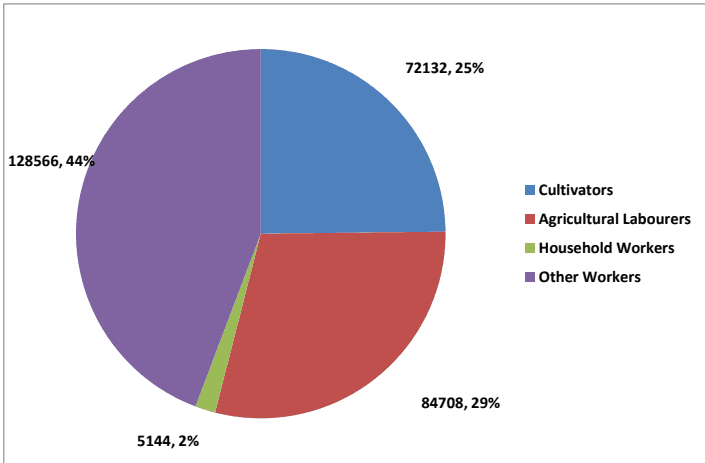
When the composition of main workers across category is analyzed, it becomes apparent that the agriculture still is the mainstay of the economy in NMA with 54 percent of employment, 72,132 cultivators and 84,708 agricultural labourers being concentrated in the sector. The “others” category employs 44 percent of the main workforce with 128,566 workers. This includes people spread across both manufacturing as well as services sectors.
5-16
Figure 5-11 : Main workers composition
Source: Census 2001, CRIS analysis
The dependency on agriculture is still high with 54 percent of people engaged in agriculture either as cultivators (25 percent) or agricultural labourers (29 percent). Household economic activities engage only 2 percent of the total main workers. This trend is marginally different from the overall NMA employment trend where the pre-dominant occupation theme emerges to be agriculture.