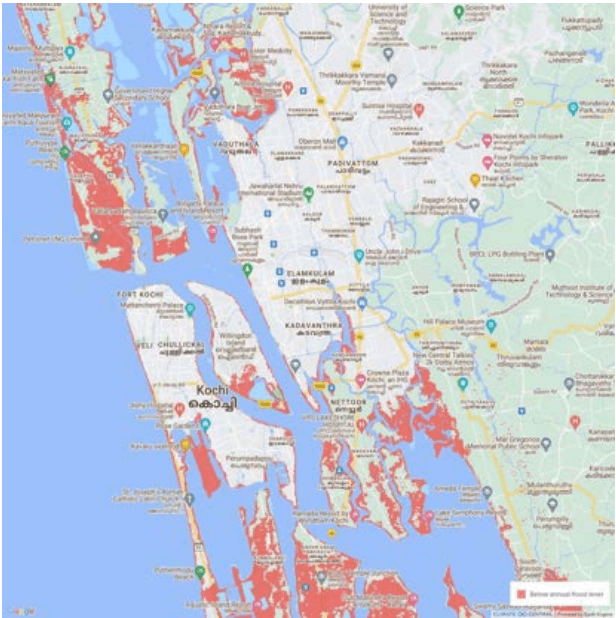
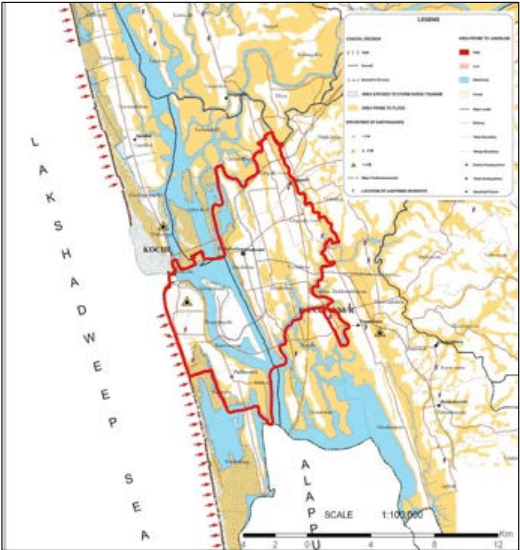
Kerala has been placed in zone III, where the maximum expected intensity is 5.6 ML. Ernakulam district which falls under the low-lying terrain has high probability of occurrence of earthquake which is anticipated due to the rising building construction activities in the area.3 Kerala has experienced occasional mild tremors since historical times. However, pockets of higher ground acceleration have been identified in central Kerala. In this region higher levels of earthquake hazard are expected calling for the introduction of better building practices. In Kerala, several deep-seated faults exist, the notable among them are Periyar fault, Idamalayar fault, Muvattupuzha fault, Bhavali fault and Kuthuparamba fault. Besides there are many more minor faults and fractures that can generate minor tremors as a result of crustal readjustment.
The locations of the earthquakes that have occurred in the Kerala region for which records are available are plotted in Figure 22:7 . Higher levels of seismicity are seen in Kottayam-Idukki districts and Thrissur-Palakkad districts. Detailed seismic micro-zonation of the urban areas especially those situated on reclaimed wetlands such as parts of Kochi city are still lacking. In Kochi amplification of seismic energy due to landfills and liquefaction of sub surface rocks are some of the major areas of concern. Kochi is located on a thick sedimentary pile consisting of alternating layers of sand and clay. Any seismic event can disturb these sediments.
Moderate earthquakes of Magnitude 6 are a possibility both on land as well as offshore sources.(Area falling within zone III of seismic zonation map) So far moderate earthquakes (M5) experienced in Kerala at distant sources( Erattupetta, Wadakkancherry sequence) from Kochi has not caused any damaging effects on these sedimentary piles. But in case such a seismic event takes place at or adjacent to this sedimentary pile (onshore or offshore) the effect is unpredictable. Such a calamity can seriously affect the foundation of multi-storeyed structures to cause its collapse. The clayey plastic soil of Kochi can be disastrous during tremors and the filling of water bodies and wetlands can amplify the disaster. Puthuvype and Mattancherry are hotspots of an earthquake occurrence within the corporation.
3 Disaster Management Plan Ernakulum district - KSDMA
Kochi Municipal Corporation
DISASTER MANAGEMENT
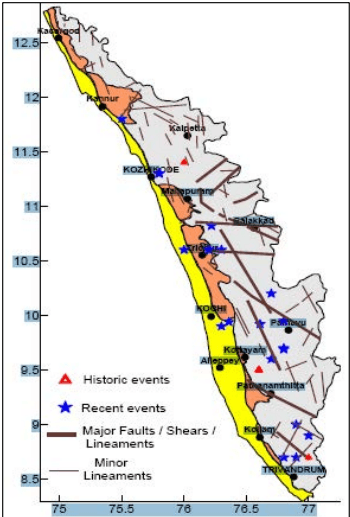
Figure 22:7 Location of historic and recent earthquakes in Kerala, Source: Kerala State Disaster Management Plan Profile