Primary collection includes the collection of waste from the sources which are mainly households and commercial establishments. Currently in Kochi the municipal solid waste is collected at the household level in bins in segregated form at the household level by a waste collector. This collection of waste from households is carried out by workers belonging to different groups like self-help groups under the banner of Kudumbashree (self-help groups
Kochi Municipal Corporation
Govt. of Kerala program), Harithakarmasena, Resident Welfare Associations, Kerala Builders Forum (KBF), Rotary Clubs, NGOs etc.
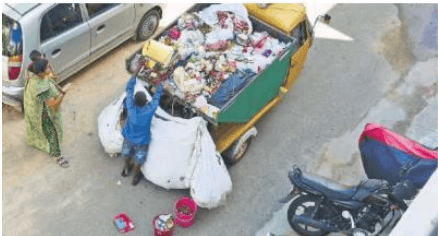
Photo showing primary collection of wastes from households
The Corporation has provided them with tricycles/ petti auto for the purpose of transporting waste to common collection points. Door-to-door waste collectors would come to each household early in the morning each day and would take away the waste kept in the respective waste bins. Each door-to-door waste collector covers about 150 households each day. Towards afternoon, these waste collectors bring all the waste collected by them in the morning to the common collection points from where they would load these waste onto the Corporation Lorries that would carry the waste away.
The frequency of collection varies from everyday collection to alternate and thrice/twice in a week in different places depending on the availability of collectors. The door-to-door waste collectors are paid a fixed remuneration by each household. Even then, the Corporation exercises indirect control over these door-to-door waste collectors.
An average of 2.5 T of waste are collected from each division. 75% of the households are covered under Door to Door Waste collection. Remaining 25% of the households either treat the biodegradable fraction through composting and bio - methanation (Biogas plants) or dump the waste on open spaces creating problems for others.
Chapter XI
11.1.1 Waste Composition
The waste composition can be explained mainly in terms of Physical and Chemical Composition. While the physical composition of solid waste is important for deciding the prime management actions namely the reduction, reuse and recycling of waste, the chemical characterization of waste is important to understand the utilization as well as the pollution potential of the waste. The physical composition of solid waste at the collection point and dumping sites, as reported by the KSUDP, is given in Table 11:3. It indicates that in the city, around 80% of the waste is compostable organics enabling high level of recycling in the form of manure or fuel.
Table 113 Physical composition of waste
Sl.No.
Physical Composition
% by Weight
1
Paper
4.9
2
Vegetable
58
3
Metals
0.7
4
Glass
0.3
5
Plastics, Rubber
1.1
6
Wooden matter (Coconut shells, husk, etc.)
6
7
Stones, earth
14
8
Textiles
2
9
Miscellaneous
13
Total
100
Source: KSUDP Report 2005
The chemical composition of MSW as reported by the KSUDP is given in Table 11:4.
Kochi Municipal Corporation
Table 114 Chemical characteristics of MSW at the dumping sites of Kochi
Density(Kg/m3)
Moisture Content(%)
Calorific Value(K.Cal/kg)
pH
C (%)
N (%)
C/N
P as P205(%)
267.81
55.29
1759
7.46
26.39
1.25
21.11
129.25
Source :KSUDP 2010
The above table indicates high moisture content, low calorific value and high nutrient content making the dominant organic fraction of waste more conducive for recycling in the form of manure. One of the notable features of the chemical characteristics of waste is the high content of heavy metals.
Table 11:5 gives the heavy metal content of Municipal Solid Wastes (MSW) in Kochi Municipal Corporation. It indicates that dumping of waste will lead to metallic pollution of land, especially if the waste is subjected to putrefaction.
Table 115 Heavy metal content in MSW at the dumping sites of Kochi
Ar
Mn
Ni
Cd
Pb
Cr
Cu
Zn
Hg
Mg/kg
ppm
ppm
ppm
ppm
ppm
ppm
ppm
Mg/kg
5.72
--
4.49
0.38
2.48
--
47.53
98.98
<0.1
Source :KSUDP 2010
Municipal Solid Waste (MSW) Management
The corporation of Cochin is responsible for the Municipal Solid Waste (MSW) management of the city. The two departments of corporation of Cochin who is responsible for the MSW management are Health department and Engineering department. The collection, transportation, disposal of MSW is the responsibility of the Health Department while the Engineering Department assists them in planning, formulation of programs, procurement of vehicles and equipment and developing the site.
11.3.2Commercial collection & street sweeping
In case of collection from commercial establishments, Waste that is not collected from small hotels and commercial establishments by the Hotels Association is collected by either Kudumbashree or RWA workers serving that particular division. The large hotels have their own systems and mostly produce biogas from their kitchen waste. Market waste is directly collected from large heaps accumulated in front of the market. Dumping waste in the adjacent canal is also practised in the market places. However, a container collection system has been adopted in one market and at a few commercial centres where 5 cu. m containers were
Kochi Municipal Corporation
replaced by dumper placers. Only 50% of the hotels keep the waste in plastic or gunny bags for the municipal workers to collect.
Under the Kerala Municipalities Act 1994, road/street sweeping and drain cleaning are obligatory responsibilities of the Municipal Corporation. The urban local body shall also arrange to collect and dispose solid waste generated in the city. Labourers from health department both temporary and permanent engage in two shifts with about 60% of them being deployed for the task of collecting waste and sweeping road in the morning and the remaining 40% being deployed for the same task in the evening. Only the main roads and city centre area are cleaned daily; the cleaning frequency for other parts of the city varies. Street sweepers keep the waste collected in small heaps, which are removed by a handcart collection crew to the secondary collection points.
11.3.3Waste Transportation and Storage
The Kochi Municipal Corporation Health Department has a fleet of collection vehicles. Loading and unloading operations are both mechanized and manual. Segregated waste is collected by workers in two separate dustbins and brought to the secondary collection points. The primary collection vehicle is either an auto rickshaw or tricycle that belongs to the Corporation and has been given to the various groups for collection of waste. On the vehicle, 4 bins are provided in which pre-segregated waste at the household level is collected. Some of the workers also collect wet waste in the cart and dry waste in bags. The various vehicles for the transportation from primary and secondary collection points to the treatment plant which are owned by corporation are listed in table below.
Table 116 Corporation Owned Vehicles
Vehicle
Nos.
Compactors
13
Covered tipper
22
Uncovered tipper
2
Pickup van
45
Tricycle
360
Source: Health Inspector, Health circle XXII
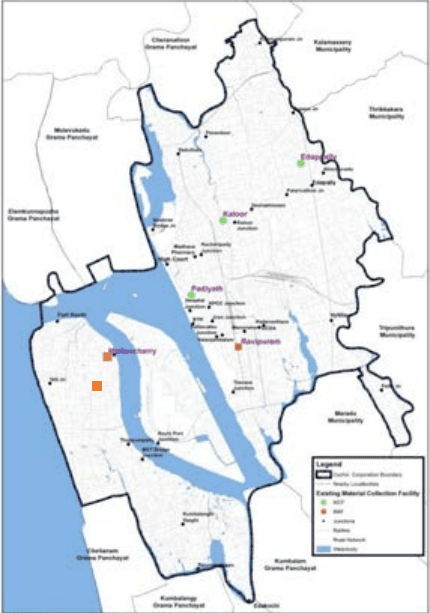
The non – bio waste is also segregated and temporarily stored at Material Collection Facilities of the corporation located at Mattancherry, Kaloor, Padiyath & Edappally. Apart from this each circle has 6 – 7 points where the non – bio wastes are separately stored before they are transported. A small portion of the non – bio wastes are also given for recycling. At Ravipuram, the existing MCF also has bailing and shredding unit and hence is called as Resource Recovery Facility. The RRF at Ravipuram is presently maintained by CREDAI.
Kochi Municipal Corporation
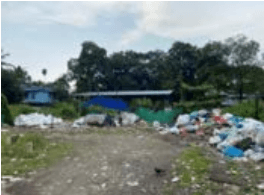
Photo showing non – bio waste collection in front of Edappally MCF Map showing the distribution of existing MCF/ RRF is Kochi Corporation is shown below.
Figure 11:4 Map showing the existing MCF/ RRF in Kochi Corporation Source: Kochi Municipal Corporation 2020
Kochi Municipal Corporation
SOLID WASTE MANAGEMENT
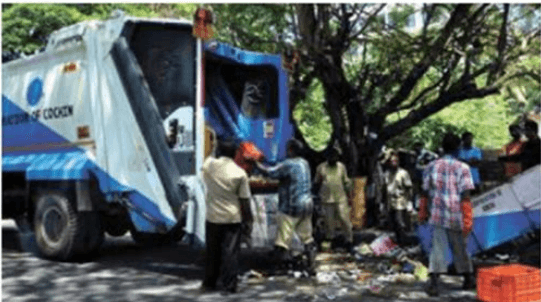
After primary collection the waste is brought to the secondary collection points where the garbage is further segregated on the floor, before it is transferred to the Corporation truck. These transfer points have been pre-determined by the Corporation and the time when the vehicle reaches this spot is also defined. In some places the pre-segregated waste from households is directly transferred to the trucks from the large bins.
Waste transported to treatment plant in compactors
11.3.4Disposal and Treatment of Wastes
The existing waste treatment plant is located at Brahmapuram. The Brahmapuram plant is of area 110 acres. To treat the solid waste generated in the city, a windrow composting plant was established by the corporation in 2008. The waste from 9 LSGI’s are dumped in Brahmapuram. These include Kochi Corporation, Aluva, Angamaly, Kalamassery, Thrikkakara and Thrippunithura Municipalities and Cheranellore, Kumbalangi and Vadavucode – Puthencruz Grama Panchyats.
The solid waste management facility situated in 110 acres of land consists of:
Windrow composting facility of capacity to process 250 TPD of Municipal Solid waste
A RDF facility to convert waste into usable fuel for combustion (Not operated since commissioning)
3. Plastic shredding and balling unit
Presently, the plant is treating only biodegradable waste. All the other waste, including plastic and sanitary is being dumped outside the plant. These rejects, non-recyclable plastics and the waste dumped over these years at Brahmapuram turned this land to a “DUMPING YARD”. Also, the 2018 flood worsened the situation which added the load on Brahmapuram. About Half of the land area was covered up with the legacy wastes over the years. In this scenario, the proposal of bio-mining is being implemented.
Brahmapuram plant treats 220 tonnes biodegradable waste and receiving 72 tonnes non-biodegradable waste on an average on a daily basis. There are almost 60 workers at the plant.
Kochi Municipal Corporation
The organic waste is being treated at Brahmapuram using Inoculum bacteria in aerobic method (aerobic decomposition).
The existing plant at Brahmapuram is in a dilapidated condition. About 100 tonnes of plastic wastes are dumped in the site within the plant premises every day. Of this 1% of the plastic wastes having potential to be recycled are recovered from the wastes, the remaining 99% of the wastes end up as heap in the dumping yard. With frequent fires posing a threat at the Brahmapuram waste treatment plant, the Corporation is presently gearing up to remove nearly five lakh cubic metres of legacy waste from the site through bio-mining.
Open dumping has led to serious environmental issues. The air quality of this area is affected. The odour nuisance from the plant is beyond control.
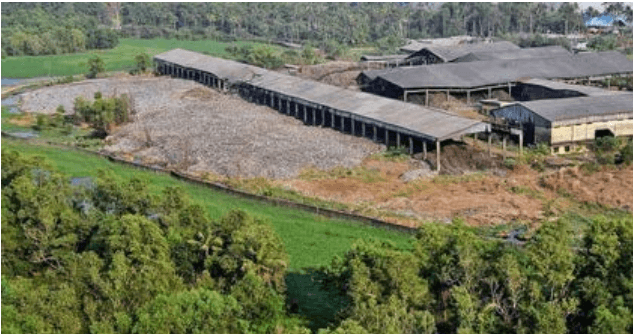
Brahmapuram solid waste treatment plant with the collected garbage piled outside
The main problem happens with this plant is the contamination in the surface water bodies. The plant is on the banks of river Kadambrayar. The aquatic life is being affected by the existence of plant. The current issues including migration of people from neighbourhood shows that it is high time to check the efficiency of current open dumping practice followed in the city.
At this plant, recyclable material from combustible non-biodegradable waste material can be recovered to create a high calorie uniform material, which can be used as a substitute for fuel at cement kilns and incinerators. However, various environmental concerns have been expressed about the suitability of the Brahmapuram site, which is a low-lying and water logged area, in close proximity of the Kadambrayar River.
Kochi Municipal Corporation
Service levels
Table below provides a status update vis-à-vis the parameters identified under MoUD’s Service Level Benchmarking program. It shows that there is plenty of scope for improvement in Solid Waste Management Service Levels for Kochi Municipal Corporation.
Table 117 SWM service levels vis-à-vis SLB set by MoUD
Sl. No.
Parameters
Benchmark
Kochi Service levels
1
HH Coverage
100%
75%
2
Waste Collection Efficiency
100%
40%
3
Source Segregation
100%
85%
4
MSW recovery
80%
NA
5
Scientific disposal
100%
NA
6
Cost recovery
100%
NA
7
Cost collection efficiency
90%
NA
8
Complaints redressal
80%
NA
Source: CSP, 2011, Kochi Municipal Corporation, 2019-2020
Hazardous - Bio-medical and e - Waste Management
The Industrial Wastes, collected from industries are managed by Kerala Enviro Infrastructure Ltd (KEIL), the only Hazardous Waste Management Facility in Kerala that has established Engineered landfill which is approved for a capacity to dispose 10,00,000 MT for a period of 20 years. The bio – medical wastes generated from the hospitals are given to IMAGE (Indian Medical Association Goes Eco- Friendly) the bio-medical waste treatment and disposal project at Palakkad of Indian Medical Association and Common Bio – Medical Waste Treatment Plant run by Kerala Enviro Infrastructure Ltd (KEIL) at Ambalamedu. The bio-medical treatment plant run by KEIL has all the facilities for collection, transportation, treatment, and scientific disposal of biomedical waste from healthcare facilities of:
Modern Medicine, including Dental Care
Ayurveda/AYUSH centres
Veterinary Hospitals/Clinics
Diagnostic Laboratories
Domestic Biomedical waste
Kochi Municipal Corporation
A part of the e-wastes generated by the households are collected by Clean Kerala Company Ltd. The Company then hands over the hazardous waste collected by them to KEIL while the non-hazardous faction is given for recycling. The non-hazardous e-wastes are given for recycling. However the Corporation of Kochi is yet to have a direct tie-up with the Clean Kerala Company for the collection of e waste, non-recyclable and recyclable plastics which will make the collection and disposal system more efficient.
11.2.1The Health Department
Health Department of Kochi Corporation is vested with the duty of waste collection, cleaning and management of waste management infrastructure within the city limits. For the purpose
Kochi Municipal Corporation
SOLID WASTE MANAGEMENT
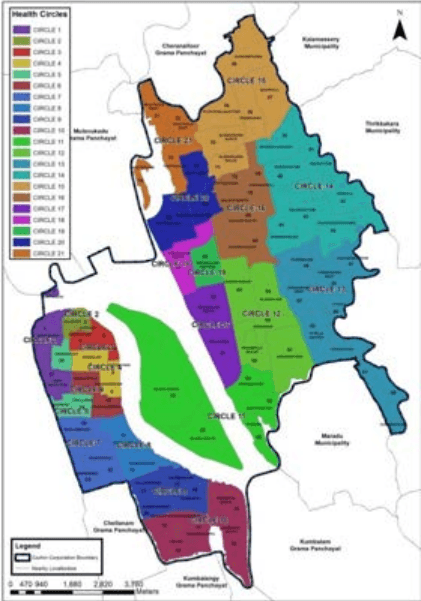
of solid waste management, the entire municipal corporation is divided into 21 Health circles as shown in the Figure 11:2.
Figure 11:2 Health Circle offices at Kochi Corporation Source: Kochi Municipal Corporation, 2020
Each circle comprises of 1 to 5 wards and is managed by a Health Inspector who is assisted by Junior Health Inspectors. Deployment of vehicles for transportation is managed by the Vehicle Section (Circle 22) headed by a senior HI. Above the Health Inspectors, there are 2 Senior Health Inspectors and a Health Supervisor. The head of the Department is the Health Officer who shall report directly to the Corporation Secretary vide Section 226 of the Kerala Municipalities Act, 1994. The final say in the Department is vested upon the Corporation Secretary, who convenes weekly meetings of the Health Officers to discuss and evaluate the functioning of the Department. The Secretary also calls emergency meetings of the Health Officers to tackle emergency situations.
Kochi Municipal Corporation
11.2.2The Engineering Department
The Engineering Department is headed by the Corporation Engineer having the status of Superintending Engineer. The Corporation Engineer is vested with powers of Chief Engineer in respect of Corporation works. The Department undertakes various activities like repairs, up-gradations, and modifications etc. of the Corporation installations. The Department has been vested with the task of constructing, and maintaining the Brahmapuram Plant for Solid waste treatment.
Step by Step process in SWM
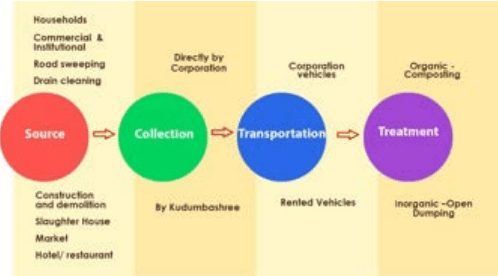
The step by step process in the Solid Waste Management of Kochi Corporation is detailed in figure below.
Figure 11:3 Step by step process in the solid waste management of Kochi Corporation Source: Kochi Municipal Corporation 2020
The household waste mainly in seggregated form of Bio-waste/ Non-Bio waste is collected by Harithakarmasena/ Kudumbasree/ Sanitation workers which is then transported to the collection points. Each health circle has 5 – 10 collection points. From the collection points, they are ultimately transported for treatment/ dumping in Brahmapuram plant. The step by step process in Solid Waste Management is detailed in the following sections.