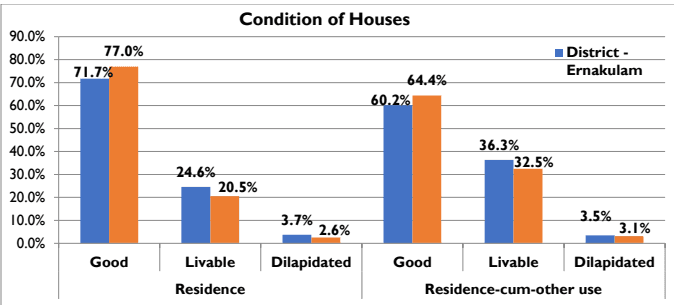
Out of total census houses 99.5 % of houses are of residential use only and 0.5 % of houses are of residence-cum other use. Out of total 99.5 % of houses 77.0 % of houses are of good condition, 20.5 % of houses are of liveable condition and 2.6 % of houses are of dilapidated condition. Out of 0.5 % of houses of residence-cum other use, 64.4 % of houses are of good condition, 32.5 % of houses are of liveable condition and 3.1% of houses are of dilapidated condition.
Kochi Municipal Corporation
HOUSING
Figure 19:3 Condition of Houses in Kochi Corporation Source: Census 2011
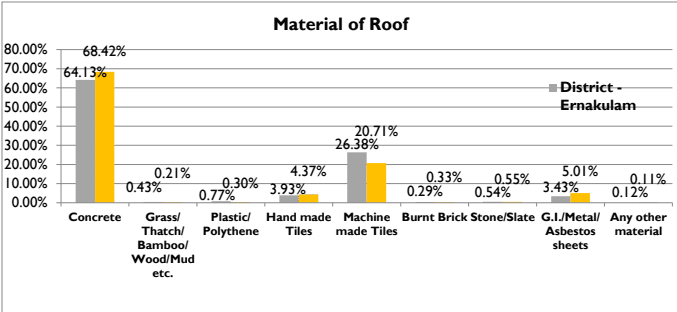
Major share of material of roof of houses within Kochi Corporation is of concrete and followed by machine made tiles, G.I/Metal sheets etc. Figure 19:4 shows detailed characteristics of material of roof of houses within the Ernakulam district and Kochi Corporation.
Figure 19:4 Material of Roof in Kochi Corporation, Source: Census 2011
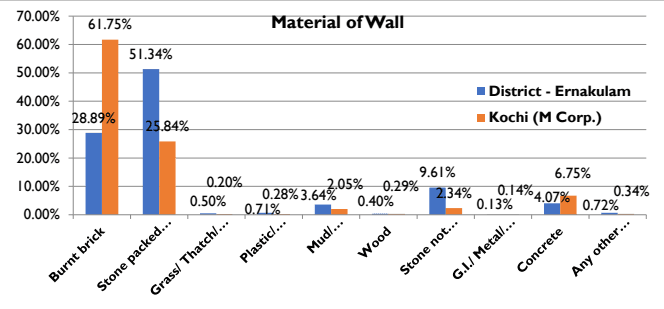
It is found that material of majority of wall used in Kochi Corporation is burnt brick whereas compared with Ernakulam district it is stone packed with mortar. Figure 19:5 shows the material of wall used in houses within Ernakulam district and Kochi Corporation.
Kochi Municipal Corporation
HOUSING
Figure 19:5 Material of Wall in Kochi Corporation, Source: Census 2011
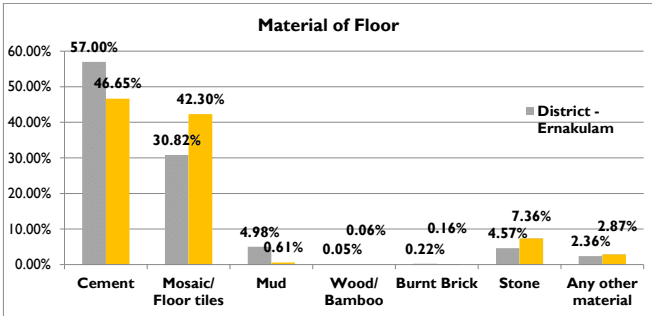
Cement and floor tiles are predominantly used for flooring in Kochi Corporation, followed by stone and other materials. Figure 19:6 shows the material of floor in Ernakulam and Kochi Corporation.
Figure 19:6 Material of Floor in Kochi Corporation, Source: Census 2011
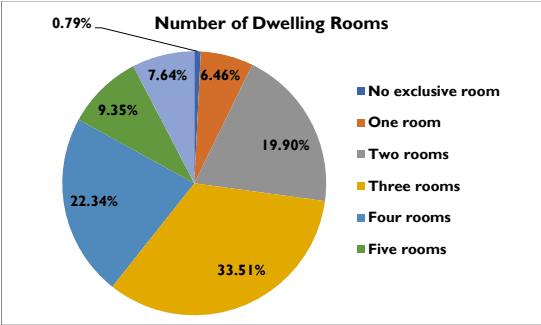
Figure 19:7 shows the number of dwelling rooms of houses in Kochi Corporation. Majority of houses in Kochi Corporation consists of 3 dwelling rooms followed by 4 and 2 dwelling rooms.
Kochi Municipal Corporation
HOUSING
Figure 19:7 Number of dwelling rooms in Kochi Corporation, Source: Census 2011
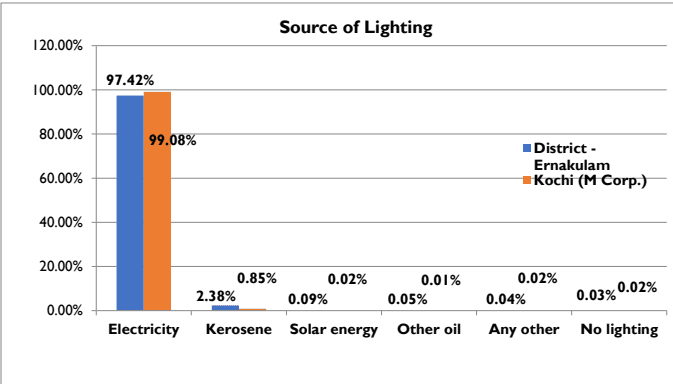
Figure 19:8 shows the sources of lighting in households as per Census 2011. The values show that 99.08% of the households are electrified.
Figure 19:8 Source of Lighting for houses in Kochi Corporation, Source: Census 2011
507
Kochi Municipal Corporation
HOUSING
Chapter 19Housing
Housing is an important aspect that is to be considered for making the city a liveable city, as shelter is one of the basic needs that affect the human well-being. Housing affordability is vital to the social and economic sustainability of our community. Also, Housing sector is employment intensive; it generates employment during its construction period and for its maintenance. The demand for housing increases due to growth of population, rapid pace of industrialization and urbanization. This chapter details about Housing characteristics, Housing shortage, sub-standard housing and the issues faced.
19.1Introduction
Shelter is one of the primary requirements of a human being. The term housing may be used “to cover all the socially accepted ways by which a man acquires a territory for his home, the procedures by which he retains that territory, the price he pays for it and the manner in which the stock of houses is maintained and enlarged”.
The characteristics of the shelter count in defining housing in relation to the standard of living. It is the residential use which determines the future living patterns and densities in a community.
Online building plan approval system reduced average time for approvals by nearly 50%. Census 2011 data reveals that among million plus population cities in India, Kerala has the lowest percentage of urban population (1.5%) living in slums. The Kochi urban agglomeration is the largest in the state and also its commercial capital. The Corporation area of Kochi also has very low number of households (around 1%) living in slums.
19.2 Housing Shortage
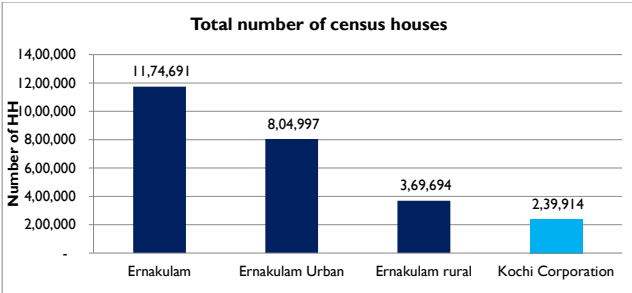
The total number of houses in the Kochi Corporation area is 2,39,914. The total number of occupied houses is 2,06,689. The vacant housing in the Corporation area is 33,225.
Kochi Municipal Corporation
HOUSING
Figure 19:1 Number of total houses, Source: Census 2011
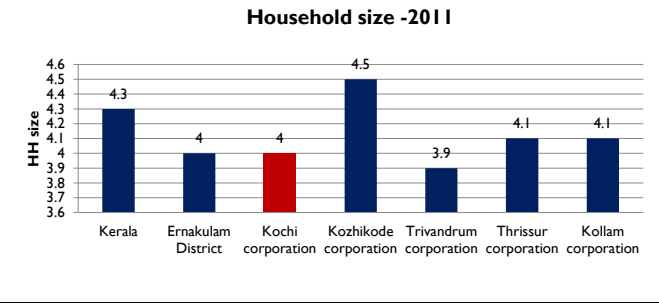
Figure 19:2 Household size in various corporations, Source: Census 2011
19.4Below Poverty Line (BPL) and Slum Housing
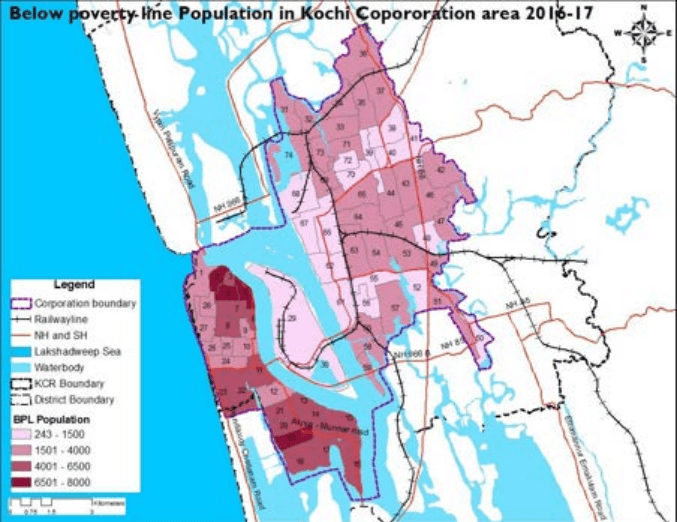
Total population below poverty line in Kochi Corporation is 202788 (33.68% of total population). The percentage of population below poverty line is higher in the coastal areas, where fishermen constitute a major share of the population.
508
Table 191 Ward wise population below BPL (2016-17)
dr a W
Name of Ward
No. of BPL
dr a W
Name of Ward
No. of BPL
HH
Populati on
HH
Populati on
1
Fort Kochi
959
3854
38
Devankulangara
174
661
2
Kalvathy
1619
7014
39
Karukappilli
169
779
3
Earaveli
1444
6403
40
Mamangalam
186
682
4
Karippalam
1581
6744
41
Padivattom
222
989
5
Mattancherry
1774
7698
42
Vennala
492
2151
6
Kochangadi
1056
4426
43
Palarivattom
547
2426
7
Cheralayi
1016
4148
44
Karanakodam
512
2253
8
Panayappilli
1263
5063
45
Thammanam
592
2627
9
Chakkamadam
636
2525
46
Chakkarapparambu
358
1661
10
Karuvelippady
876
3387
47
Chalikkavattom
443
2031
11
Thoppumpady
1199
4802
48
Ponnurunni East
286
1241
12
Tharebhagam
436
2614
49
Vyttila
490
2061
13
Kadebhagam
1544
6430
50
Chambakkara
209
961
14
Thazhappu
1416
5020
51
Poonithura
383
1665
15
Edakochi North
1197
4718
52
VytillaJanatha
321
1381
16
Edakochi South
1037
4311
53
Ponnurunni East
426
1777
17
Perumpadappu
1036
4170
54
Elamkulam
371
1635
18
Konam
1088
4448
55
Girinagar
82
345
Kochi Municipal Corporation
HOUSING
19
Palluruthy-Kacherippady
1596
6713
56
Panampilly Nagar
236
970
20
Nambyapuram
1537
6331
57
Kadavanthra
654
2771
21
Pullardesom
1251
5099
58
Konthuruthy
346
1524
22
Mundamveli
1009
4095
59
Thevara
393
1644
23
Manassery
1326
5229
60
Perumanoor
434
1953
24
Moolamkuzhi
721
2948
61
Ravipuram
184
796
25
Chullikkal
620
2483
62
Ernakulam South
238
1080
26
Nasrath
985
3933
63
Gandhi Nagar
526
2221
27
Fort Kochi Veli
502
1912
64
Kathrukadavu
377
1689
28
Amaravathy
664
2729
65
Kaloor South
395
1788
29
Island North
316
1249
66
Ernakulam Central
271
1169
30
Island South
59
243
67
Ernakulam North
202
868
31
Vaduthala West
593
2641
68
Ayyappankavu
287
1294
32
Vaduthala East
643
2764
69
Thrikkanarvattom
319
1505
33
Elamakkara North
654
2823
70
Kaloor North
209
949
34
Puthukkalavattom
442
1962
71
Elamakkara South
440
2030
35
Ponekkara
422
1835
72
Pottakkuzhi
191
846
Source: Civil supplies department (2016-17)
It can be observed in Figure 19:9 that the proportion of BPL is more towards the coastal areas of the Corporation. The shift of economic activities from the western part of Kochi to the east has also accelerated poverty and growth of slums in the former.
Kochi Municipal Corporation
HOUSING
Figure 19:9 Ward wise population below BPL Source: Civil supplies department (2016-17)
19.5Slums and Other Sub-Standard Housing
The formation of slums and squatter settlements in major urban areas in the developing world is largely attributable to the lack of resources and capability in the public sector to adequately plan for, provide, and manage the housing, infrastructure, and services needed to match demand and stimulate economic growth. In urban areas where a high rate of population growth exerts extreme development pressures, these conditions result in the rapid expansion of slum and squatter areas. UN - HABITAT defines a slum as a continuous settlement where the inhabitants are characterized as having inadequate housing and basic services. Census defines slum as a compact area of at least 300 populations or about 60-70 households of poorly built congested tenements, in unhygienic environment usually with inadequate infrastructure and lacking in proper sanitary and drinking water facilities. But even in Calicut, where the population has grown relatively slowly over the past few decades as a result of economic stagnation, slum areas have expanded and their environmental conditions have worsened because of limited government resources and capability.
Kochi Municipal Corporation
HOUSING
The economic boom of the past decade has seen Kochi soaring into one of the hottest employment hubs of the country. This has led to a large number of migrants flowing into the city, the number of such workers being the largest in Kerala. This has, however, also contributed to a growing slum-dwelling population in the city. As of 2006, there were about 349 slums in the whole of the Kochi CDP area, containing about 32,420 people. In these areas, poverty is high both in relative and in absolute terms.
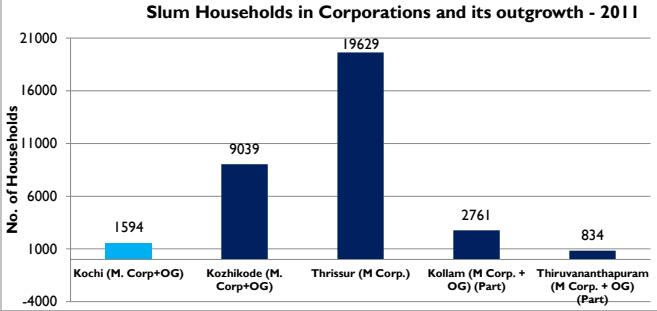
Majority of slums in the Ernakulam District are located in the corporation area. From the table below it can be observed that the proportion of slum households in Kochi Corporation including its outgrowth is less in comparison with other Corporations in the state except for Trivandrum. As per the Development plan 2031, Kochi city alone has more than 15,000 landless and homeless persons. Housing for these sections have been constructed through several scheme like VAMBAY, RAY, BSUP, DFID scheme, Janakeeya Bhavana Padhathi, credit cum subsidy under housing etc.
Figure 19:10 Slum Households in Corporations and their outgrowth-2011, Source: Census 2011 Office of the Registrar General & Census Commissioner, India
Table 192 Slum Population in Corporations of Kerala
Municipal Corporation
Total number of Slum Households
Total slum population
Male population
Female population
Kochi (M. Corp+OG)
1594
5184
2648
2536
Kozhikode (M. Corp+OG)
9039
50343
24075
26268
Kochi Municipal Corporation
HOUSING
512
Thrissur (M Corp.)
19629
79801
38545
41256
Kollam (M Corp. + OG) (Part)
2761
11659
5688
5971
Thiruvananthapuram (M Corp. + OG) (Part)
834
3320
1634
1686
Source: Census 2011
Slums in Kochi
The number of slums and their names selected for PMAY scheme in each ward in the Corporation area is given below in Table 19:3.
Table 193 Details of Slums in each ward (selected for PMAY)
Slum name
Ward No.
Popn
Name of Ward
Ward No.
Popn
Thuruthy
2
4268
Pattalathu West and South
18
747
Karingathuruthi colony
3
2387
Bangladesh parambu Colony
19
446
Paliyathparampu
3
2741
Kollasherry north colony
19
418
Adhikaravalappu colony
4
802
Tharayilparambu
20
391
BIGBEN
4
450
Federal Bank West Colony
21
473
Maliyakkalparambu colony
4
1169
SDPY West Colony
21
359
Thundiparambu colony
4
317
Venkitachalapathi Colony
21
493
Bazar Road Colony
5
1506
MundamveliSanthom Colony
22
480
Ceelattuparambu
5
511
Arayad Colony
23
242
Gelamsait colony
5
400
Athipozhi Colony
23
675
Puthukattuparambu
5
576
Fishermen Colony
23
571
Mepparambu Colony
6
229
Mukkthuparambu Colony
23
761
Kochi Municipal Corporation
HOUSING
CheraliParambu Colony
7
301
Saudi colony
23
692
Mathuttiparambu Colony
8
443
Thekkechoolezhath colony
24
1430
Ottachal colony
8
202
Kaliyathparambu Colony
25
401
Panayappilly Colony
9
1654
KurupathuParambu
25
747
Chullikkal East
10
399
Beach Colony
26
2625
EttukandamKinginikara
10
619
Kallukulam Colony
26
321
Indira Colony
10
447
Rameswaram Colony
26
1074
Karuvelipadi colony
10
936
East West Odatha
27
1038
Thakkavu colony
10
540
Holly Cross Nagar
27
1127
Achuthuthamenon enclave colony
11
438
St.JohnPattam North
27
1345
Thoppumpady Colony
11
934
Ajentha cinema colony
28
50
Valummel Colony
11
985
Alunkal Colony
28
0
Kadabagam colony
13
1690
Bhagavathiparambu Colony
28
342
Kadabhagam SD puram south colony
13
298
Kuriplavu road amravathi
28
466
Madhura Company Colony
13
1011
Palamaraparambu Colony
28
1303
Vyasapuram Colony
13
844
Palliparambu Colony
28
616
KMP Oil mill colony
14
615
SJD Colony
28
696
MangamadomPazhekkatu Colony
14
440
Vathuruthy
30
2400
Palekkattu Colony
14
575
Janakeya Road
31
674
Thangal Nagar
14
783
Mothertheresia Lane
31
549
Source: Kochi Municipal Corporation, 2018
Kochi Municipal Corporation
HOUSING
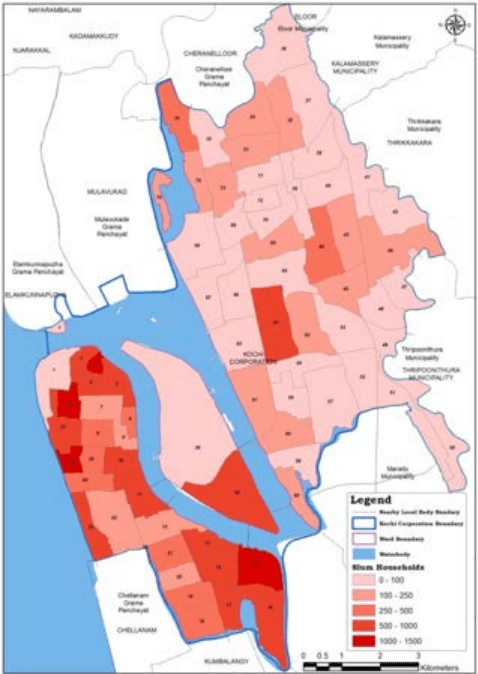
The largest slum in the Corporation area is Thuruthy slum with a population of 4268 with an area of 1 acre.
Figure 19:11 Slum Households in Each Wards Source: Kochi Corporation, 2018
19.7Housing Tenure
The tenure problem of the urban poor in the city is complex in nature. Overcrowded and dilapidated buildings owned by private individuals and trusts are threats to the residents. In many cases the owners of these buildings have no other property and share the premises with slum dwellers. An analysis of the insecurity experienced by the poor clearly suggest the need to specifically target the groups whose vulnerability is increased by the nature of their living environment. These have been identified as the homeless, the landless, various types of tenants and encroachers on government and private land even on the verges of canals and roads.
19.6Trends in housing
Traditionally house construction is a private sector activity. But the shortage of housing especially in the lower income and middle income groups has prompted the government to view this as a social obligation. Consequently public housing bodies have been constituted to supplement the house construction. Affordable housing to the economically weaker sections and low income category through a proper programme of allocation of land, extension of
Kochi Municipal Corporation
HOUSING
funding assistance and provision of support service is essential. In Kochi city there are 16,774 landless and homeless persons (Source: Kochi Corporation). The government, both central and state has implemented several schemes such as VAMBAY, Janakeeya Bhavana Padhathi, credit cum subsidy under housing etc. for development of weaker sections.
19.8Housing for migrants
Migrant labourers are a significant economic force in the state. A study on ‘In-migration, Informal Employment and Urbanisation in Kerala’, sponsored by State Planning Board (Evaluation Division) and released in August 2021, found that the state, which had an estimated 31.4 lakh migrants from other states during 2017-18, will have a migrant population between 45.7 lakh and 47.9 lakh by 2025 and 55.9 lakh and 59.7 lakh by 2030 as per the current rate of immigration. In fact, the inter-state migrant workers have become an indispensable part of Kerala’s economy. The state also offers the highest wages for migrant workers for jobs in the unorganised sector in the entire Indian subcontinent.
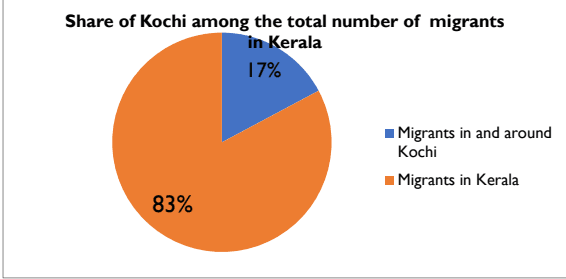
As per the “Strategic Action Plans for Rental Housing for Internal Migrants in Kochi Municipal Corporation” done by Prof Angelique Chettiparamb, Henley Business School, a post disaster needs assessment carried out in 2018 by the state government states that the area including and surrounding Kochi accommodates about 6.03 lakh migrants. Post Covid, the labour commissionarate estimated a total of 92930 migrant workers in Ernakulam district in 2017 labour camps. Reportedly, the greatest number of migrant workers in Kerala are in Ernakulam district.
515
Kochi Municipal Corporation
HOUSING
Figure 19:12 Figure showing the share of Kochi among the total number of migrants in Kerala Source: “Strategic Action Plans for Rental Housing for Internal Migrants in Kochi Municipal Corporation”
Ernakulam district has some of the oldest labour ‘Nakas’ in the state. Men and women from Tamil Nadu have been present seeking work at Kaloor and Kadavanthra junctions in Kochi city for more than two decades. Thevara and Vazhakkala are two other labour nakas in Kochi. Tamil workers are available seeking work at Vathuruthy also. In addition to workers from Tamil Nadu, workers from Anantapur in Andhra Pradesh as well as Muzaffarpur and Patna in Bihar can be found seeking work at the major nakas in the city.
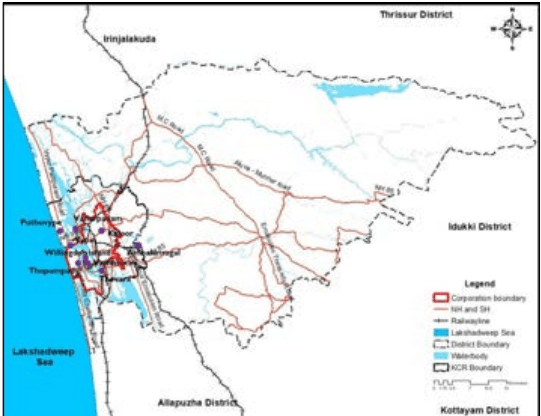
Figure 19:13 Major housing pockets of migrants, Source: District migration profile- CMID 2016-17
Kochi Municipal Corporation
HOUSING
Kochi city has some of the largest residential pockets of migrant workers in the District followed by Perumbavoor. Vathuruthy on Willingdon Island is the oldest and the largest residential cluster of workers from Tamil Nadu in the district. Now workers from other states also live in Vathuruthy. Tamil migrants in Kochi are concentrated in Vazhakkala, Kaloor, Kalamassery and Pathalam, in addition to Vathuruthy. There are also workers from Jharkhand, West Bengal, Assam and other states. Migrant families try to stay together at places where other such families are present. Single male migrants live in crowded rooms, paying exorbitant rents, mostly in buildings exclusively housing migrant workers. Several pukka as well as kutcha structures house migrant workers along the labyrinth of lanes near the Kochi Refinery including Kuzhikkad-Puthenkurishu Road. Vathuruthy in Kochi is a typical example of housing of single as well as migrant families, particularly from Tamil Nadu. Tamil families are clustered in Elamakkara also.
The Kochi Metro Rail workers are housed at H.M.T. Colony and near the L.N.G. Terminal in Puthuvype, which is outside the Corporation area. Several workers from Tamil Nadu and Andhra Pradesh rest at Kaloor junction on the Kaloor-Kadavanthra Road as well as inside the Kaloor bus stand. Thevara in Kochi city is also an area where migrants from most of the states can be seen. Gardeners from Odisha and West Bengal live with their families near Champakkara Canal in Maradu. (District migration profile 2016-17, CMID).
19.11Problems and Potentials
520
The low density of slum settlements in Kochi City makes life in the city’s slums generally less oppressive than in many other major cities in the country. Still, conditions are bad and deteriorating. Housing condition is poor and basic infrastructure facilities are all in short supply. Some schemes for slum improvement failed to implement as most of the slum dwellers in the study area were land title owners and they didn’t approve of giving up their land title for proposed better living in flats. Hence, slum improvement projects where infrastructure improvements are implemented while the people in the slums retain their claims on land, will offer a useful solution for the problems faced by the slum dwellers in the Corporation area.
With the increasing demand for housing, the government is finding it difficult to locate land within the city. Most of the land identified lacks basic services like water supply, drainage system etc. Hence, housing projects not only involve the construction of housing units but also extending city services to the plots. This delays the completion of the project, since it involves the participation of various government departments and higher expenditure. Representatives of private development firms working on housing for the urban poor claims that, subserviced plots as a main reason for their inability to reduce the cost per unit.
Kochi Municipal Corporation
HOUSING
Lack of awareness on acquiring title deeds is a major issue. Poor education and awareness among the beneficiaries have led to their incapability to go through the procedures for repaying loans and obtaining certificates. The beneficiaries have no organisations or agencies that could guide them through the process. They do not know whom to approach for solutions. This has immobilised the households, restricting their social and economic growth. The lack of title deeds stunts the economic growth of the households.
Due to the unavailability of land and disputed land in the city, the housing complexes are designed to house a large number of households on small plots of land. Vertical housing is not practised for urban poor housing, since the households are reluctant to maintain the common areas. This has resulted in congested designs like row houses of small units and one-storey complexes with dingy corridors. Many of these units lack privacy. The quality of construction is also a major concern, due to corrupt contractors. Poor quality has led to leaky roofs and weak walls, which need constant maintenance. These also restrict the vertical and horizontal expansion of each unit.
The size of the units of all the housing projects is fixed to the basic minimum, in order to reduce their cost and make them affordable to the urban poor. This is done irrespective of the household size. Overcrowded small units create bad living environments, posing threat to the well-being of the individuals. In informal settlements, it is observed that households expand their units when they have enough savings or when there is an increase in the household size. In the case of housing colonies, the units have no provision for expansion, vertically or horizontally. This forces them to live in a small space, until they have saved enough to buy or build a new house, but most of the households might not be capable of saving enough money. As per the PMAY scheme, the unit size is 300 square feet for a EWS family and 600 square feet for a LIG family. It is to be analysed whether income is a factor on which the housing unit size can be fixed. Illegal construction of rental units and poor living conditions due to the non-performing formal rental market, the informal rental market is the only option for migrants.
19.10On-going and Completed Projects
Poverty eradication programs by the Municipal Corporation are undertaken through Community Development Societies (CDS), Area Development Societies (ADS), and Neighbourhood Groups (NHGs). The Municipal Corporation has provided loans for self-employment programs by utilizing Central and State Government funds.
19.10.1 Rajiv Awas Yojana (RAY)
Rajiv Awas Yojana (RAY) has been formulated by the Ministry of Housing and Urban Poverty Alleviation (MoHUPA) in pursuance of the Government's vision of a "Slum-free-India". This scheme aims at providing support to States that are willing to provide property rights to slum dwellers. The scheme follows the strategy of a 'whole city, 'whole slum' approach. In each slum, an integrated approach would be taken, with provision of infrastructure, basic civic and social amenities and decent housing. Further, the benefits of health, education, social security, construction workers' welfare and livelihood and public transport linkages for holistic slum redevelopment would be provided through convergence of schemes and dovetailing of budgetary provisions available under the programs in the respective sectors.
The preparatory phase of RAY has already commenced from March 2010 and the States are being assisted to draw up their Slum-free Plans of Action to proceed towards the goal of Slum-free Cities/States in a systematic and time bound manner. This scheme comprises of all the preparatory activities such as slum survey, GIS Mapping of Slums and development of Slum free City and Slum-free State Plans with active involvement of experts having expertise in the areas of GIS, MIS, and Planning etc.
The Corporation of Cochin has selected 441 slums under Rajiv Awas Yojana (RAY). After merging and physical verification by the external agency, the slum count has been finalized as 218 as per the slum selection criteria by Government of Kerala. These slums have a population of more than 28,000 families – an average of 128 families per slum. According to the geographical nature of the City the administrative area has been divided into five zones. More than 60% of the slums which are identified for RAY are in the Fort Kochi Zone.
Kochi Municipal Corporation
HOUSING
19.10.2 Pradhan Manthri Awas Yojana (PMAY)
Hon'ble Prime Minister envisioned Housing for All by 2022 when the Nation completes 75 years of its Independence. In order to achieve this objective, Central Government has launched a comprehensive mission "Housing for All by 2022" Housing for All (HFA) mission is since launched in compliance with the above objective of the Government and with the approval of competent authority. The mission seeks to address the housing requirement of urban poor including slum dwellers through following four programme verticals:
Beneficiary Led individual house Construction/Enhancement
According to 6 DPR prepared for PMAY-housing for all scheme about 8266 house sare identified under this scheme by the Corporation. Another project is set to come up in Mattanchery to rehabilitate landless and homeless slum dwellers in the area; where in a residential complex will be constructed.
19.10.3. LIFE (Livelihood Inclusion Financial Empowerment)
LIFE (Livelihood Inclusion Financial Empowerment) Mission is the mission of the Government of Kerala to build free houses for all the homeless in Kerala. LIFE mission scheme envisages a comprehensive housing scheme for all the landless and homeless in the State. Mission LIFE focuses on four major thrust areas: Affordable housing, improving public infrastructure, strengthening agriculture, and improving management of natural resources.
19.10.4. Basic Services to the Urban Poor (BSUP)
The sub-Mission on Basic Services to the Urban Poor will cover the follwing:
Integrated development of slums, i.e., housing and development of infrastructure projects in the slums in the identified cities.
• Projects involving development/improvement/maintenance of basic services to the urban poor.
Slum improvement and rehabilitation projects.
• Projects on water supply/sewerage/drainage, community toilets/baths, etc.
519
• Houses at affordable costs for slum dwellers/ urban poor/EWS/LIG categories.
Construction and improvements of drains/storm water drains.
• Environmental improvement of slums and solid waste management.
Street lighting.
Kochi Municipal Corporation
HOUSING
A comprehensive package for poverty alleviation introduced by Government of India called JNNURM in which Basic Services to the Urban Poor (BSUP) is a major component. Kochi Corporation has submitted BSUP a CDP & DPR with a vision of Making Kochi as a slum free city.
The Smart Cities Mission aims to rejuvenate the prevailing urban ecosystem through Area Based Development strategies. Major projects include construction of Multi – storeyed housing complex at Thuruthy and fund support to other agencies.
Table 195 CSML Projects
Project Name
Project Estimated Cost (Cr)
Status
Construction of Multi - storeyed housing complex at Thuruthy
46.36
Ongoing
Beneficiary led housing
13
Fund support to other agencies (KMC)
Upgradation of infrastructure in Housing through Credit linked schemes
21
Fund support to other agencies (KMC)
Source: CSML, June 2021
19.9Housing need
As per the Pradhan Manthri Awas Yojana (PMAY) survey, about 8266 houseless and landless were identified as per 6 DPR prepared for PMAY scheme in Kochi Corporation. Considering the future growth in population as the projected population of 8.2 lakhs, housing requirement is calculated based on Table 19:4.
Table 194 Table showing the housing need by 2040
2011
2040
Houseless/Landless at present (with 8266 PMAY identified Beneficiaries)
16774
8508
Dilapidated Houses at present
3822
Obsolescence of existing houses (2.5%) + Congestion factor of HH (0.5%)
6793
Total Housing Need
15301
Source: LSGD (Planning)
Kochi Municipal Corporation
HOUSING
Assuming that all the identified beneficiaries (8266 households) under the PMAY scheme is benefitted fully during the scheme period then the projected housing requirement will be about 8508. It is also assumed that the present dilapidated houses also are repaired by the horizon year. When the congestion factor of 0.5% and obsolescence of 2.5% is considered, the housing shortage by horizon year will be 15301.`