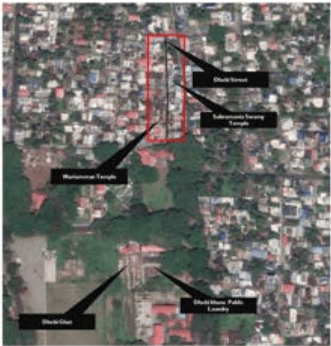
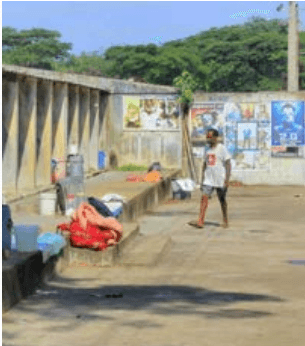
Dhobi street and its landmarks
Source: Generated from land use survey and google imagery.
Dhobi Street, about 150 meters north of Dhobi Khana, near the Pallath Raman Hall at Fort Kochi, is the residence of the Tamil-speaking Vannan community. The community migrated to Kochi and settled here centuries ago.Washer men by profession, it is believed that the King of Kochi invited the Vannans from Coimbatore and Tirunelveli to Kochi, offering them land for their settlement and laundry work. Though the year of the settlement of the Vannans is not known, it is assumed that the migration of the Vannans happened during the colonial period.
The King had allotted them 13 acres of land at Veli for their work and living. They had 70 ponds to wash the clothes. However, in 1976, the Greater Cochin Development Authority (GCDA) took away a part of the land and in return built a ‘DhobhiKhana’ with washing facility for the community.Adhering to their traditions, the Vannans do their laundry work manually, even to this day.The shed has 40 washing pens, each assigned to a family. Earlier, the members of the community used to live in row houses which resembled a typical village in Tamil Nadu. Now many have demolished the thatched huts and built Kerala-style concrete buildings in their places. There are two temples of Goddess Mariyamman, one temple of Lord Siva, and one temple of Murugan on this street. Mulamkoottu, an eight day long festival, is celebrated every year in August by the Vannans, with traditional Tamil songs and dance. Presently about 70 Vannan families reside at Dhobi Street. The street has many common facilities, including a library, park, common rest room, badminton court gymnasium, and a room for indoor games.
Kochi Municipal Corporation
HERITAGE