While the Kerala Muslims trace their origin to the trade links between Arabia and Malabar that existed even before the advent of Prophet Muhammad, the Kutchi Memons embraced Islam only in AD 1421. Memons were originally Lohanas, belonging to Vasiya caste, in the Sindh region of Gujarat.The Memons, who were driven out from their homeland at Kutch in Gujarat by a drought in the early 19th Century, had to face several odds in rebuilding their lives in Kochi. The Maharaja of Cochin, allowed them to settle down in the city. They started in earnest by finding global market for various products from the state. While other ethnic groups focused on spices, the Memons concentrated on fish products. They began the global hunt by exporting dry shrimps to Burma. Memons were the first in Kochi to export dry shrimp.
The Memons also took a leading role in seafood industry when India started exports in 1950s. Memons also tried to lay a strong foundation for commerce in the city by establishing the Cochin Chamber of Commerce and Industry.
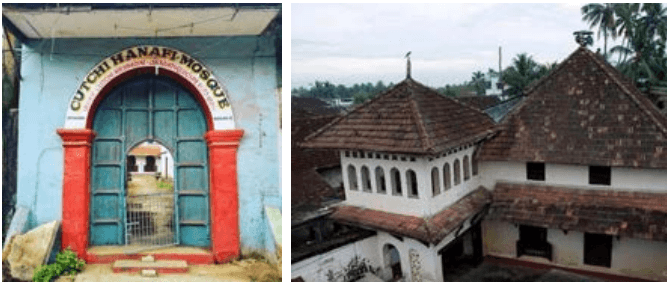
Kutchi Hanafi Mosque
For muslims in Kerala the public places likemosques, shops etc. are located in the outer boundary and thehouses at the centre of the settlement to ensure the privacy ofwomen . The features likenarrow streets, Small window openings, and two separate livingareas for men and women etc. are also found.
Currently there are about 3,000 Kutchi Memons in Kochi. Local people call them Saits or Sethu (owners). The prominent mosque of Memons at Mattancherry is Kutchi Hanafi mosque built in 1875. The population of the Memons was shrinking as majority of them have adopted small family norms unlike other Muslims in the state.While the Memons in other parts of the country have abandoned Kutchi and switched over to Urdu, those in Kochi still speak their own language, which is close to Sindhi.
Kochi Municipal Corporation
HERITAGE