Education and learning raise aspirations, set values and ultimately enrich live. Education helps equip students with the skills they need to lead healthy, productive and meaningful lives. This sector is thus a powerful driver of development and one of the strongest measures to reduce poverty, improve health, ensure gender equality and provide access to better standards of living. Kochi Corporation falls within Ernakulam District which is a major educational hub of the State. This chapter focuses on the existing scenario of education in Kochi, its spatial distribution and the challenges pertaining to the sector.
Progress of education in Kochi
The ideals of freedom, nationalism and liberalism that emerged in European countries after many incidents of revolutions and movements influenced the Indian nationalists when they appeared on the Indian horizon producing a deep impact on the society and life of Kochi. The liberal minded rulers of Kochi inspired by the noble ideals took concrete measures to promote education with the help of their Diwans so that the above ideals might be embedded in the social psyche or incorporated into the state craft. As a result the movement started to educate masses in British Indian Provinces. The need for a state system of education was felt when there was retrogression in education. In 1818, a Proclamation was issued by the Cochin raja and as a result; vernacular schools started in different parts of the Proverthies (taluks). In the schools pupils were taught astrology and Sanskrit, besides the three R's (reading, writing and arithmetic). They were closed in 1833 due to poor response from the public but were reopened as Taluk Schools in 1835. Education was brought under government control by 1890 and Village Pyal Schools began to disappear from the state and remained as dwindling survivals in rural areas.
455
The liberal patronage given to education by the Cochin rajas resulted in an early start and faster rate of progress in English as well as native education in the state. In respect of English education Kochi was ahead of the entire Southern India except the Madras State. In 1845 two English schools started, one at Tripunithura for the members of the Cochin royal family and the other school at Ernakulam meant for others. Grant-in-aid rules were passed in 1889 for the private schools in the state. It resulted in the establishment of a number of primary and secondary schools in Ernakulam District and Kochi.
Presently, Kochi city in Ernakulam district is a major educational hub. The Cochin University of Science and Technology is situated in the suburb of the city. Other national educational institutes in Kochi include the Central Institute of Fisheries Nautical and Engineering Training,
Kochi Municipal Corporation
EDUCATION
the National University of Advanced Legal Studies, the National Institute of Oceanography, Central Institute of Fisheries Technology and the Central Marine Fisheries Research Institute. College of Fisheries affiliated to Kerala Agricultural University is situated at Panangad, a suburban area of the city. In this chapter, analysis of educational institutions, level of education and the problems faced in educational sector in Kochi Corporation are detailed.
Educational Facilities
There are five hierarchies of schools in the city namely, Pre-Primary school, Primary school, Upper Primary school, High school, Higher Secondary School and Higher Secondary School with VHSS. There are 287 schools in Kochi Corporation, in which 60 are government run; whereas 227 schools are under aided or unaided ownership.
15.4.1 Schools
The schools in the area are affiliated to either Kerala State Education Board, Indian Certificate of Secondary Education (ICSE) or Central Board of Secondary Education (CBSE) Among the schools, there are 76 Pre-Primary schools in which 10 are government schools and in 67
Kochi Municipal Corporation
EDUCATION
primary schools in which 15 are government schools. Among 81 High Schools 16 are government schools and 67 Highers Secondary 16 are government schools and there are 6 Higher Secondary schools with VHSE among this 3 are government schools. There are also 5 Kendriya Vidyalaya schools within the Kochi Corporation other than that 7 special schools are functioning within the Kochi Corporation with student strength of 387. Major share of students are studying in private schools compared to government and government aided schools in all four hierarchies. There are about 300 government, aided and unaided schools in the planning area. The details of the schools are given below, in the table below.
Table 151 Details of Schools in Kochi corporation
Category of School
Total
Student to teacher ratio
Pre-Primary School
76
24:1
Primary School
61
25:1
Upper-Primary School
32
19:1
High School
81
24:1
Higher Secondary School
63
18:1
Higher Secondary School with VHSS
6
Source: Statistics wing, LSGD Planning, Deputy Director of Education Ernakulam, 2020
Nature clubs are formed in schools and seminars related to Green Protocol and Haritha Kerala programs are also conducted. As part of the Haritha Kerala project, various classes have been conducted in schools to educate children about the importance of diverting and treating waste and the importance of protecting drinking water sources and ensuring access to clean water.
Soft skill training programs are conducted at school level. Under the School Safety Committee, classes on natural disasters, safety measures to be adopted in the event of a road accident, road safety and traffic laws, and monsoon illnesses and preventive measures are provided to students. Students and parents are also given awareness classes on the psychological and physical abuse the students face and the precautions to be taken to avoid them.
Kochi Municipal Corporation
EDUCATION
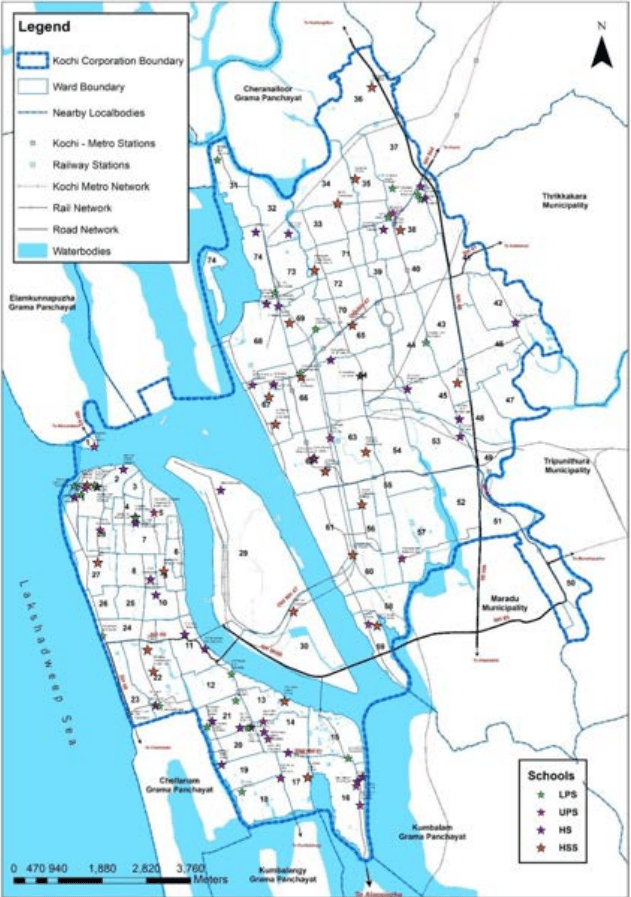
Figure 15:2 Location of Schools in Kochi Corporation Source: Deputy Director of Education Ernakulam, 2020, Primary survey
Kochi Municipal Corporation
EDUCATION
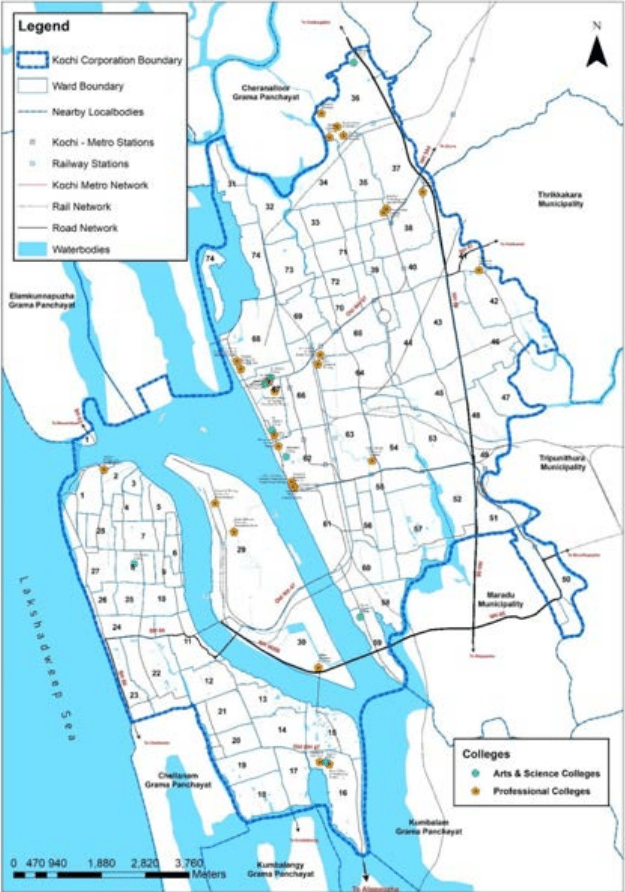
There are 7 arts and science colleges and 18 professional colleges within Kochi Corporation. Among the 7 arts colleges one is Government College, 5 are aided and unaided colleges and one is unaided college. Among 18 professional colleges 5 are government colleges including Government Law College and 2 are aided colleges. Details of arts and science and professional colleges within the Kochi Corporation are as listed in table 15-2 and table 15-3 respectively. The spatial distribution is shown in figure 15-3 below.
Table 152 Details of Arts & Science Colleges
Sl. No.
Name of College
Type
Mixed/ Men's/ Women's
1
Sacred Heart College
Aided & Unaided
Mixed
2
St. Teresas College
Aided
Woman's
3
The Cochin College
Aided & Unaided
Mixed
4
St. Alberts College
Aided & Unaided
Men's
5
Maharaja's College
Govt.
Mixed
6
Aquinais College Edakochi
Aided & Unaided
Mixed
7
Amrita School of Arts &Sciences
Unaided
Mixed
Source: Deputy Directorate of Collegiate Education Ernakulam, 2020
Table 153 Details of Professional Colleges
Sl. No.
Name of College
Type
Mixed/ Men's/ Women's
1
Amrita Institute of Medical Sciences and Research Centre
Unaided
Mixed
2
School of Marine Sciences, CUSAT
Govt.
Mixed
3
Govt. Law College
Govt.
Mixed
4
Central Institute of Fisheries, Nautical and Engineering Training.(CIFNET)
Govt. (Central)
Mixed
5
School of Nursing under Cochin Port Trust Educational Society
Govt. (Central)
Mixed
Kochi Municipal Corporation
EDUCATION
6
Amrita School of Dentistry
Unaided
Mixed
7
Govt. School of Nursing, Ernakulam.
Govt.
Mixed
8
St. Joseph College of Teacher Education for Women, Ernakulam
Aided & Unaided
Women's
9
Lisie College of Nursing
Unaided
Mixed
10
Lisie College of Allied Health Sciences
Unaided
Mixed
11
Lisie College of Pharmacy
Unaided
Mixed
12
Indira Gandhi College of Nursing
Unaided
Mixed
13
M.A.J. School of Nursing
Unaided
Women's
14
Amrita College of Nursing
Unaided
Mixed
15
School of Technology and Applied Science
Unaided
Mixed
16
Siena College of Professional Studies
Unaided
Mixed
17
Avila College of Education
Unaided
Mixed
18
Amrita School of Pharmacy
Unaided
Mixed
19
Department of Management
Unaided
Mixed
20
Lourdes College of Nursing
Unaided
Mixed
Source: Deputy Directorate of Collegiate Education Ernakulam, 2020
Programmes have been organised by National Services Scheme (NSS), National Cadet Corps (NCC), Youth Red Cross (YRC), etc. on topics like communication and soft skills, waste management, e-governance and environment protection. Different waste decomposition methods are practised in different colleges such as mulching, vermicomposting, biogas and biobin. Colleges without facility for waste decomposition are handing over the collected waste to the corporation waste collection system.
Kochi Municipal Corporation
EDUCATION
Figure 15:3 Location of Colleges in Kochi Corporation Source: Deputy Director of Education Ernakulam, 2020, Primary survey
Kochi Municipal Corporation
EDUCATION
Existing Scenario
15.5.1 Infrastructure Facilities
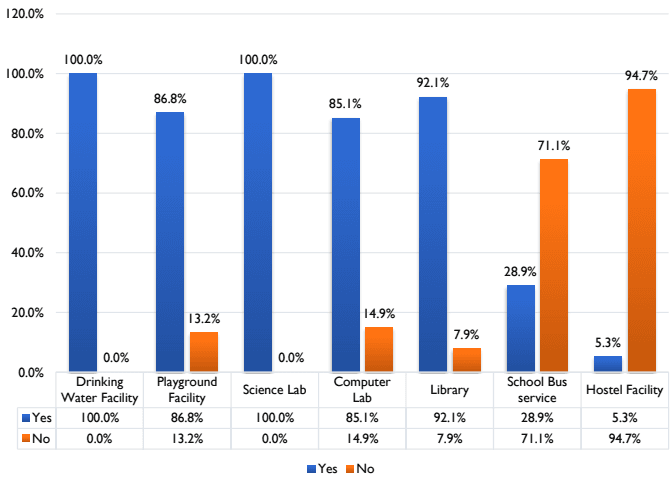
The various facilities available at schools were assessed on the basis of parameters like playground, drinking water, science lab, computer lab, hostel, school bus, etc. Most of the schools are having playground and separate toilet facilities within their school premises. However certain institutions lack facilities such as libraries, school bus, hostels etc. b shows the details of available infrastructure facilities at Government and aided schools in Kochi corporation.
Infrastructure Facilities in Govt. & aided schools in Kochi corporation
Figure 15:4 Infrastructure Facilities available at schools in Kochi corporation Source: DDE Ernakulam, 2016-2017
Most of the schools are equipped with laptop, projector, speakers, and internet connection in each class rooms for smart class room project by the Government. Details of schools equipped with the smart class rooms are given below.
Kochi Municipal Corporation
EDUCATION
Table 154 Details of Features Provided for Smart Class Rooms
Category of School
No. of Schools
Features Provided
Primary School (Upto 7th)
23
Smart class rooms with Laptop, Projector, Speakers and Internet
High School
44
Smart class rooms with Laptop, Projector, Speakers and Internet
Higher Secondary School
27
Smart class rooms with Laptop, Projector, Speakers and Internet
Higher Secondary School with VHSS
6
Smart class rooms with Laptop, Projector, Speakers and Internet
Source: Deputy Director of Education Ernakulam, 2020
15.5.2 Distance to Educational Facilities
All schools are well connected with motorable road having a width of 3m or more. Kochi city is well developed in terms of education facilities with a range of pre-primary to secondary education, technical educational institutions and professional colleges run by Govt., private & semi Govt. agencies
Even though there are sufficient numbers of schools in the city, the students opt for schools based on the quality of education and the syllabus followed. The infrastructure facilities provided in private schools attract students in the middle and upper class groups, whereas lower income groups prefer government institutions. Despite schools being well-distributed and easily accessible, various factors mentioned above dictate the choice in the selection of school resulting in students travelling more than 2 to 3km daily to schools.
15.5.3 Affordability of Education
Average monthly expenditure by the LIG on children’s education is Rs.360; MIG households spend Rs.350 per month and HIG households spend Rs.680 per month on children’s education. The poor spend up to Rs.135 per month on meeting children’s education expenses. The poor send their children either to government schools or aided schools where fees and other expenditures are low. LIG, MIG and HIG send their children to private/unaided schools. (Source: Kerala Sustainable Urban Development Project, May 2005).
Kochi Municipal Corporation
EDUCATION
15.5.4 Comparison to Standards
As per URDPFI guidelines, the numbers of existing educational facilities under various categories are assessed with respect to the population. On comparison, it is observed that the number of Pre-Primary and Primary schools are a deficit for the existing population. Special needs school like school for mentally challenged and physically challenged also fall short on existing requirement. The other categories are seen to be a surplus and cater to the requirements of the present population. The details of the assessment are shown below;
Table 155 Number of Schools comparison with URDPFI guidelines
The Union Cabinet has approved the new National Education Policy (NEP), 2020 with an aim to introduce several changes in the Indian education system - from the school to college level.
• The NEP 2020 aims at making “India a global knowledge superpower”.
The Cabinet has also approved the renaming of the Ministry of Human Resource Development to the Ministry of Education.
The NEP cleared by the Cabinet is only the third major revamp of the framework of education in India since independence.
464
The two earlier education policies were brought in 1968 and 1986.New Education Policy aims to facilitate an inclusive, participatory and holistic approach, which takes into consideration field experiences, empirical research, stakeholder feedback, as well as lessons learned from
Kochi Municipal Corporation
EDUCATION
best practices. It is a progressive shift towards a more scientific approach to education. The prescribed structure will help to cater the ability of the child – stages of cognitive development as well as social and physical awareness. If implemented in its true vision, the new structure can bring India at par with the leading countries of the world.
Additional schemes in educational sector are as given below
15.6.2 Public Education Rejuvenation Campaign
This Campaign of the General Education Department (GED) of Government of Kerala is an ambitious programme to elevate the selected 1000 Government schools to high educational standards.
The selected schools that fall within the planning area include
o Fort Kochi , Government EMG HSS and Elamakkara Government HSS to be developed as Centers of Excellence
o GGHSS, Ernakulam, Vennala Government HSS to have infrastructure Upgradation.
15.6.3 Akshaya Project
• Akshaya centres for citizen support will be implemented across select locations in the region.
The centres will provide a location for Tourist assistance and tourist information kiosk components under the smart city scheme.
15.6.4 It@school
It is an ICT driven school education scheme of the Government of Kerala. The ICT component under the Smart classroom component Smart City schemes shall be implemented with part funding under the scheme.
15.6.5 Project Roshni
It is a project for the educational upliftment of migrant children in primary classes by bridging the language barrier through pedagogical tool of code-switching.
The project is being implemented by the District Administration with funding from Bharat Petroleum Corporation (BPCL) under its Corporate Social Responsibility Initiative
• It is currently running in 40 schools covering over 1000 migrant students
Kochi Municipal Corporation
EDUCATION
On-going Projects
CSML has taken few projects for the upgradation of facilities of school infrastructure within the Kochi Corporation and details of the projects are as listed in Table 15-6.
Table 156 CSML Projects
Project Name
Project Estimated Cost
Higher secondary block, Central Calvathy GHSS, Fort Kochi
4.67 Cr
Smart Classroom for 100 classrooms PAN city
4.90 Cr
CIVIL - Anganwadis and public schools Upgradation of facilities - Basic services, Libraries, Eco-toilets, Sports kits, Biogas plant, Urban farming etc
1.00 Cr
Source: CSML, 2019
Kerala government has launched a new project aimed at infrastructure development in government schools in the state using KIIFB fund. This ambitious programme is expected to elevate these schools to high educational standards, considering the requirements of the schools over a twenty-year horizon. The various schemes under the project is given below
Rs. 5Cr Category (Centres of excellence)
Rs. 3Cr Category (Betterment of Infrastructure Facilities)
Rs. 1Cr Category
Table 157 KIIFB funded schools in Cochin corporation
School Name
Scheme
SPV
Edward Memorial Govt. HSS Veli, Fort Cochin, Ernakulam
5 Cr
KITE
S.R.V. Govt. Model. H.S.S And V.H.S.S Ernakulam
1 Cr
KILA
Govt Girls H S S, Kochi, Ernakulam
3 Cr
KILA
Govt HSS, Edappalli,Ernakulam
5 Cr
KITE
Govt. H.S.S And V.H.S.S. Edappally North
1 Cr
KILA
Govt. H.S.S. Vennala
3 Cr
INKEL
Govt. H.S.S. Elamakkara
5 Cr
KITE
Model Technical HSS Kaloor
1 Cr
KILA
Source: Sametham, Kerala School Data bank; General Education Department Kerala
Kochi Municipal Corporation
EDUCATION
General Education Status
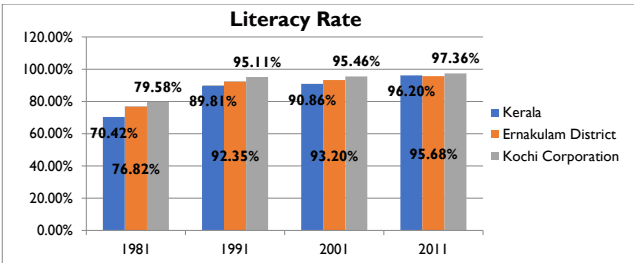
The general education status is assessed based on literacy rate, number of educational institutions and educational status. The literacy rate of Kochi Corporation as per 2011 census is 97.36% which is higher than district rate of 95.89% as well as the state literacy rate of 94%. The phenomenal raise in literacy rate from 80% in 1981 to 92% in 1991 shows the improvement in the education sector over the years in Ernakulam district. The literacy rate of the planning area over past decades is shown in Figure 15-1.
Figure 15:1 Literacy Rate comparison of Kochi with district and state Source: Census of India 2011
15.8Issues
On analysis, certain hierarchies of educational facilities fall short on the requirement of the existing population. The categories are Pre-Primary and Primary school. There exists a shortfall of 165 and 54 number respectively in each category. There also exists infrastructure disparities among private schools and Government schools.
This difference forms a prominent criteria for a higher percentage of students opting for private schools. This higher dependency can be balanced through adequate provision of infrastructure facilities and upgradation of existing facilities in all schools within Kochi Corporation.Due to lack of proper drainage, proper functioning of some schools in the Cochin Corporation were severely affected by gushing waters entered the school premises during heavy rainfall. Also, during heavy rains, the drainage canals in the school premises overflows and sewage enters the school grounds, causing unsanitary conditions.
To prevent this proper drainage facilities should be provided in the affected schools. In order to achieve Sustainable Development Goal in education sector, improving access to and quality of education for children with disabilities is paramount. Children with disability remain one of the main groups being widely excluded from quality education and disability is often recognised as one of the least visible yet most potent factors in educational marginalisation.
Presently in Kochi Corporation, the number of schools for physically and mentally challenged students falls short on the requirement. This is a major issue within the city and steps need to be taken to ensure inclusive and integrated education for all.
Potentials
The higher order hierarchies of educational institutions in the planning area and in the peripheries have a catchment area that extends to a regional and international scale. Kochi Corporation thus offers immense potential to be developed as an education hub at various scales. Opportunities exist in cross-sectoral integration resulting in the development of childfriendly streets and the provision of adequate recreational facilities that can help in the holistic development of a child within the city.
The higher education facilities in the planning area and its peripheries not only serve the region, but also are attractive for national and international scholars. As the details of schools in the private sector are not available, the adequacy of the infrastructure in this sector could not be assessed. Nevertheless, from socio-economic survey and other investigations, the educational facilities in the planning area are found to be adequate. But, many of the schools
Kochi Municipal Corporation
EDUCATION
in govt. /aided sector in the planning area are struggling due to infrastructural shortcomings, which invite urgent attention.