The migration of Konkanis to Kerala was led by SaraswatBrahmins, Sonars(goldsmiths), Kudumbis (manual workers), Vaniyars (traders), and Devadasis who accompanied them.Thirumala Devaswom, which is called Gosripuram, is the socio-religious nerve centre of the Konkanis in Mattancherry. It also serves as the headquarters of all migrated Konkanis in Kerala. They established a temple in the late half of 16th century with the help of Raja of Cochin. The major development occurred around this Konkani temple and this is the main social space in their settlement where they meet for common functions .The Saraswat Brahmins live around Gosipuram, while the Kudumbis and others live in the periphery. There is an unwritten rule among the Saraswat Brahmins that prohibit members not to sell their land or buildings to outsiders.The locations of all houses are based on the position of this temple. As in Tamil Agraharam, here the street is a major living space. In this settlement also, religion plays a wide role in determining the form and character of each space.With the help of the rulers and the Dutch merchants they flourished in their business. The rulers gave the Konkanis free hand in the business, which helped them control the trade globally. Today, there are 30,000 Konkanis in Mattancherry. The TD School they established at Mattancherry is today a major centre of learning in Kochi. Besides, they set up many other schools and colleges not only in Kochi but also in the nearby areas.The elephant procession that later become an integral part of Hindu festivals in the state is also a contribution of the Konkanis.
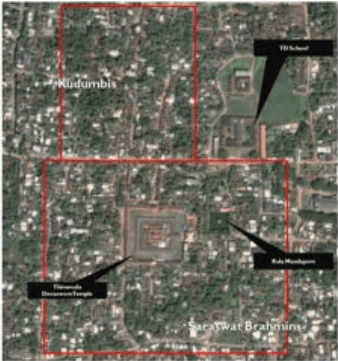
Figure 9:16 Konkani Brahmin settlements and their landmarks Source: Generated from land use survey and google imagery
While the Saraswat Brahmins have prospered, the benefits of their prosperity were not passed on to the Kudumbis, who had accompanied them in the migration.
Kochi Municipal Corporation
HERITAGE
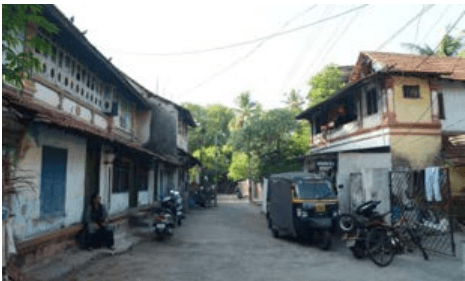
Kudumbi settlements in Mattanchery
9.4.4 Place assets – Canal Network
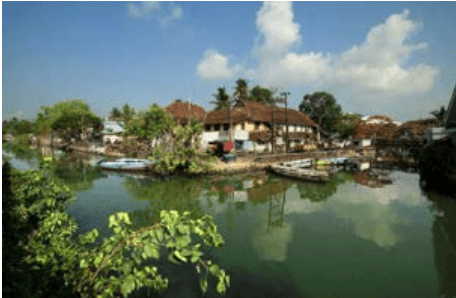
Calvetti canal
Calvetti Canal is one of the important landmarks in Kochi. At one end, Calvetti Canal meets the magnificent Vembanad Lake, where the river Periyar merges with the Arabian Sea. This canal effectively separates Fort Kochi from Mattancherry. Calvetti Bridge, the bridge over Calvetti Canal, which was built by the British in 1939, connects Fort Kochi and Mattancherry. The banks of the Calvetti Canal became, for centuries, the hub of Kerala’s spice trade. Traders from various parts of the world anchored their ships near Calvetti to conduct their business in Kochi. The Arabs were followed by traders from China and Portugal, and from the seventeenth century onwards the Dutch and the British.
River Periyar played an important role in making Kerala, especially Kochi, a centre for spice trade. Goods were brought in traditional wooden boats (vallom or vanchi in Malayalam). They
Kochi Municipal Corporation
HERITAGE
would reach Vembanad Lake and then navigate through the Calvetti Canal to get to the appropriate warehouse to offload their wares. Goods would come to Calvetti by country boats and were stocked in various godowns and warehouses built on the banks of Calvetti Canal. From Calvetti, spices were transported to different parts of the world by ships.
The canal merges with the Vembanad Lake near the present Fort Kochi boat jetty. Here, the 15 meter long Calvetti Bridge serves as the all-important connection between Fort Kochi and Mattancherry. Historically, this bridge used to connect what was then British Kochi (since it was directly under British control) with the native state under the control of King of Kochi. The canal was used by traders until the 1970s, and now remains the chief waterway through which fishermen access the lake to bring in their catch for the day.
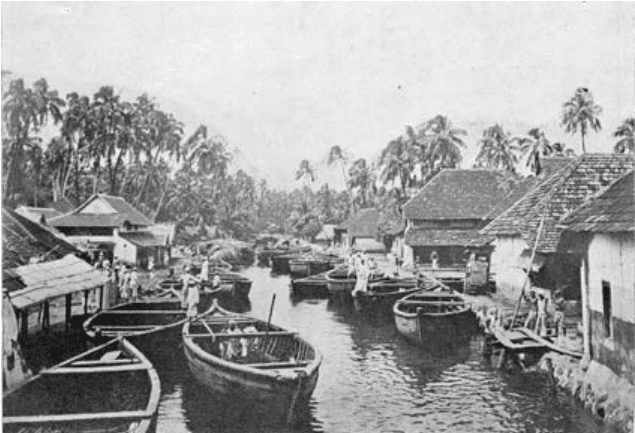
Canal through Cochin Town
Source: Negative by Charley Brown, Madras