For the purpose of this Part, the definitions given in Part 1/Section 2 of the Code shall apply.
Loading…
3.1 Installations in agricultural premises shall be broadly classified into:
a) Farm houses and agricultural processing units, and
b) Livestock houses.
Farm houses and agricultural processing units are premises where livestock are not normally present and are those utilized solely for the purposes of handling, processing or storing farm inputs and produce.
Livestock houses are premises where livestock are present for long periods of time during the day (such as in a dairy farm) with or without associated farm units.
3.1.2.1 Livestock houses are further classified depending on the type of climatic conditions:
a) Plain areas with moderate rainfall,
b) Arid areas and high altitude areas, and
c) Heavy rainfall areas and high rainfall humidity areas.
3.1.2.2 Livestock houses can also be classified depending on the type of animal or bird housed. For example:
| Animal/Bird Housing | Sub-classification | |
| Poultry housing | Layer house Brooder house | Stationary portable |
| Sheepfolds (sheep and goats) piggeries horse stables or equine houses Cattle housing | ---Cattle sheds for average farmer (3 milk animals with their calves and pair of bullocks) Cattle sheds for rural milk producer (average of about 20 animals) Organized milk produces (130 animals) Large dairy farm (about 500 animals) | |
1.1 This Part of the National Electrical Code of India (Part 6) covers requirements for the fixed electrical installations in agricultural premises excluding dwellings or similar locations situated in these premises.
1.2 This Part applies to premises where livestock are present.
NOTE — Examples of such premises are stables, cow houses, sheepfolds, stalls, hen-houses, piggeries, etc.
5.1 Information shall be exchanged among the people concerned on the electrical needs of the premises before installation work begins. Each installation may have to cater to the services required in the subunits of the premises which depend on the type of agricultural premises as enumerated in 4.
5.1.1 In agricultural farms the following sub-units are present:
a) Outdoor processing,
b) Indoor processing,
c) Heating/cooling,
d) Cold storage,
e) Stores, and
f) Office.
5.1.2 In sheepfolds, the following sub-units are present:
a) Sheds, such as flock shed, ram or buck shed, sick shed, etc;
b) Sheering and store room; and
c) Shepherd house.
5.1.3 In cattle housing, the following sub-units are present:
a) Sheds for animals,
b) Milk recording and testing room,
c) Utensils room,
d) Ration room,
e) Stores, and
f) Office.
a) Animal sheds before slaughter,
b) Slaughter shed,
c) Flaying, dressing and washing,
d) By-products handling,
e) Inspection,
f) Laboratory, and
g) Office.
5.2.1 Main switchgear shall not be installed:
a) within reach of livestock, or
b) in any position where access to it may be impeded by livestock.
5.2.2 Where an installation serves more than one building, it shall be possible to isolate and control the buildings individually.
5.2.3 Means of access to all live parts of switchgear and other fixed live parts where different nominal voltages exist shall be marked to indicate the voltages present.
5.2.4.1 All cables shall be placed out of reach of livestock and clear of all vehicular movement.
5.2.4.2 Where additional protection against mechanical damage to cables is required, it shall, wherever possible, be provided by the use of non-metallic materials.
5.2.4.3 Where long runs of cable must be placed along the sides of buildings, they shall wherever possible be placed on the outside of the buildings, and as high as practicable.
5.2.4.4 Where conductors or cables are carried overhead supported by buildings or by poles, the minimum height above ground shall be 6 m.
In locations accessible to, and enclosing, livestock wiring systems shall be erected so that they are inaccessible to livestock or suitably protected against mechanical damage.
Overhead lines shall be insulated.
In areas of agricultural premises, where vehicles and mobile agricultural machines are operated, the following methods of installation shall be applied:
a) Cables to be buried in the ground at a depth of at least 0.6 m with added mechanical protection;
NOTE — Where conduits are used as additional protection, they should provide a degree of protection against compression of 450 N and a normal degree of protection against impact according to IS 16205 (Part 24).
SP 30 : 2023
b) Cables in arable or cultivated ground to be buried at a depth of at least 1 m; and
c) Self-supporting suspension cables to be installed at a height of at least 6 m.
NOTE — Cables buried in the ground is the preferred method of installation.
5.2.4.6 Wiring systems supplying main distribution boards at the origin of the electrical installation, if not protected by RCDs, shall be protected against mechanical damage, for example, buried in the soil or installed in separated enclosed cable trunking or ducting systems.
This requirement shall also apply to residences and other locations belonging to agricultural or horticultural premises.
5.2.4.7 Special attention shall be given to the presence of different kinds of fauna, for example, mice and rats.
For locations where livestock is kept, external influences shall be classified AF4, and conduits shall have protection against corrosion of at least Class 2 (medium) for indoor use and Class 4 (high protection) outdoor according to IS 16205 (Part 21).
For locations where the wiring system may be exposed to impact and mechanical shock due to vehicles and mobile agricultural machines etc., the external influences shall be classified AG3:
a) conduits shall have a degree of protection against compression of at least Class 4 (heavy) according to IS 16205 (Part 21);
b) cable trunking and ducting system shall provide a heavy degree of protection against impact according to IS 14927 (Part 2).
Equipment shall be so selected that they suit the environmental conditions of use and shall be installed in such a way that their normal functioning is not affected by the external influences enumerated in 4.
5.3.1 It is recommended to protect final sub-circuits by residual current devices, the rated operating residual current not exceeding 30 mA and as low as practicable but avoiding nuisance tripping.
In agricultural or horticultural premises, electrical equipment shall have a minimum degree of protection of IP 44, when used under normal conditions. Where equipment of IP 44 rating is not available, it shall be placed in an enclosure complying with IP 44.
Socket-outlets shall be installed in a position where they are unlikely to come into contact with combustible material. Where there are conditions of external influences >AD4, >AE3 and/or >AG1, socket outlets shall be provided with the appropriate protection.
Protection may also be provided by the use of additional enclosures or by installation in building recesses.
These requirements do not apply to residential locations, offices, shops and locations with similar external influences belonging to agricultural and horticultural premises where, for socket-outlets IEC 60884-1 applies.
Where corrosive substances are present for example, in dairies, byres, the electrical equipment shall be adequately protected.
Earthing arrangements, protective conductors and protective bonding conductors
Protective (equipotential) bonding conductors shall be protected against mechanical damage and corrosion, and shall be selected to avoid electrolytic effects.
For example, the following may be used:
a) hot-dip galvanized steel strip with a dimension of at least 30 mm × 3 mm,
b) hot-dip galvanized round steel with at least 8 mm diameter,
c) copper conductor having a minimum cross-sectional area of 4 mm2, and
d) copper coated steel conductor with at least 6 mm diameter.
Other suitable materials may be used.
Socket-outlets of agricultural and horticultural premises shall comply with:
a) IS/IEC 60309-1,
b) IS/IEC 60309-2 when interchangeability is required, or
For the application of protective measure by safety extra-low voltage in locations in which livestock are present or situated outside, protection against direct contact shall be provided by:
a) barriers or enclosures affording at least the degree or protection IP2X, or
b) insulation capable of withstanding a test voltage of 500 V for 1 min.
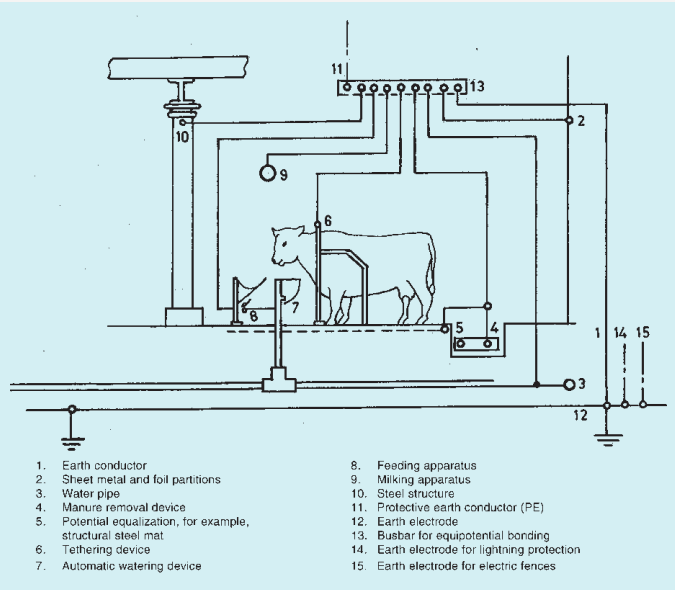
Fig. 1 Example of Equipotential Bonding on Agricultural Premises
For achieving protection by automatic disconnection of supply, the conventional voltage limit in locations in which livestock are present or situated outside is U = 25 V. These conditions are also applicable to locations directly connected through extraneous conductive parts to the locations where livestock are present.
Where electrical equipment is installed in livestock building, supplementary equipotential bonding shall connect all exposed conductive parts which can be touched by livestock and the protective conductor of the installation.
NOTE — A metallic grill connected to the protective conductor laid in the floor is recommended (see Fig. 1).
In circuits, whatever the type of earthing system, the following disconnection device shall be provided:
a) in final circuits supplying socket-outlets with rated current up to 32 A, a RCD with I∆ n not exceeding 30 mA;
b) in final circuits supplying socket-outlets with rated current more than 32 A, a RCD with I∆ n not exceeding 100 mA; and
c) in all other circuits RCDs with I∆ n not exceeding 300 mA.
NOTE —Where improved continuity of service is required, RCDs with a rated residual operating current up to 300 mA should be of the S type or time delayed.
5.4.2.4 Where the protective measure SELV or PELV is applied, whatever the nominal voltage, protection against direct contact (basic protection) shall be provided by one of the following measures:
a) barriers or enclosures affording a degree of protection of at least IP XXB or IP 2X, or
b) insulation capable of withstanding a test voltage of 500 V a.c. r.m.s for 1 min.
General guidelines on the assessment of general characteristics of buildings are given in Part 1/Section 8. For the purpose of installations covered by this Part the conditions given below apply.
The following conditions generally apply:
| Environment | Characteristics | Remarks |
| (1) | (2) | (3) |
| Presence of water | Possibility of splashes from any direction | Locations where equipment maybe subjected to splashed water, for example external lighting fittings |
| Possibility of jets of water from any direction | Locations where hose-water is used regularly | |
| Presence of foreign solid bodies | Presence of dust in significant quantity | Applies to barns, stores and stalls |
| Presence of corrosive or polluting substances | a) Intermittent or accidental subjection to corrosive or polluting substances | Applies to locations in which livestock are present or fertilizers or plan protective products are stored or handled |
| b) Continuously subjected to corrosive or polluting substances | ||
| Presence of flora and/or mould growth | Harmful hazard present | - |
| Presence of fauna Electromagnetic influences | Harmful hazard present | Insects, birds and small animal |
| Harmful presence of induced currents |
The following conditions apply:
| Utilization | Characteristics | Remarks |
|---|---|---|
| Electrical resistance of human body | Low to resistance due to wet conditions | - |
| Contact of persons with earth potential | Persons are frequently in touch with extraneous conductive parts or stand on conducting surfaces | |
| Conditions of evacuation during emergency | Low density occupation difficult conditions of evacuation High density occupation easy conditions of evacuation | Special precautions to be taken where animals are present |
| Nature of processed or stored materials | Flammable material including dust | Barns |
| Building design | Propagation of fire is facilitated and risks due to structural movement of structures which are weak |
Persons and livestock shall be protected against injury and property shall be protected against damage due to excessive temperatures or electromechanical stresses caused by any overcurrent likely to arise in conductors.
Protection can be achieved by limiting the overcurrent to a safe value or duration.
SP 30 : 2023
NOTE — Where electronic equipment is used, it is recommended to provide protective measures against lightning according to IS/IEC 62305-3 and IS/IEC 62305-4 and against overvoltage according to 4.5.3 of IS 732 and 5.3.5 of IS 732.
Conductors, other than live conductors, and any other parts intended to carry a fault current shall be capable of carrying that current without attaining an excessive temperature. Electrical equipment, including conductors shall be provided with mechanical protection against electromechanical stresses of fault currents as necessary to prevent injury or damage to persons, livestock or property.
Live conductors shall be protected against overcurrent arising from faults by the methods in 4.1.2.4 of IS 732.
NOTE — Particular attention should be given to PE conductor and earthing conductor currents.
6.3.1 Persons and livestock shall be protected against injury and property shall be protected against any harmful effects as a consequence of a fault between live parts of circuits supplied at different voltages.
6.3.2 Persons and livestock shall be protected against injury and property shall be protected against damage as a consequence of overvoltage, such as those originating from atmospheric events or from switching.
NOTE — For protection against direct lightning strikes, see IS/IEC 62305 series.
6.3.3 Persons and livestock shall be protected against injury and property shall be protected against damage as a consequence of under voltage and any subsequent voltage recovery.
6.3.4 The installation shall have an adequate level of immunity against electromagnetic disturbances so as to function correctly in the specified environment. The installation design shall take into consideration the anticipated electromagnetic emissions, generated by the installation or the installed equipment, which shall be suitable for the current-using equipment used with, or connected to, the installation.
This Part of the Code is primarily intended for covering the specific requirements of electrical installations in agricultural premises which include premises where livestock are present and farm produce are handled or stored. With the increase in sophistication in organizing the farm output of the country, and the use of electricity for certain essential purposes, it has been felt necessary to cover the requirements of such installations as a part of the Code.
Installations in agricultural premises are different from those covered in other Sections of the Code in that the external influences on the electrical services are quite different from those encountered elsewhere. Even though the overall power requirements for such installations would be small, the presence of livestock and other extraneous factors necessitate laying down specific requirements.
For fire safety purposes, a residual current protective device shall be installed having a rated residual operating current of 0.5A. Devices for emergency electrical switching including emergency stopping shall not be installed within reach of livestock or in any position where access to them may be impeded by livestock, account being taken of the condition likely to arise in the event of panic by livestock.
Farm houses and livestock houses do not in general require sophisticated electrical services, but in the case of the latter, lack of proper ventilation or lighting leads to insanitation and discomfort to the livestock thereby leading to retarded growth, high mortality or poor fertility. The houses are required to be maintained reasonably cool in summer and warm in winter, with a regular supply of fresh air and light. The guidelines given in 9.1 to 9.3 shall be adhered to.
A minimum of 14 h day length shall be provided to the birds and artificial lighting shall be provided for the same. For the purposes, 1 W (GLS) or 0.75 W (fluorescent) per bird or 1 W per 28-38 cm are considered adequate. The light sources shall be hung at a height not less than 1.8 m above floor. For poultry sheds of 6 m width and below, one row of bulbs in the centre shall be adequate. For sheds of larger width two rows of lamps properly interspaced may be desirable.
In meat houses and abattoirs, in halls where meat or carcasses are hung, a temperature of not greater than 10°C would be required and air-conditioning may be required. In unrefrigerated work rooms, ample artificial light and ventilation shall be provided by electrical means. The overall intensity in every abattoir shall not be less
than 200 lux throughout the slaughter hall and workroom and at places where meat inspection is carried out, the illumination shall be at least 500 lux.
In large dairy farms, roof-lights shall be provided to give 50-200 lux of artificial lighting. The lamps shall be hung at a height not less than 2 m above floor level.
For large scale livestock keeping, such as in a dairy farm, it shall be essential to provide:
a) a warning device for indicating failure of air circulation system; and
b) for continuity of supply, a fast acting emergency supply system is recommended.
Where electric fences are in the vicinity of overhead lines, appropriate distances shall be observed to take account of induction currents, falling lines, etc.
Any earth electrode connected to the earth terminal of an electric fence controller shall be separate from the earthing system of any other circuit and shall be situated outside the resistance area of any electrode used for protective earthing.
11.2 Circuits of wirings which are only occasionally used, for example, during threshing time, shall be fitted with a separate switch marked accordingly.
SP 30 : 2023
c) relevant national standards provided the rated current does not exceed 20 A.
For high density livestock rearing, systems operating for the life support of livestock shall be taken into account as follows:
a) Where the supply of food, water, air and/or lighting to livestock is not ensured in the event of power supply failure, a secure source of supply shall be provided, such as an alternative or back-up supply (see also 5.5.2 of IS 732). For the supply of ventilation and lighting units separate final circuits shall be provided. Such circuits shall only supply electrical equipment necessary for the operation of the ventilation and lighting.
b) Discrimination of the main circuits supplying the ventilation shall be ensured in case of any overcurrent and/or short-circuit to earth.
c) Where electrically powered ventilation is necessary in an installation one of the following shall be provided:
NOTE — For the functional efficiency, a notice should be placed adjacent to the stand-by electrical source, indicating that it should be tested periodically according to the manufacturer’s instruction.
NOTES
1 Consideration should be given to legal requirements for the keeping of livestock.
2 The reliability of the installation for ventilation will be increased if, for this purpose, separate supply circuits are erected downstream from the main distribution board.
Luminaires shall comply with the IEC 60598 or IS 10322 series and be selected regarding their degree of protection and surface temperature according to the conditions of the surrounding areas and the places of installation (for example, IP 54, suitable temperature marking for mounting on combustible material).
In areas where a fire risk and a danger from a combustible coating of dust exist, only luminaires marked in accordance with IEC 60598-2-24, luminaires with limited surface temperature, shall be used.
Luminaires marked shall only be installed if the luminaire containing the lamps are in compliance with the degree of protection IP 54.
Luminaires shall be mounted at places where a sufficiently large distance from combustible materials is ensured taking into account the storage of goods and other dangerous work processes.
NOTE S f ty di t gi i th f t ‘ i t ti f ti g. F th , f i d 4.3.2 f IS 732. — a e s ances are ven n e manu ac urer s ns ruc ons or moun n ur ermore re erence s ma e o
The switched conditions (on or off) of luminaires installed in hay or straw storage places or similar locations, shall either be recognizable at the location of the switch or indicated there by a visible signal.
In locations intended for livestock, supplementary bonding shall connect all exposed-conductive-parts and extraneous-conductive-parts that can be touched by livestock. Where a metal grid is laid in the floor, it shall be included within the supplementary bonding of the location (see figures of Annex A).
Extraneous-conductive-parts in, or on, the floor for example, concrete reinforcement in general or reinforcement of cellars for liquid manure, shall be part of the supplementary equipotential bonding.
It is recommended that spaced floors made of prefabricated concrete elements be part of the equipotential bonding (see Fig. A-3). The supplementary equipotential bonding and the metal grid, if any, shall be erected so that it is durably protected against mechanical stresses and corrosion
The electrical installation shall be so arranged to minimize the risk of damage or ignition of flammable materials due to high temperature or electric arc. In addition, during normal operation of the electrical equipment, there shall be no risk of persons or livestock suffering burns.
5.4.4.2 For fire protection purposes, RCDs shall be installed with a rated residual operating current not exceeding 300 mA (see 705.411 of IEC 60364-7-705). RCDs shall disconnect all live conductors. Where improved continuity of service is required, RCDs not protecting socket-outlets shall be of the S type or have a time delay.
NOTE — The protection of the final circuits by RCD required according to 705.413.1 of IEC 60364-7-705 is also effective for protection against fire.
5.4.4.3 In locations where a fire risk exists conductors of circuits supplied from extra low voltage shall be protected either by barriers or enclosures affording a degree of protection according to IP XXD or IP 4X or in addition to their basic insulation by an enclosure of insulating material.
5.4.5 Electrical heating appliances used for the breeding and rearing of livestock shall comply with IEC 60335-2-71 and shall be fixed mounted in an appropriate position in order to avoid:
a) any risk of burns to livestock, and
b) any risk of fire by ignition of combustible material.
Radiant heaters shall be installed at a distance of at least 0.5 m from livestock and from combustible material unless a greater distance is specified by the manufacturer of the apparatus in the instructions for use.
5.4.5.1 For fire protection purposes, RCDs shall be installed with a rated residual operating current not exceeding 300 mA (see 705.411 of IEC 60364-7-705). RCDs shall disconnect all live conductors. Where improved continuity of service is required, RCDs not protecting socket-outlets shall be of the S type or have a time delay.
NOTE — The protection of the final circuits by RCD required according to 705.413.1 of IEC 60364-7-705 is also effective for protection against fire.
5.4.5.2 In locations where a fire risk exists conductors of circuits supplied from extra low voltage shall be protected either by barriers or enclosures affording a degree of protection according to IP XXD or IP 4X or in addition to their basic insulation by an enclosure of insulating material.
(Normative)
Protective Measures for Application Only When the Installation IS Controlled or under the Supervision of Skilled or Instructed Persons
Protection by non-conducting location is not permitted.
Protection by earth free equipotential bonding is not permitted.
IS/IEC 60309-1 : 2002 Plugs, socket-outlets and couplers for industrial purposes: Part 1 General requirements
IS/IEC 60309-2 : 2002 Plugs, socket-outlets and couplers for industrial purposes: Part 2 Dimensional interchangeability requirements for pin and contact-tube accessories
IEC 60335-2-71 Household and similar electrical appliances — Safety — Part 2-71: Particular requirements for electrical heating appliances for breeding and rearing animals
IEC 60364-5-53 Low-voltage electrical installations of buildings — Part 5-53: Selection and erection of electrical equipment — Isolation, switching and control
IEC 60364-5-55 Low voltage electrical installations — Part 5-55: Selection and erection of electrical equipment — Other equipment
IS 10322/IEC 60598 Luminaires (all parts)
IEC 60598-2-24 Luminaires — Part 2-24: Particular requirements — Luminaires with limited surface temperatures
IEC 60884-1 Plugs and socket-outlets for household and similar purposes — Part 1: General requirements
Free Standard provided by BIS via BSB Edge Private Limited to self-developer - SP bengaluru(shivaprasad.safare@tandemloop.in) 49.204.144.146.
NATIONAL ELECTRICAL CODE OF INDIA PART 7 ELECTRICAL INSTALLATIONS IN HAZARDOUS AREAS
Metallic grid with at least two welding joints laid in the floor to form an extraneous conductive part for the purpose of equipotential bonding.
On parts of galvanized steel, no copper conductors are fixed.
Only materials resistive to corrosion are used for earthing arrangement.
Mesh dimensions of metallic grid made of round rods are approximately 150 mm X 150 mm.
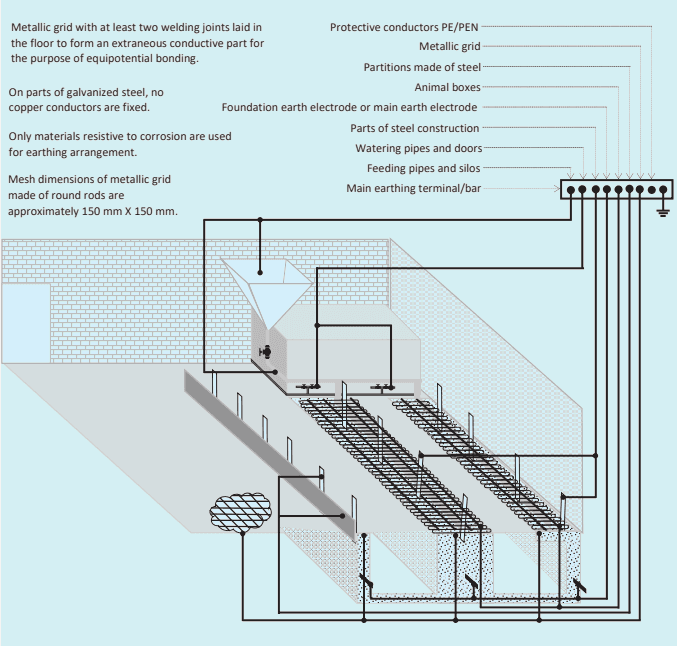
Fig. A-1 Example of Equipotential Bonding Within Cowshed
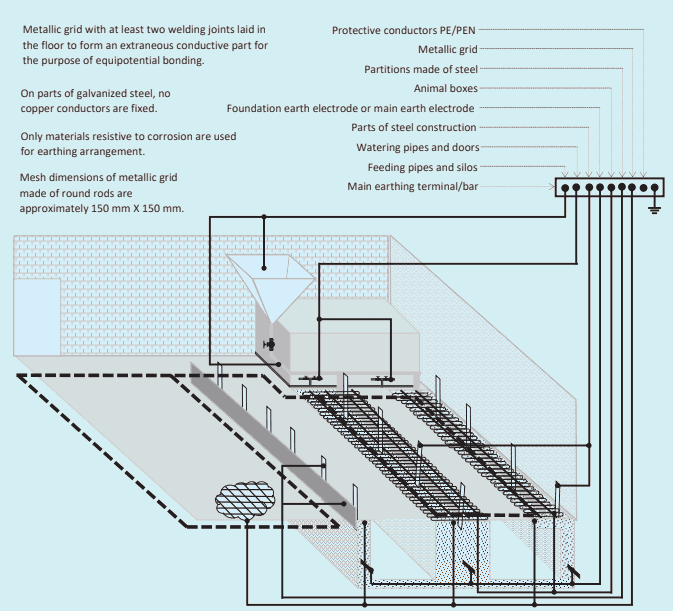
Fig. A-2 Example of Equipotential Bonding Formed As Ring Within Cowshed
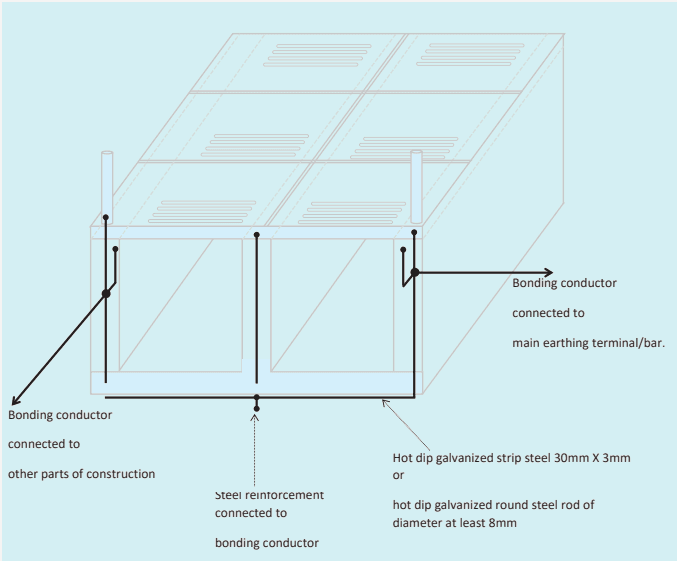
Fig. A-3 Example of Equipotential Bonding to Concrete Construction with Spaced Floor for Collection of Manure
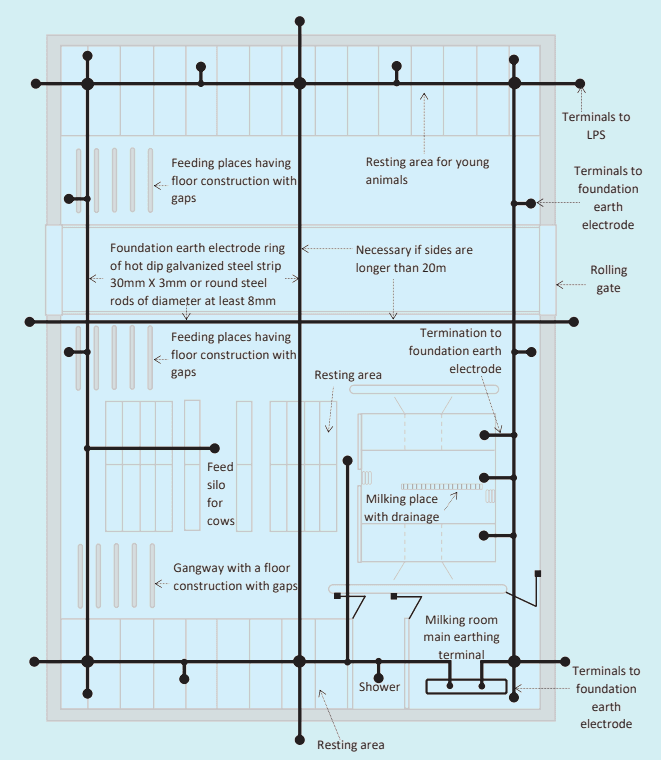
Fig. A-4 Example of Arrangement of Foundation Earth Electrode within A Cowshed
SP 30 : 2023