For the purpose of this Section, the following terms together with those provided in IS 1885 (Part 16/Sec 2) shall apply.
3.1 Terms Relating to Highways
3.1.1 Highway — A way for the passage of vehicular traffic over which such traffic may lawfully pass.
3.1.2 Layout — All those physical features of a high way other than the surfacing of the carriage way, which must be considered in planning a lighting installation.
3.1.3 Carriageway — That portion of a highway intended primarily for vehicular traffic.
3.1.4 Dual Carriageway — A layout of the separated carriageways, each reserved for traffic in one direction only.
SP 30 : 2023
3.1.5 Central Reserve — A longitudinal space dividing a dual carriageway.
3.1.6 Service Road — A subsidiary road between principle road and buildings or properties facing thereon or a parallel road to the principal road and giving access to the premises and connected only at selected points with the principle road.
3.1.7 Cycle Track — A way or part of a highway for use by pedal cycles only.
3.1.8 Footway — That portion of a road reserved exclusively for pedestrians.
3.1.9 Verge — The unpaved area flanking a carriageway, forming part of the highway and substantially at the same level as the carriageway.
3.1.10 Shoulder — A strip of highway adjacent to and level with the main carriageway to provide an opportunity for vehicles to leave the carriageway in an emergency.
3.1.11 Refuge — A raised platform or a guarded area so sited in the carriageway as to divide the streams of traffic and to provide a safety area for pedestrians.
3.1.12 Kerb — A border of stone, concrete or other rigid material formed at the edge of a carriageway.
3.2 Terms Relating to Lighting Installation. . p
3.2.1 Lighting Installation — The whole of the equipment provided for lighting the highway comprising the lamps, luminaires, means of support and electrical and other auxiliaries.
3.2.2 Lighting System — An array of luminaires having a characteristic light distribution sited in a manner concordant with this distribution (lighting systems are commonly designated by the name of the characteristic light distribution, for example, cut-off, semi-cut-off, etc.).
3.2.3 Luminaire — A housing for one or more lamps, comprising a body and any refractor, reflector, diffuser, or enclosure associated with the lamp(s).
3.2.4 Outreach — The distance measured horizontally between the centre of the column or wall face and the centre of a luminaire (see Fig. 1).
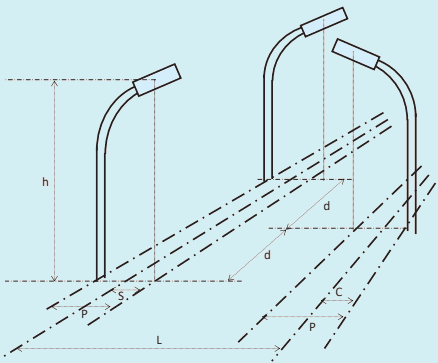
p= outreach, h = mounting height of luminaires, s = overhang, L = width of the carriage way d p = outreach, h = mounting height of luminaires, s = overhang, L = width of the carriage way d – Spacing, – Spc = clearance
Fig. 1 Siting of Luminaires Characteristic Dimensions
PART 5 OUTDOOR INSTALLATIONSy .
3.2.5 Overhang — The distance measured horizontally between the centre of a luminaire mounted on a bracket and the adjacent edge of the carriageway (see Fig. 1).
3.2.6 Mounting Height — The vertical distance between the centre of the luminaire and the surface of the carriage (see Fig. 1).
3.2.7 Spacing — The distance, measured along the centre line of the carriageway, between successive luminaires in an installation (see Fig. 1).
NOTE — In a staggered arrangement, the distance is measured, along the centre line of the carriageway, between a luminaire on one side of the carriageway and the next luminaire, which is on the other side of the carriage. It is not the distance measured on the diagonal joining them, nor the distance between successive luminaires on the same side of the carriageway.
3.2.8 Span — That part of the highway lying between successive luminaires in an installation.
3.2.9 Width of Carriageway — The distance between kerb lines measured at right angles to the length of the carriage way (see Fig. 1).
3.2.10 Arrangement — The pattern according to which luminaires are sited on plan, for example, staggered, axial, opposite.
3.2.11 Geometry (of a Lighting System) — The inter related linear dimensions and characteristics of the system, namely the spacing, mounting height, width, overhang and arrangement.
3.3 Photometric Terms
3.3.1 Luminous Flux — The light given by a light source or a luminaire or received by a surface irrespective of the directions in which it is distributed. The unit of the luminous flux is lumen (l m).
3.3.2 Lower Hemispherical Flux or Downward Flux — The luminous flux emitted by a luminaire in all directions below the horizontal.
3.3.3 Luminous Intensity — The quantity which describes the light-giving power of a luminaire in any direction. The unit of luminous intensity is Candela (cd).
3.3.4 Illumination — The luminous flux incident on a surface per unit area. The unit of illumination is lumen per square metre (lux).
3.3.5 Luminance (at a Point of Surface and in a Given Direction) — The luminous intensity per unit projected area of a surface. If a very small portion of a surface has an intensity I in a particular direction and its orthogonal projection (that is, its projection on a plane perpendicular to the given direction) has an area D, the luminance in this direction is I/D candelas per unit area. The usual unit is candela per square metre (cd/m2).
3.3.6 Luminosity — The attribute of visual sensation according to which an area appears to emit more or less light. It is sometimes called brightness.
NOTE — Luminosity is the visual sensation which correlates approximately with the photometric quantity ‘luminance’.
3.3.7 Light Output — The luminous flux emitted by a luminaire.
3.3.8 Light Distribution — The distribution of luminous intensity from a luminaire in various directions in space.
3.3.9 Symmetrical (Converse Asymmetrical) Distribution — A distribution of luminous intensity which is substantially symmetrical (conversely asymmetrical) about the vertical axis of the luminaire.
3.3.10 Axial (Converse Non-axial) Distribution — An asymmetrical distribution in which the directions of maximum luminous intensity lie (do not lie) in vertical planes substantially parallel to the axis of the carriageway.
3.3.11 Peak Intensity Ratio — The ratio of the maximum intensity to the mean hemispherical intensity of the light emitted below the horizontal.
3.3.12 Mean Hemispherical Intensity — The downward flux divided by 6.28 (2π) (this is the average intensity in the lower hemisphere).
3.3.13 Intensity Ratio (in a Particular Direction) — The ratio of an actual intensity from the luminaire (in a particular direction) to the mean hemispherical intensity.
3.3.14 Beam — The portion of the light output of the luminaire contained by the solid angle subtended at the effective centre of the luminaire containing the maximum intensity, but no intensity less than 90 percent of the maximum intensity.
3.3.15 Beam Centre — A direction midway between the directions for which the intensity is 90 percent of the maximum in a vertical plane through the maximum and on a conical surface through the maximum.
623
3.4 Terms Relating to Luminaires
3.4.1 Street Lighting Luminaire — A housing for a light source or sources, together with any refractor, reflector, dispersive surround or other enclosure which may be associated with the source in order to modify the light distribution in a desired manner and protect the light from weather conditions and insects and/or for the sake of appearance, brightness and other lighting characteristic the source.
3.4.2 Cut-off Luminaire — Luminaire employing the technique used for concealing lamps and surfaces of high luminance from direct view in order to reduce glare.
3.4.3 Semi-cut-off Luminaire — Luminaire employing the technique for concealing lamps and surfaces of high luminance from direct view in order to reduce glare but to a lesser degree than cut-off luminaire.
3.4.4 Integral Luminaire — Luminaire with all its accessories, such as ballasts, starters, igniters, capacitors, etc. However, integrally with the body of the luminaire.
3.4.5 Post Top Luminaire — Luminaire with arrangement for mounting the same symmetrically on the top of the column.