For assuring continuous safety, observing and complying with the schedules of maintenance is plays an important role. Owner of electrical installation shall be responsible to maintain the installation safe. Routine, preventive and predictive maintenance ensures keeping installation safe, avoid break-down maintenance; mitigate hazards like electric shock, electric arc flash and electrical fires which may result into loss of human life and loss of livestock in thousands, apart from loss and damages to property. This section covers guidelines on the aspect of safety related to electrical maintenance:
12.1 All maintenance activities in a low voltage installation shall be followed by the necessary tests as recommended in 6 of IS 732: 2019.
12.2 Maintenance can be broadly categorized into three types:
a) routine maintenance; which is of general nature, period and frequency of which shall be decided based on actual use, work conditions, site environment;
b) preventive maintenance; which shall cover protections, useful and safe working life of apparatus, equipment, component of system and recommended replacement in due time after expiry of that period; and
c) predictive maintenance; which is to be attended as and when abnormality indicative of future breakdown hazardous condition is noticed in visual inspection or in the routine tests.
12.3 Maintenance schedules of routine and preventive shall be prepared depending on installation. To assess conditions of installation, observations in periodical inspections comprising visual check and routine tests shall be recorded in standard forms/checklists. The defects noticed shall be attended on priority wise depending on the hazard.
12.4 Maintenance schedule in respect of electrical equipment/apparatus shall be followed as per the recommendations of manufacturer and relevant code of practice.
NOTE — Delays and connivance in attending defects due to lack of financial provision or otherwise, often leads to possible disaster. Under these circumstances, if it is seen that operation/function of such component of system/apparatus is risky, adequate alternative shall be chosen and use of same shall be curbed by keeping it isolated.
12.5 As per provision under Reg. 30 of CEA Safety Regulations, installation shall be certified/inspected by chartered electrical safety engineer or an electrical inspector as per the mandate of state government, depending on notified voltage level.
NOTES
1 Under CEA Safety Regulations for Inspection Reports, Forms I/II/III have been specified under schedule IV of the regulations, depending on voltage level.
2 Installations in domestic dwellings and small commercial establishments, shall be inspected, at least, once in five years. It is recommended that inspections in industrial and large commercial establishments, public entertainment places shall be done annually.
12.6 Installations where designation of electrical safety officer is necessary as per 4.6, it shall be his responsibility to interpret and comply statutory safety provisions, monitor the maintenance activities including periodical inspections of installation, arrange for inspection/testing at least once in year and to, further, check compliance against defects noticed/identified.
12.7 In case of supplier’s installation within the premises of consumer, supplier of electricity shall maintain the installation in safe condition up to the point of commencement of supply.
NOTE — As per the definition given under Reg. 16 of CEA Safety Regulations ‘point of commencement of supply’ shall mean the point at the incoming terminal of switchgear installed by consumer (immediate after energy meter).
12.8 Maintaining resistance value of the earthing system/equipotential bonding, considering loop impedance within permissible limits shall be a priority. To check and assess disconnection of supply with in the stipulated time, earth fault loop impedance test shall be taken at least once in a year. If vertical earth electrodes (such as rods/pipes/plates) are provided, resistance of these electrodes shall be tested. Continuity of earth conductor shall be checked and maintained intact. Connections at earth terminal shall be cleaned and tightened. Under the corrosive atmosphere, these points are of more importance.
12.9 Illumination level required for operation and maintenance of apparatus, equipment, system shall be maintained as per standards. Any depreciation in lux level, if noticed, shall be reinstated.
12.10 During visual inspection, surface wiring and cable work shall be checked to ensure that it is rigid and intact. There shall not be any loose wiring or open joints. Insulation shall be checked for damages, and reasons causing such damages, for example, due to contact with sharp edges, heat, rodents etc shall be adequately addressed. Necessary preventive action shall be taken.
12.11 All electrical panels shall be checked for ingress protection. Door gaskets shall be replaced wherever necessary. Smooth mechanical operation of panels like door opening/closing, racking in and out, locking system shall be ensured. Identification marking of all switchgears and circuits shall be adequate. Insulating mats, marking of approach boundaries (see Fig. 2) shall be intact in place.
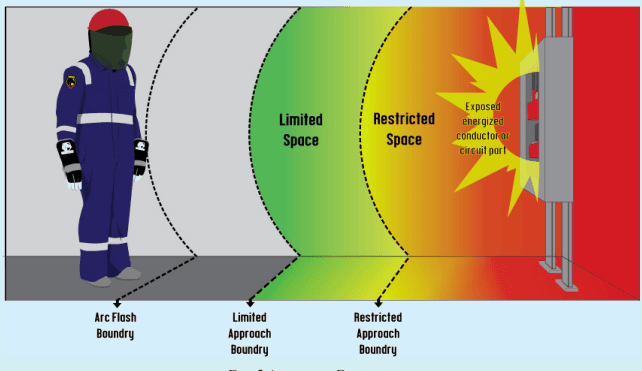
Fig. 2 Approach Boundaries
12.12 It shall be ensured that covers of switchgears, DBs, fuse cut out boxes etc are in place and door of electrical panels are closed/locked to avoid exposure to live parts.
12.13 Points of terminations, joints, loose contacts, corrosion and heating are common cause of electrical trouble. Such points shall be cleaned and tightened. Wherever necessary, use of bimetallic lugs shall be made. Continuity of conductors testing as specified in 6.2.3.2 of IS 732 shall be conducted in all final circuits. In case of major installations, hot spots in electrical panels/system shall be checked by thermal camera, and needful action be taken, if required.
12.14 All protective devices shall be calibrated tested and its proper coordination shall be verified, at least, once in two years or as and when found necessary. Changes, if required, in settings shall be made. Such records shall be preserved.
12.15 Tests related to harmonics shall be conducted, especially, where non-linear loads exist. Corrective action to mitigate effects and bring the values within permissible limit as per IEEE 519 shall be taken immediately.
12.16 Electric panel/switchgear room, meter room, ducts for electrical cables shall be for specific use only and always be maintained clean, no encroachment shall be allowed within, and easy access to same shall be maintained without any obstacles on its way.
12.17 Raceways installed below ground/false flooring shall be maintained clean and free from entry of rodents, water or other things which may cause damages to the cables.
12.18 Locations where access is restricted, it shall be checked that appropriate system to prevent entry of un authorised persons is in place and is in proper condition.
12.19 Wherever sub-stations, panel rooms are located in basement, seepages/leakages and working of de-watering system and its automation shall be checked periodically and particularly, in rainy season. Necessary action shall be taken, if not found in order.
12.20 Necessary precaution for oil filled transformers shall be taken in respect of its insulating properties, moisture content, oxidation and sludge, acidity, DDF, DGA, leakages if any and oil level shall be maintained.
12.21 Overhead lines shall be maintained and checked periodically for permissible sag, allowable joints, guarding arrangement, interference of trees, creepers, construction of unauthorised structures/storage below endangering clearances, encroachment on way, interference of other overhead services of LV systems, such as that of cables of TVs, internet, telephones using overhead line structures/crossing electric lines with unsafe clearances etc.
12.22 Condition of poles shall be checked, especially, metal tubular poles which are susceptible to corrosion which are prone to corrosion at the bottom, often due to missing pole caps leading to accumulation of water within.
12.23 Earthing of poles/OH line structures and other accessories shall be checked and tested. Counterpoise earthing shall be at required depth and unexposed.
12.24 Necessary repainting with anti-corrosive paint shall be done to protect overhead line poles/structures, as per necessity.
12.25 Required fencing/entry barriers for distribution transformer centres, switching stations, sub stations existing, especially, in public places shall be well maintained.
12.26 Operation of required and mandatory fire protection devices and systems shall be checked. Class of fire extinguishers shall be verified and refilled in due time. Fire drill shall be conducted as per schedule and record shall be preserved. Periodical training sessions of operating staff shall be conducted to handle the situation in case of fire emergency.
12.27 In case of maintenance of underground cable work after locating the fault and attending it by jointing, record shall be maintained along with geographical location and date of attending the fault.
12.28 Due to civil work, any change in the required minimum depth of cable shall be corrected/adequate preventive measures be taken.
12.29 Checking of strain relief arrangement of cables for not causing any load on terminals shall be ensured.
12.30 Special care for street feeder boxes shall be taken to keep the doors closed and locked. Earthing shall be intact with proper termination.
12.31 It shall be checked that all tools, tackles and PPE are kept in place, well maintained and in safe usable condition and sufficient in number. Visual checks and tests shall be carried out for confirmation. Storage place and arrangement shall be appropriated so as not to cause damage.
12.32 Batteries shall be maintained and shall be checked for swelling as per the schedule. Under normal conditions, batteries shall be replaced before expiry of recommended useful life. Battery rooms shall be kept clean and well ventilated.