For the purpose of this Part, the following definitions shall apply.
2.1 Access — Approach, entry, internal circulation or exit, including in cases of emergency.
2.2 Ageing — Getting old, specifically beyond the design life of the asset.
2.3 As-built Information — Expression of the design, its working detail, construction works and/or installations, functions, operations and maintenance needs of a facility in a form suitable for use in managing that facility.
2.4 Asset — A useful or valuable thing or an item of property owned by a person or organization, regarded as having value and life of more than one year, available to meet debts, commitments, or legacies and performing predetermined functions to facilitate the users.
2.5 Asset Life — Period from asset creation to end of its functional life.
2.6 Asset Register — A central database of information about asset/facility in terms of their manufacturer, vendor, make, model, specifications, date of acquisition, initial cost, maintenance costs and requirements, additions/alterations over period, accumulated depreciation and written down value.
2.7 Asset Type — Grouping of assets having common characteristics that distinguish those assets as a group or class, for example, physical assets, information
assets, intangible assets, critical assets, enabling assets, linear assets, information and communications technology (ICT) assets and infrastructure assets.
2.8 Asset/Facility Management — Integration of processes within an organization to maintain and develop the agreed services which support and improve the effectiveness of its primary activities.
2.9 Benchmarking — Comparing performance, often between companies in similar sectors.
2.10 Biodegradable Waste — Any organic material that can be degraded by microorganisms into simpler stable compounds.
2.11 Briefing — Briefing is the process of communicating the objectives and needs of an owner, or prospective owner, of a facility to a designer in order to prepare a design for that facility. This process includes clarification and confirmation of the owner's intentions and documenting the consequent provisions for the facility to enable informed decision making primarily in design, but also in construction work and/or installation, testing and commissioning, handover and start-up of operations. A number of stages are envisaged for preparing and applying the brief during design and in later phases.
2.12 Buffer Zone — A zone of no development which shall be maintained around landfills, processing and disposal facilities of solid waste.
2.13 Building Fabric — Elements and components of a building other than furniture and services installations.
2.14 Building Information Model (BIM) — Shared digital representation of physical and functional characteristics of any built object (including buildings, bridges, roads, etc) which forms a reliable basis for decisions.
NOTE — A building information model may embody, for example, building geometry, spatial relationships, geographic information and the quantities and properties of building components.
2.15 Building Maintenance Work undertaken to maintain or restore the performance of the building fabric and its services to provide an efficient and acceptable operating environment to its users.
2.16 Building Management System (BMS) — Computer aided control systems, including hardware and software, to collect and monitor parameters and performance data of plant, equipment, systems and elements either at source or remotely and to enable corrective action to be initiated.
2.17 Building Manual — Guidance to assist in making the best use of the design features, services and systems of a building or other facility.
2.18 Business Continuity Management (BCM) — Holistic management process that identifies potential threats to an organization and the impacts to business operations that those threats, if realized, may cause, and which provides a framework for building organizational resilience with the capability for an effective response that safeguards the interests of its key stakeholders, reputation, brand and value creating activities.
2.19 Carbon Emissions — Polluting carbon substances released into the atmosphere.
2.20 Carbon Footprint — Totality of greenhouse gas (GHG) emissions caused directly and indirectly by an individual, organization, event or product.
2.21 Cleaning — Locating, identifying and properly disposing of undesirable substances from surfaces or material.
2.22 Cleaning Services — Services undertaken to ensure the cleanliness, maintenance and aesthetic upkeep of the building/property.
2.23 Competent Person — Person, suitably trained and qualified by knowledge and practical experience.
2.24 Computer Aided Facilities Management (CAFM) — Systems, applications and tools that automate functions needed to support the core business in its efficient and effective use of facilities.
2.25 Computer Aided Maintenance Management System (CMMS) — System specifically designed to enable planning, organizing, directing and controlling maintenance programmes and to collect and collate historical data on the performance of assets so that the most effective maintenance method is selected under actual performance and environmental conditions.
2.26 Condition Monitoring — Act of measuring and recording data from operating parameters, using either human senses or instrumentation, to verify plant and equipment condition and trends. It is also the act of assessing an asset to understand how it is likely to perform in future.
2.27 Confined Space — Space which may be inadequately ventilated for any reason and may result in a deficiency of oxygen, or a build-up of toxic gases, for example, closed tanks, sewers, ducts, closed and unventilated rooms, and tanks particularly where heavier than air gases or vapours may be present.
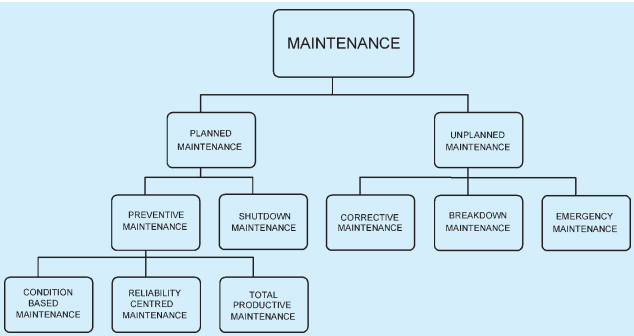
2.28 Corrective Maintenance — Maintenance carried out after fault recognition and intended to put an item into a state in which it can perform a required function.
2.29 Crime Prevention Through Environmental Design (CPTED) — A multi-disciplinary approach to deterring criminal behavior through environmental design. CPTED strategies rely upon the ability to influence offender decisions that precede criminal acts. CPTED principles of design affect elements of the built environment ranging from the small-scale (such as the strategic use of shrubbery and other vegetation) to the overarching, including building form of an entire urban neighbourhood and the amount of opportunity for ‘eyes on the street’.
2.30 Critical Activities — Activities which have to be performed in order to deliver the key products and services which enable an organization to meet its most important and time sensitive objectives.
2.31 Critical Asset — Asset having potential to significantly impact on the achievement of the organization's objectives.
2.32 De-construction — A planned selective demolition in which salvage, re-use and recycling of the demolished structure is maximized.
2.33 Deliverable — Product or service as an outcome of a process.
2.34 Design Development — Transitional phase where the basis of the design progresses towards the production of detailed design information.
2.35 Design Life (DL) — Intended/expected service life by the designer or as stated by the designer to the client to support specification decisions.
2.36 Documented Information — Information required to be controlled and maintained by an organization and the medium on which it is contained.
2.37 Domestic Hazardous Waste — Waste contaminated with hazardous chemicals or infectious waste such as discarded paint drums, pesticide cans, CFL bulbs, tube lights, expired medicines, broken mercury thermometers, used batteries, used needles, gauge and syringes, etc, generated at the household level.
2.38 Dry Waste — Waste, other than food waste, inert and including recyclable waste, non-recyclable waste, combustible waste and sanitary waste.
2.39 Dump Sites — A land utilized by urban local body for unscientific disposal of solid waste without following the principles of sanitary land filling.
2.40 Durability — Ability of a building and its parts to perform its required function over a period of time and under the influence of agents.
2.41 Duress Alarms — Duress alarms are installed to protect personnel who may be placed in danger of
6
physical assault during interactions with other persons. Duress alarms are normally placed in locations where an employee may be alone with a potentially threatening person.
2.42 End-user — Recipient of facility-related services.
NOTE — Recipients include occupants and other users of a facility.
2.43 Estimated Service Life (ESL) — Service life that a building or parts of a building should be expected to have in a set of specific in use conditions, determined from the reference service life data after taking into account any differences from the reference in-use conditions.
2.44 Exterior Property – The open space on the premises under the control of owners or operators of such premises.
2.45 External Envelope — Roof and façade including openings.
2.46 Facilities Maintenance — Work needed to maintain the performance of the building structure, fabric and components, and engineering installations.
2.47 Facility — Tangible asset that supports/serves an organization.
2.48 Facility Asset Performance — Requirements in terms of measurable outcomes for meeting organizational goals.
2.49 Hazardous Waste — It shares the properties of a hazardous material (for example ignitability, corrosivity, reactivity, or toxicity), or other physical, chemical, or biological characteristics that may pose a potential risk to human health or the environment if improperly managed. Wastes may also be defined as ‘hazardous’ by local regulations or international conventions, based on the origin of the waste and its inclusion on hazardous waste lists, or based on its characteristics. Sludge from a waste treatment plant, water supply treatment.
2.50 House Keeping — The routine recurring work which is required to keep a structure in good condition so that it can be utilized at its original capacity and efficiency along with proper protection of capital investment, throughout its economic life.
2.51 Information Management — Processing and storage of information in a controlled manner.
2.52 Intrusion Detection Systems — An intrusion detection system (IDS) is a device or software application that monitors the activities for malicious activities or policy violations and produces reports to a management station. Intrusion detection and prevention systems (IDPS) are primarily focused on
identifying possible incidents, logging information about them, and reporting attempts.
2.53 Life Cycle — The stages of an asset from acquisition through commissioning and operation to disposal.
2.54 Maintenance — An intervention on an asset to improve its operation or ensure its continued good operation (It is also the combination of all technical and associated administrative actions during the service life to retain a building, or its parts, in a state in which it can perform its required functions.).
2.55 Maintenance Management — Process of ensuring that the most effective and efficient maintenance programme is formulated and delivered to ensure that assets/facilities continue to perform their intended function. The organization of maintenance has to be within an agreed policy. Maintenance can be seen as a form of ‘steady state’ activity.
2.56 Maintenance Manual — Technical instructions intended to preserve an asset/facility in, or, restore it to a state in which it can perform a required function.
2.57 Maintenance Plan — Structured and documented set of tasks that include the activities, procedures, resources and the time scale required to carry out maintenance.
2.58 Maintenance Policy — Scope and course of action taken to achieve an organization's objectives.
2.59 Maintenance Programme — Arrangement of maintenance tasks in terms of their sequence, durations and resource requirements.
2.60 Maintenance Strategy — Statement of organizational approach to maintenance management.
2.61 Management System — Set of interrelated or interacting elements of an organization to establish policies and objectives and processes to achieve those objectives.
2.62 Mantrap — A small room with two doors. The first door is locked; a person is identified and authenticated. Once the person is authenticated and access is authorized, the first door opens and allows the person into the mantrap. The person has to be authenticated again in order to open the second door and access a critical area. The mantrap area can have a weight sensing floor as an additional control to prevent literal piggybacking.
2.63 Occupants — Users who spend a significant proportion of their time in or about a facility.
2.64 Operational Plan — Organization's statement of actions intended to achieve a specific business goal(s).
2.65 Operational Strategy — Overall approach to managing production or use of a facility.
2.66 Perimeter Intrusion Detection and Assessment System (PIDAS) — A type of fencing that has sensors on the wire mesh and base of the fence. A passive cable vibration sensor sets off an alarm if an intrusion is detected.
2.67 Perimeter Security — Control and observation of areas of ingress and egress to a building and parking structure, including main lobby doors, rear plaza doors, truck docks, fire exits, and other points of access.
2.68 Physical Asset — A tangible, manmade object that has a specific function, normally within a broader system.
2.69 Planned Preventive Maintenance — Maintenance organized and carried out with forethought, control and the use of records to a plan based on the results of condition surveys.
2.70 Predicted Service Life — Service life predicted from performance recorded over time in accordance with standard laid down procedure.
2.71 Predictive Action — Action to monitor the condition of an asset and predict the need for preventive action or corrective action.
2.72 Preventive Maintenance — An intervention on an asset taken in advance of a failure to reduce the chances of failure.
2.73 Preventive Action — Action to eliminate the cause of a potential non-conformity or other undesirable potential situation (for asset/facility management).
2.74 Primary Collection — Collecting, lifting and removal of segregated solid waste from source of its generation including households, shops, offices and any other non-residential premises or from any collection points or any other location specified by the urban local body.
2.75 RASCI Chart — Responsible, accountable, supported, consulted and informed chart that is used to summarize the roles and functions performed in the procurement process and the activities within it.
2.76 Reliability Centered Maintenance (RCM) — An approach which targets intervention on assets based on the known historic performance of that or similar assets.
2.77 Repair, Renovate, Refurbish — An intervention which improves the performance and condition of an asset to upgrade or retain desired performance.
2.78 Residual Waste — Includes the waste and rejects from the solid waste processing facilities which are not
suitable for recycling or further processing.
2.79 Root Cause Analysis — A thorough assessment of all of the factors influencing the occurrence of a fault or failure.
2.80 Sanitary Land Filling — The final and safe disposal of residual solid waste and inert wastes on land in a facility designed with protective measures against pollution of ground water, surface water and fugitive air dust, wind-blown litter, bad odour, fire hazard, animal menace, bird menace, pests or rodents, greenhouse gas emissions, persistent organic pollutants slope instability and erosion.
2.81 Sanitary Waste — Wastes comprising of used diapers, sanitary towels or napkins, tampons, condoms, incontinence sheets and any other similar waste.
2.82 Scope Creep — Uncontrolled changes to the agreed scope of the facility related service being provided.
2.83 Secondary Collection — Collection of solid waste deposited at secondary waste storage depots or bins for onward transportation of the waste to the processing or disposal facility.
2.84 Secondary Storage — The temporary containment of solid waste at a public place in a covered bin or container in a manner so as to prevent littering, vectors, stray animals and odour.
2.85 Service Life — Period of time after installation during which a building or its parts meets or exceed the performance requirements.
2.86 Shutdown/Outage — A period, either planned or otherwise, during which asset interventions occur.
2.87 Stabilizing — The biological decomposition of biodegradable wastes to a stable state where it generates no leachate or offensive odours and is fit for application to farm land, soil erosion control and soil remediation.
2.88 Stakeholder — Individual, organization or group with an interest in an organization, facility or project. It also applies to the person or entity with an interest in or concern about a facility.
2.89 Surveillance — Surveillance is the monitoring of the behaviour, activities, or other changing information, usually of people for the purpose of influencing, managing, directing, or protecting them. This can include observation from a distance by means of electronic equipment (such as, CCTV cameras). Surveillance is used for intelligence gathering, the prevention of crime, the protection of a process, person, group or object, or for the investigation of crime. Surveillance is often a violation of privacy, and is opposed by various civil liberties groups and activists.
8
2.90 Surveillance Devices — Surveillance device can be defined as any instrument, apparatus or equipment used either alone, or in conjunction with other equipment, which is being used to conduct surveillance.
2.91 Whole Life Costing — An understanding of the full economic impact of owning an asset, covering all stages of its life cycle.