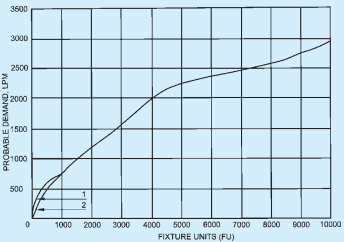
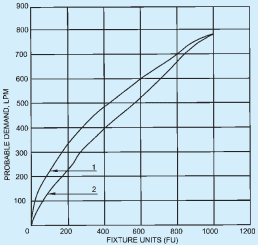
2.1 Definitions Relating to Water Supply
2.1.1 Access Panel — A removable panel mounted in a frame, normally secured with screws and mounted in a wall or ceiling, to provide access to concealed valves or items which may require maintenance.
2.1.2 Air Gap, Water Distribution — Unobstructed vertical distance through the free atmosphere between the lowest opening from any pipe or faucet conveying water to a tank or plumbing fixture and flood level rim of the receptacle.
2.1.3 Air Valve — A valve that releases air from a pipeline automatically without loss of water, or introduce air into a line automatically if the internal pressure becomes less than that of the atmosphere.
2.1.4 Authority Having Jurisdiction — The authority which has been created by a statute and which for the purpose of administering the Code/Part may authorize a committee or an official to act on its behalf; hereinafter called the ‘Authority’.
2.1.5 Available Head — The head of water available at the point of consideration due to mains' pressure or overhead tank or any other source of pressure.
2.1.6 Anti-Siphon—A device or mechanism to prevent siphonage.
2.1.7 Backflow
a) The flow of water or other liquids, mixtures or substances into the distributing pipes of a system of supply of potable water from any source or sources other than its intended source.
b) The flow of a liquid in a direction reverse of that intended.
2.1.8 Backflow Prevention Device — Any approved measure or fitting or combination of fittings specifically designed to prevent backflow or back siphonage in a water service.
2.1.9 Back Pressure Back Flow — Due to an increased pressure above the supply pressure, which may be due to pumps, other equipment, gravity or other source of pressure.
2.1.10 Back Siphonage — The flowing back of used, contaminated, or polluted water from a plumbing fixture or vessel into a water supply due to a reduced pressure in such pipe (see 2.1.7).
2.1.11 Barrel — This portion of a pipe in which the diameter and wall thickness remain uniform throughout.
2.1.12 Base — The lowest portion or lowest point of a stack of vertical pipe.
2.1.13 Bath Room Group — Group of fixtures consisting of water closet, lavatory, bath tub or shower and other fittings with a floor drain located together.
2.1.14 Bedding — The material on which the pipe is laid and which provides support for the pipe. Bedding can be concrete, granular material or the prepared trench bottom.
2.1.15 Chair — A bed of concrete or other suitable material on the trench floor to provide a support for the pipes at intervals.
2.1.16 Channel — The open waterway through which sewage, storm water or other liquid wastes flow at the invert of a manhole or an inspection chamber.
2.1.17 Communication Pipe — That part of a service pipe which vests in the water undertakes. It starts at the water main and terminate at a point which differs according to the circumstances of the case.
2.1.18 Consumer — Any person who uses or is supplied
water or on whose application such water is supplied by the Authority.
2.1.19 Consumer's Pipe — The portion of service pipe used for supply of water and which is not the property of the Authority (see Fig. 1).
2.1.20 Cover
a) A removable plate for permitting access to a pipe, fitting, vessel or appliance.
b) The vertical distance between the top of the barrel of a buried pipe or other construction and the surface of the ground.
2.1.21 Cross-Connection — A connection between two normally independent pipelines which permits flow from either pipeline into the other.
2.1.22 Direct Tap — A tap which is connected to a supply pipe and is subject to pressure from the water main.
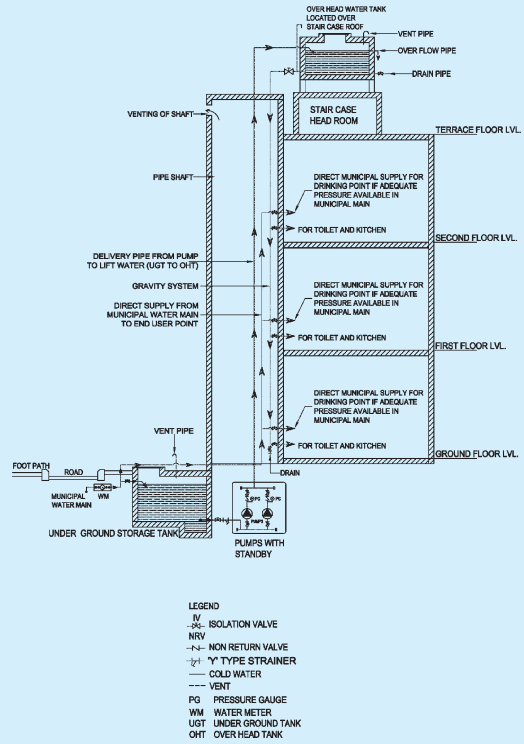
LEGEND
IV
--* ISOLATION VALVE
NRV
--N NON RETURN VALVE
--+ 'Y' TYPE STRAINER
— COLD WATER
--- VENT
PG PRESSURE GAUGE
WM WATER METER
UGT UNDER GROUND TANK
OHT OVER HEAD TANK
FIG. 1 IDENTIFICATION OF DIFFERENT TYPES OF WATER SUPPLY SYSTEM
2.1.23 Down Take Tap — A tap connected to a system of piping not subject to water pressure from the water main.
2.1.24 Effective Opening — The minimum cross-sectional area at the point of water supply, measured or expressed in terms of,
a) the diameter of a circle; and
b) the diameter of a circle of equivalent cross-sectional area, if the opening is not circular.
2.1.25 Feed Cistern — A storage vessel used for supplying cold water to a hot water apparatus, cylinder or tanks.
2.1.26 Fittings — The appurtenances such as coupling, flange, branch, bend, tees, elbows, unions, waste (with or without plug), P or S trap (with or without vent), stop ferrule, bib tap, pillar tap, bath faucet, water meter, garden hydrant, valves and any other article used in connection with water supply, drainage and sanitation.
2.1.27 Fixture Unit — A quantity in terms of which the load producing effects on the plumbing system of different kinds of plumbing fixtures is expressed on some arbitrarily chosen scale.
2.1.28 Float Operated Valve — Ball valves or ball taps and equilibrium valves operated by means of a float.
2.1.29 Flushing Cistern — A cistern provided with a device for rapidly discharging the contained water and used in connection with a sanitary appliance for the purpose of cleaning the appliance and carrying away its contents into a drain.
NOTE — The nominal size of a cistern is the quantity of water discharged per flush.
2.1.30 Flushometer Tank –A tank integrated with an air accumulator vessel that is designed to discharge a predetermined quantity of water to fixtures for flushing purposes.
2.1.31 Formation — The finished level of the excavation at the bottom of a trench or heading prepared to receive the permanent work.
2.1.32 Frost Line — The line joining the points of greatest depths below ground level up to which the moisture in the soil freezes.
2.1.63 Subsoil Water Drain
a) A drain intended to collect and carry away subsoil water.
b) A drain intended to disperse into the subsoil from a septic tank.
2.1.64 Sub-Zero Temperature Regions — Regions where temperatures fall below 0° C and freezing conditions occur.
2.1.65 Supply Pipe — So much of any service pipe as is not a communication pipe.
2.1.66 Supports — Hangers and anchors or devices for supporting and securing pipe and fittings to walls, ceilings, floors or structural members.
2.1.67 Surface Water — Natural water from the ground surface, paved areas and roofs.
2.1.68 Surface Water Drain — A drain conveying surface water including storm water.
2.1.69 Thermostatic/Pressure Balancing Valve—Mixing valve that senses outlet temperature and incoming hot and cold water pressure and compensates for fluctuations for stabilization.
2.1.70 Vertical Pipe – Any pipe or fitting which is installed in a vertical position or which makes an angle or not more than 45° with the vertical.
2.1.71 Warning Pipe — An overflow pipe so fixed that its outlet, whether inside or outside a building, is in a conspicuous position where the discharge of any water there from can be readily seen.
2.1.72 Wash-Out Valve — A device located at the bottom of the tank for the purpose of draining a tank for cleaning, maintenance, etc.
2.1.73 Water Hammer Arrestor — A device designed to provide protection against hydraulic shock in the building water supply system.
2.1.74 Water Main (Street Main) — A pipe laid by the water undertakers for the purpose of giving a general supply of water as distinct from a supply to individual consumers and includes any apparatus used in connection with such a pipe.
2.1.75 Water Outlet — A water outlet, as used in connection with the water distributing system, is the discharge opening for the water: (a) to a fitting; (b) to atmospheric pressure (except into an open tank which is part of the water supply system); and (c) to any water-operated device or equipment requiring water to operate.
2.1.76 Water Supply System — Water supply system of a building or premises consists of the water service pipe, the water distribution pipes, and the necessary connecting pipes, fittings, control valves, and all appurtenances in or adjacent to the building or premises.
2.1.77 Waterworks — Waterworks for public water supply include a lake, river, spring, well, pump with or without motor and accessories, reservoir, cistern, tank, duct whether covered or open, sluice, water main, pipe, culvert, engine and any machinery, land, building or a thing used for storage, treatment and supply of water.