BUREAU OF INDIAN STANDARDS
- FOREWORD
- ... 3
- 1 SCOPE
- ... 5
- 2 TERMINOLOGY
- ... 5
- 3 ORIENTATION OF BUILDING
- ... 8
- 4 LIGHTING
- ... 11
- 5 VENTILATION
- ... 35
- ANNEX A METHOD OF CALCULATING SOLAR LOAD ON VERTICAL SURFACES OF DIFFERENT ORIENTATION
- ... 46
- ANNEX B SKY COMPONENT TABLES
- ... 49
- LIST OF STANDARDS
- ... 55
2
This Code (Part 8/Section 1) covers requirements and methods for lighting and natural ventilation of buildings.
Illumination levels for different tasks are recommended to be achieved either by daylighting or artificial lighting or a combination of both. This Section, read together with Part 8 ‘Building Services, Section 2 Electrical and Allied Installations’ of the Code, adequately covers the illumination levels required and methods of achieving the same.
Ventilation requirements to maintain air quality and control body odours in terms of air changes per hour and to ensure thermal comfort and heat balance of body are laid for different occupancies and the methods of achieving the same by natural means are covered in this Section. The provisions on mechanical ventilation are covered in Part 8 ‘Building Services, Section 3 Air conditioning, Heating and Mechanical Ventilation’ of the Code.
Climatic factors which normally help in deciding the orientation of the buildings to get desirable benefits of lighting and natural ventilation inside the buildings are also covered in this Section.
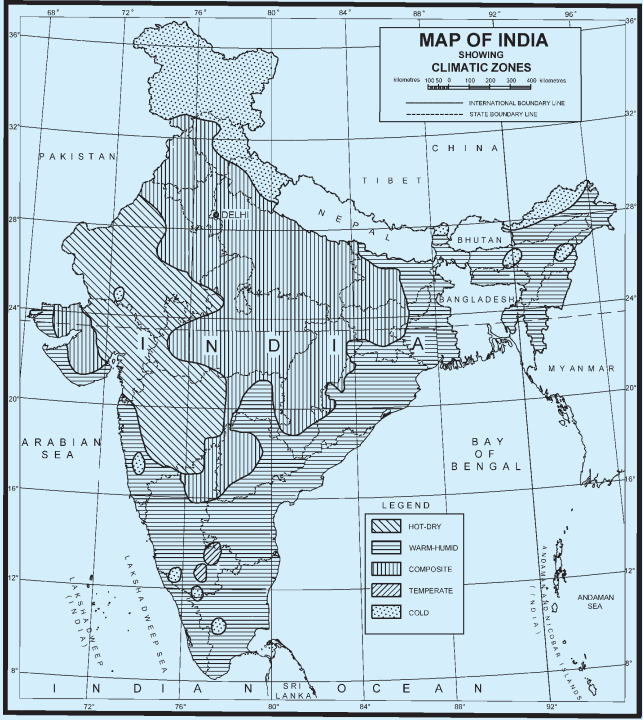
This Section was first published in 1970. The first revision of the Section was brought out in 1983. In the second revision, some provisions were updated based on the information given in the SP 41:1987 'Handbook on functional requirements of buildings (other than industrial buildings)'; other major changes in the last revision included rationalization of definitions and inclusion of definitions for some more terms; inclusion of climatic classification map of India based on a new criteria; updating of data on total solar radiations incident on various surfaces of buildings for summer and winter seasons; inclusion of design guidelines for natural ventilation; reference to Part 8 'Building Services, Section 3 Air Conditioning, Heating and Mechanical Ventilation' of the Code for guidelines on mechanical ventilation, was made, where these provisions were covered exhaustively; inclusion of rationalized method for estimation of desired capacity of ceiling fans and their optimum height above the floor for rooms of different sizes; incorporation of design sky illuminance values for different climatic zones of India, etc. Energy efficiency was another important aspect which was taken care of in the last revision of the Code. Accordingly, the relevant requirements for energy efficient system for lighting and natural ventilation were duly included in the concerned provisions under the Section.
As a result of experience gained on implementation of 2005 version of the Code and feedback data received, a need was felt to revise this Section. This draft revision has, therefore, been formulated to take care of these. The significant changes incorporated in this revision are:
a) Calculation for solar load has been elaborated, and a detailed 'Method of Calculating Solar Load on Vertical Surfaces in Different Orientation' has been added in Annex A, supporting the relevant provisions.
b) Detailed provisions on sky component calculation procedure have been included along with examples in Annex B supporting the relevant clauses.
c) Reference to SP 41 : 1987 for obtaining coefficient utilization for determination of luminous flux has been included.
d) Provisions relating to efficient artificial light source and luminaires have been updated.
e) Modern lighting techniques such as LED and induction light have been included vis-à-vis their energy consumption.
f) Provisions relating to photocontrols for artificial lights have been updated.
g) Definitions and enabling provision for lighting shelves and light pipes have been included.
h) Provisions related to thermal comfort clause have been elaborated including therein indices such as effective temperature, adaptive thermal comfort along with elaborations on tropical summer index.
j) Design guidelines for natural ventilation have been elaborated with illustrations.
k) Provisions related to determination of rate of ventilation, particularly on combined effect of wind and thermal actions, have been elaborated.
m) Provision on colour rendering has been included in line with that in SP 72 : 2010 ‘National Lighting Code 2010’.
n) Various other existing provisions have been updated based on the latest technical developments in the field.
The provisions of this Section are without prejudice to the various acts, rules and regulations including the Factories Act, 1948 and rules and regulations framed thereunder.
The information contained in this Section is largely based on the following Indian Standards/Special Publications:
IS 2440 : 1975 Guide for daylighting of buildings (second revision)
IS 3103 : 1975 Code of practice for industrial ventilation (first revision)
IS 3362 : 1977 Code of practice for natural ventilation of residential buildings (first revision)
IS 3646 (Part 1): 1992 Code of practice for interior illumination: Part 1 General requirements and recommendations for working interiors (first revision)
IS 7662 (Part 1) : 1974 Recommendations for orientation of buildings : Part 1 Non-industrial buildings
IS 11907 : 1986 Recommendations for calculation of solar radiation on buildings
SP 32 : 1986 Handbook on functional requirements of industrial buildings (lighting and ventilation)
SP 41 : 1987 Handbook on functional requirements of buildings other than industrial buildings
Provisions given in National Lighting Code, ‘SP 72 : 2010’ may also be referred.
The following publication has also been referred to in the formulation of this Section:
Report on energy conservation in buildings, submitted to Department of Power, Ministry of Energy by CSIR-Central Building Research Institute, Roorkee.
All standards, whether given herein above or cross-referred to in the main text of this Section, are subject to revision. The parties to agreement based on this Section are encouraged to investigate the possibility of applying the most recent editions of the standards.