8.2.1 The storage, stacking and handling of materials generally used in construction shall be as given in 8.2.2 to 8.2.31, which have been summarized in the form of a check list in Annex A. Exposure to asbestos fibres/dust is known to be harmful to health of human beings. Prescribed guidelines in accordance with good practice [7(22)] shall be followed for handling and usage of asbestos cement products.
8.2.2 Cement
a) Storage and stacking — Cement shall be stored at the work site in a building or a shed which is dry, leak-proof and as moisture-proof as possible. The building or shed for storage should have minimum number of windows and close fitting doors and these should be kept closed as far as possible.
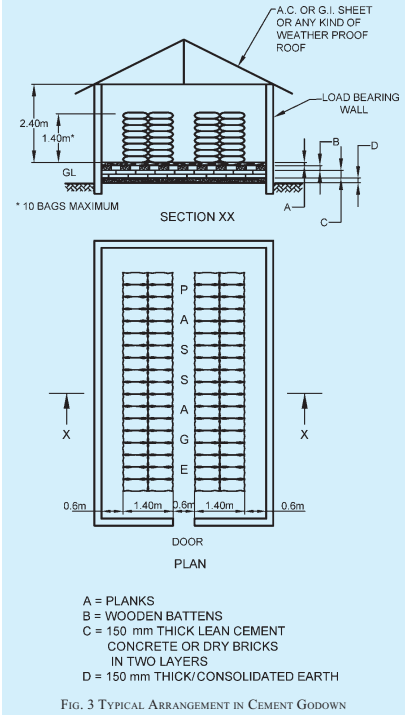
Cement received in bags shall be kept in such a way that the bags are kept free from the possibility of any dampness or moisture coming in contact with them. Cement bags shall be stacked off the floor on wooden planks in such a way as to keep them about 150 mm to 200 mm clear above the floor. The floor may comprise lean cement concrete or two layers of dry bricks laid on a well consolidated earth. A space of 600 mm minimum shall be left around between the exterior walls and the stacks (see Fig. 3). In the stacks the cement bags shall be kept close together to reduce circulation of air as much as possible. Owing to pressure on bottom layer of bags sometimes ‘warehouse pack’ is developed in these bags. This can be removed easily by rolling the bags when cement is taken out for use. Lumped bags, if any should be removed and disposed of.
The height of stack shall not be more than 10 bags to prevent the possibility of lumping up under pressure. The width of the stack shall be not more than four bags length or 3 m. In stacks more than 8 bags high, the cement bags shall be arranged alternately length-wise and cross-wise so as to tie the stacks together and minimise the danger of toppling over. Cement bags shall be stacked in a manner to facilitate their removal and use in the order in which they are received; a table showing date of receipt of cement shall be put on each stack to know the age of cement.
For extra safety during monsoon, or when it is expected to store for an unusually long period, the stack shall be completely enclosed by a water proofing membrane such as polyethylene, which shall close on the top of the stack. Care shall be taken to see that the waterproofing membrane is not damaged any time during the use.
Cement in gunny bags, paper bags and polyethylene bags shall be stored separately.
In case cement is received in drums, these shall be stored on plane level ground, as far as possible near the concrete mixing place. After taking out the required quantity of cement, the lid of the drum shall be securely tied to prevent ingress of moisture.
In case cement is received in silos, the silos shall be placed near the concrete batching plant. Proper access shall be provided for the replacement of silos.
Different types of cements shall be stacked and stored separately.
b) Handling — Hooks shall not be used for handling
cement bags unless specifically permitted by the engineer-in-charge. Bags shall be removed uniformly from the top of the piles to avoid tipping of the stack.
For information regarding bulk handling of cement (see 8.2.4).
8.2.3 Lime
8.2.3.1 Quicklime before slaking
a) Storage and stacking—Quicklime should be slaked as soon as possible. If unavoidable it may be stored in compact heaps having only the minimum of exposed area. The heaps shall
be stored on a suitable platform and covered to avoid direct contact with rain or being blown away by wind. In case quick lime is stored in a covered shed, a minimum space of 300 mm should be provided all-round the heaps to avoid bulging of walls.
Unslaked lime shall be stored in a place inaccessible to water and because of fire hazards, shall be segregated from the combustible materials.
b) Handling — See 8.2.4.
8.2.3.2 Hydrated lime
a) Storage and stacking — Hydrated lime is generally supplied in containers, such as jute bags lined with polyethylene or craft paper bags. It should be stored in a building to protect the lime from dampness and to minimise warehouse deterioration.
The building should be with a concrete floor and having least ventilation to eliminate draughts through the walls and roof. In general, the recommendations given in 8.2.2 for storing of cement shall be applicable for hydrated lime. When air movement is reduced to a practical minimum, hydrated lime can be stored for up to three months without appreciable change.
b) Handling — See 8.2.4.
8.2.3.3 Dry slaked lime
a) Storage and stacking — The lime shall be stored in a dry and closed godown.
b) Handling — See 8.2.4.
8.2.4 Handling of Cement and Lime
Workers, handling bulk cement or lime shall wear protective clothing, respirators, and goggles; shall be instructed in the need of cleanliness to prevent dermatitis, and shall be provided with hand cream, petroleum jelly, or similar preparation for protection of exposed skin. Workers handling cement, who are continually exposed to it, shall, in addition to the above be equipped with hand gloves and dust mask.
Bulk cement stored in silos or bins may fail to feed to the ejection system. When necessary to enter a silo or bin for any purpose, the ejection system employed shall be shut down and locked out electrically as well as mechanically. When necessary for a workman to enter such storage area, he shall wear a life-line, with another workman outside the silo or hopper attending the rope.
8.2.5 Masonry Units
a) Stones — Stones of different sizes, types and
classification shall be stored separately. Stones shall be stacked on dry firm ground in a regular heap not more than 1 m in height. Veneering stones shall be stacked against vertical support on a firm dry ground in tiers, upto a height of 1.2 m. A distance of about 0.8 m shall be kept between two adjacent stacks.
b) Bricks — Bricks shall be stacked in regular tiers as and when they are unloaded to minimise breakage and defacement. These shall not be dumped at site. In the case of bricks made from clays containing lime Kankar, the bricks in stack should be thoroughly soaked in water (docked) to prevent lime bursting.
Bricks shall be stacked on dry firm ground. For proper inspection of quality and ease in counting, the stacks shall be 50 bricks long, 10 bricks high and not more than 4 bricks in width, the bricks being placed on edge, two at a time along the width of the stack. Clear distance between adjacent stacks shall not be less than 0.8 m. Bricks of each truck load shall be put in one stack. Bricks of different types, such as, clay bricks, clay fly ash bricks, fly ash lime bricks, sand lime (calcium silicate) bricks shall be stacked separately. Bricks of different classifications from strength consideration and size consideration (such as, conventional and modular) shall be stacked separately. Also bricks of different types, such as, solid, hollow and perforated shall be stacked separately.
c) Blocks — Blocks are available as hollow and solid concrete blocks, hollow and solid light weight concrete blocks, autoclaved aerated concrete blocks, concrete stone masonry blocks and soil based blocks. Blocks shall be unloaded one at a time and stacked in regular tiers to minimise breakage and defacement. These shall not be dumped at site. The height of the stack shall not be more than 1.2 m, the length of the stack shall not be more than 3.0 m, as far as possible and the width shall be of two or three blocks. Normally blocks cured for 28 days only should be received at site. In case blocks cured for less than 28 days are received, these shall be stacked separately. All blocks should be water cured for 10 to 14 days and air cured for another 15 days; thus no blocks with less than 28 days curing shall be used in building construction. Blocks shall be placed close to the site of work so that least effort is required for their transportation. The date of manufacture of the blocks shall be suitably marked on the stacks of blocks
manufactured at factory or site.
d) Handling — Brick stacks shall be placed close to the site of work so that least effort is required to unload and transport the bricks again by loading on pallets or in barrows. Unloading of building bricks or handling in any other way likely to damage the corners or edges or other parts of bricks shall not be permitted.
8.2.6 Floors, Wall and Roof Tiles
a) Storage and stacking — Floor, wall and clay roof tiles of different types, such as, cement concrete tiles (plain, coloured and terrazzo) and ceramic tiles (glazed and unglazed) shall be stacked on regular platform as far as possible under cover in proper layers and in tiers and they shall not be dumped in heaps. In the stack, the tiles shall be so placed that the mould surface of one faces that of another. Height of the stack shall not be more than one metre.
Tiles of different quality, size and thickness shall be stacked separately to facilitate easy removal for use in work. Tiles when supplied by manufacturers packed in wooden crates shall be stored in crates. The crates shall be opened one at a time as and when required for use.
b) Handling — Ceramic tiles and roof tiles are generally supplied in cartons which shall be handled with care to avoid breakage. It is preferable to transport these at the site on platform trolleys.
8.2.7 Aggregate
a) Storage and stacking — Aggregates shall be stored at site on a hard dry and level patch of ground. If such a surface is not available, a platform of planks or old corrugated iron sheets, or a floor of bricks, or a thin layer of lean concrete shall be made so as to prevent the mixing with clay, dust, vegetable and other foreign matter.
Stacks of fine and coarse aggregate shall be kept in separate stock piles sufficiently removed from each other to prevent the material at the edges of the piles from getting intermixed. On a large job it is desirable to construct dividing walls to give each type of aggregates its own compartment. Fine aggregates shall be stacked in a place where loss due to the effect of wind is minimum.
b) Handling — When withdrawals are made from stock piles, no overhang shall be permitted.
Employees required to enter hoppers shall be equipped with safety belts and life-lines, attended by another person. Machine driven hoppers, feeders, and loaders shall be locked in the off position prior to entry, electrically as well as mechanically.
8.2.8 Pulverized Fuel Ash/Fly Ash/Silica
a) Storage and stacking — Fly ash/Silica fume shall be stored in such a manner as to permit easy access for proper inspection and identification of each consignment. Fly ash in bulk quantities shall be stored in stack similar to fine aggregates, avoiding any intrusion of foreign matter. Fly ash in bags shall be stored in stacks not more than 10 bags high. Silica fume, in general, shall be stored similar to cement/fly ash storage depending upon the storage requirements in bags/bulk form.
b) Handling — See 8.2.4.
8.2.9 Cinder
Cinder shall be stored in bulk quantities in stacks similar to coarse aggregates avoiding any extrusion of foreign matter.
8.2.10 Timber
a) Storage and stacking — Timber shall be stored in stacks upon well treated and even surfaced beams, sleepers or brick pillars so as to be above the ground level by at least 150 mm to ensure that the timber will not be affected by accumulation of water under it. Various members shall preferably be stored separately in different lengths, and material of equal lengths shall be piled together in layers with wooden battens, called crossers, separating one layer from another. The crossers shall be of sound wood, straight and uniform in thickness. In case, where separate crossers are not available smaller sections of the available structural timber may be employed in their place. In any layer an air space of about 25 mm shall be provided between adjacent members. The longer pieces shall be placed in the bottom layers and shorter pieces in the top layers but one end of the stack shall be in true vertical alignment. The crossers in different layers shall be in vertical alignment. The most suitable width and height of a stack are recommended to be about 1.5 m and 2.0 m. Distance between adjacent stacks is recommended to be at least 450 mm. In case the stacking with the help of battens is not possible, the timber may be close piled in heaps on raised foundations with the
precautions specified above.
The stacks shall be protected from hot dry winds or direct sun and rain. Heavy weights, such as metal rails or large sections of wood, are recommended to be placed on the top of the stack to prevent distortion or warping of the timber in the stack. In case timber is to be stored for about a year or more, to prevent end-cracking in the material, the ends of all members shall be coated with coal tar, aluminium leaf paints (hardened gloss oil), microcrystalline wax or any other suitable material.
b) Care must be taken that handler or workers are not injured by rails, straps, etc, attached to the used timber. This applies particularly to planks and formwork for shuttering.
8.2.11 Bamboo
8.2.11.1 The site shall be properly inspected and termite colonies or mounds, if detected, shall be destroyed.
All refuse and useless cellulosic materials shall be removed from the site. The ground may then be disinfected by suitable insecticides. The area should have good drainage.
8.2.11.2 Bamboo may preferably be stacked on high skids or raised platform at least 300 mm above ground. Storage under cover reduces the liability to fungal attack. Good ventilation and frequent inspection are important.
8.2.11.3 Bamboo dries by air-seasoning under cover in the storage yards from 6 to 12 weeks' time.
8.2.11.4 Prophylactic treatment of bamboo during storage prevents losses due to fungi and insects even under open storage. Following chemicals have been found suitable at a coverage rate of 24 litre per tonne:
a) Sodium pentachlorophenate : 1 percent solution.
b) Boric acid + borax (1:1): 2 percent solution.
c) Sodium pentachlorophenate : 2.5 percent solution + boric acid + borax (5:1:1).
A mixture of these compounds yields the best results.
NOTE — For better protection of structural bamboo (if stored outside), repetition of the treatment after four to six months is desirable.
8.2.12 Partially Prefabricated Wall and Roof Components
a) Storage and stacking — The wall components comprise blocks, sills, lintels, etc. The blocks shall be stacked in accordance with 8.2.5 (c). These shall be stacked on plane level ground having a floor of bricks or a thin layer of lean concrete.
The roof components such as precast RC joists, prefabricated brick panels, RC planks, channel units, cored units, waffle units, L-panel, single tee and double tee sections, ferrocement panels, etc shall be unloaded as individual components. These shall be stacked on plane level ground having a floor of bricks or a thin layer of lean concrete. RC planks, prefabricated brick panels and ferrocement panels shall be stacked against a brick masonry wall in slightly inclined position on both sides of the wall. Channel units, cored units and L-panels shall be stacked one over the other up to five tiers. The waffle units shall be stacked upside down as individual units. The RC joists, single tee and double tee sections shall be stacked as individual units one adjacent to the other. The distance between any two adjacent stacks shall not be less than 450 mm.
b) Handling — The components shall be handled by holding the individual components at specified points so that the stresses due to handling are minimised.
8.2.13 Steel
a) Storage and stacking — For each classification of steel, separate areas shall be earmarked. It is desirable that ends of bars and sections of each class be painted in distinct separate colours. Steel reinforcement shall be stored in a way as to prevent distortion and corrosion. It is desirable to coat reinforcement with cement wash before stacking to prevent scaling and rusting.
Bars of different classification, sizes and lengths shall be stored separately to facilitate issues in such sizes and lengths as to minimise wastage in cut from standard lengths.
In case of long storage or in coastal areas, reinforcement bars shall be stacked above ground level by at least 150 mm and a coat of cement wash shall be given to prevent scaling and rusting.
Structural steel of different sections, sizes and lengths shall be stored separately. It shall be stored above ground level by at least 150 mm upon platforms, skids or any other suitable supports to avoid distortion of sections. In case of coastal areas or in case of long storage, suitable protective coating of cement wash shall be given to prevent scaling and rusting.
b) Handling — Tag lines shall be used to control the load in handling reinforcements or structural steel when a crane is employed.
Heavy steel sections and bundles shall be lifted and carried with the help of slings and tackles and shall not be carried on the shoulders of the workers.
8.2.14 Aluminium Sections
a) Storage and stacking — Aluminium sections of different classification, sizes and lengths shall be stored separately, on a level platform under cover.
b) Handling — The aluminium sections shall not be pulled or pushed from the stack nor shall be slid over each other, to protect the anodizing layer.
8.2.15 Doors, Windows and Ventilators
a) Storage and stacking — Metal and plastic doors, windows and ventilators shall be stacked upright (on their sills) on level ground preferably on wooden battens and shall not come in contact with dirt or ashes. If received in crates they shall be stacked according to manufacturer's instructions and removed from the crates as and when required for the work. Metal and plastic frames of doors, windows and ventilators shall be stacked upside down with the kick plates at the top. These shall not be allowed to stand for long in this manner before being fixed so as to avoid the door frames getting out of shape and hinges being strained and shutters drooping.
During the period of storage of aluminium doors, windows and ventilators, these shall be protected from loose cement and mortar by suitable covering, such as tarpaulin. The tarpaulin shall be hung loosely on temporary framing to permit circulation of air to prevent moisture condensation.
All timber and other lignocellulosic material based frames and shutters shall be stored in a dry and clean covered space away from any infestation and dampness. The storage shall preferably be in well-ventilated dry rooms. The storage shall preferably be in well-ventilated dry rooms. The frames shall be stacked one over the other in vertical stacks with cross battens at regular distances to keep the stack vertical and straight. These cross battens should be of uniform thickness and placed vertically one above the other. The door shutters shall be stacked in the form of clean vertical stacks one over the other and at least 80 mm above ground on pallets or suitable beams or rafters. The top of the stack shall be
covered by a protecting cover and weighted down by means of scantlings or other suitable weights. The shutter stack shall rest on hard and level surface.
If any timber or other lignocellulosic material based frame or shutter becomes wet during transit, it shall be kept separate from the undamaged material. The wet material may be dried by stacking in shade with battens in between adjacent boards with free access of dry air. Separate stacks shall be built up for each size, each grade and each type of material. When materials of different sizes, grades and types are to be stacked in one stack due to shortage of space, the bigger size shall be stacked in the lower portion of the stacks. Suitable pallets or separating battens shall be kept in between the two types of material.
Precast concrete door and window frames shall be stored in upright position adopting suitable measures against risk of subsidence of soil/support.
b) Handling — While unloading, shifting, handling and stacking timber or other lignocellulosic material based, metal and plastic door and window frames and shutters, care shall be taken that the pieces are not dragged one over the other as it may cause damage to their surface particularly in case of the decorative shutters. The pieces should be lifted and carried preferably flat avoiding damage to corners or sides.
8.2.16 Roofing Materials
8.2.16.1 Roofing sheets shall be stored and stacked in such a manner as not to damage them in any way.
8.2.16.2 Asbestos cement sheet
a) Storage and stacking — Asbestos cement sheets shall be stacked horizontally to a height of not more than 1 m on a firm and level ground, with timber or other packing beneath them. If stacked in exposed position, they shall be protected from damage by wind. Asbestos cement sheets of same variety and size shall be stacked together. Damaged sheets shall not be stacked with sound materials. All damaged sheets shall be salvaged as early as possible.
b) Handling — Not more than two sheets shall be first pushed forward along the valley line say about one fourth of the sheet length and preferably carried by two workers. Asbestos cement sheets shall be lowered or raised gently and not thrown.
8.2.16.3 Corrugated galvanized iron sheets and aluminium sheets
a) Storage and stacking — Corrugated galvanized iron sheets and aluminium sheets shall be stacked horizontally to a height of not more than 0.5 m on a firm and level ground, with timber or other packing beneath them. To protect them from dust and rain water, these shall be covered with tarpaulin or polyethylene sheets.
b) Handling — In bulk handling of CGI sheets, workers shall be provided with suitable hand protection.
8.2.16.4 Plastic sheets and glass reinforced plastic (GRP) sheets
a) Storage and stacking — Plastic sheets and glass reinforced plastic (GRP) sheets shall be stacked under a shed to a height of not more than 0.5 m on a firm and level ground with timber or other packing beneath them.
b) Handling — Handling shall be done to avoid any damage to the sheets.
8.2.17 Boards
8.2.17.1 Gypsum boards
a) Storage and stacking — Gypsum boards shall be stored flat in a covered clean and dry place.
b) Handling — See 8.2.17.2 (b).
8.2.17.2 Plywood, fibre board, particle board, block board, etc
a) Storage and stacking — Plywood, fibre board, particle board, block board, etc, shall not be stored in the open and exposed to direct sun and rain. The boards shall be stacked on a flat dunnage, on the top of which a wooden frame shall be constructed with battens of 50 mm × 25 mm (Min) in such a way that it supports all four edges and corners of the boards with intermediate battens placed at suitable intervals to avoid warping. If required, the stack shall be adequately raised above ground level to ensure that it will not be affected by accumulation of water under it.
The board shall be stacked in a solid block in a clear vertical alignment. The top sheet of each stack shall be suitably weighed down to prevent warping, wherever necessary.
b) Handling — The board shall be unloaded and stacked with utmost care avoiding damage to the corners and surface. In case of decorative plywood and decorative boards, the surfaces
of which are likely to get damaged by dragging one sheet over another, it is advisable that these are lifted as far as possible in pairs facing each other.
8.2.18 Plastic and Rubber Flooring Sheets and Tiles
a) Storage and stacking — Plastic and rubber sheets have tendency to break-down during storage. Plastic and rubber sheets shall be stored according to manufacturer's instructions.
The coolest store room available shall be utilized for the storage of the sheets. The store rooms where the sheets are stored shall be well ventilated and direct light should not be allowed to fall on them.
The sheets shall be stored away from electric generators, electric motors, switchgears and other such electrical equipment as they produce harmful odour/gases.
Contamination of the sheets with vegetable and mineral oils; greases; organic solvents; acids and their fumes; alkalies; dust and grit shall be prevented. Where greasy contamination occurs, this shall be removed immediately with petrol and the sheets and tiles thoroughly wiped dry and dusted with chalk.
Undue stretch and strain, kinks, sharp bends or folds of the sheets and tiles shall be avoided. In case of long storage, the sheets shall be turned over periodically and treated with chalk powder, if necessary.
b) Handling — While handling plastic and rubber sheets, workers shall lift the sheets and carry them flat to avoid sharp bends or folds of the sheets.
8.2.19 Glass Sheets
a) Storage and stacking — The special glasses shall be stored and handled as per manufacturer's instructions. It is important that all glass sheets whether stored in crates or not shall be kept dry. Suitable covered storage space shall be provided for the safe storage of the glass sheets. The glass sheets shall be lifted and stored on their long edges and shall be put into stacks of not more than 25 panes, supported at two points by fillets of wood at about 300 mm from each end. The first pane laid in each stack shall be so placed that its bottom edge is about 25 mm from the base of the wall or other support against which the stack rests. The whole stack shall be as close and as upright as possible. To prevent
slipping on smooth floor, the floor shall be covered with gunny bags. The glass sheets of different sizes, thickness and type shall be stacked separately. The distance between any two stacks shall be of the order of 400 mm.
b) Handling — Workers handling glass panes, waste glass pieces and fibre glass shall be provided with suitable hand protection. In removing glass sheets from crates, due care shall be taken to avoid damages. Glass edges shall be covered or otherwise protected to prevent injuries to workers. Special glasses shall be stored and handled as per manufacturer's instructions.
8.2.20 Cast Iron, Galvanized Iron and Asbestos Cement Pipes and Fittings
a) Storage and stacking – The pipes shall be unloaded where they are required, when the trenches are ready to receive them.
Storage shall be provided at the bottom layer to keep the stack stable. The stack shall be in pyramid shape or the pipes placed lengthwise and crosswise in alternate layers. The pyramid stack is advisable in smaller diameter pipes for conserving space in storing them. The height of the stack shall not exceed 1.5 m.
Each stack shall contain only pipes of same class and size, with consignment or batch number marked on it with particulars or suppliers wherever possible.
Cast iron detachable joints and fittings shall be stacked under cover and separated from the asbestos cement pipes and fittings.
Rubber rings shall be kept clean, away from grease, oil, heat and light.
b) Handling — Pipes in the top layer shall be handled first. At a time only one pipe shall be handled by two labourers while carrying to the actual site and shall be carried on shoulders. Fittings shall be handled individually.
8.2.21 Polyethylene Pipes
a) Storage and stacking — Black polyethylene pipes may be stored either under cover or in the open. Natural polyethylene pipes, however, should be stored under cover and protected from direct sunlight.
Coils may be stored either on edge or stacked flat one on top of the other, but in either case they should not be allowed to come into contact with hot water or steam pipes and should be kept away from hot surface.
Straight lengths should be stored on horizontal
racks giving continuous support to prevent the pipe taking on a permanent set. Storage of pipes in heated areas exceeding 27° C should be avoided.
b) Handling — Removal of pipe from a pile shall be accomplished by working from the ends of the pipe.
8.2.22 Unplasticized PVC Pipes
a) Storage and stacking — Pipes should be stored on a reasonably flat surface free from stones and sharp projections so that the pipe is supported throughout its length. The pipe should be given adequate support at all times. In storage, pipe racks should be avoided. Pipe should not be stacked in large piles especially under warm temperature conditions as the bottom pipes may distort thus giving rise to difficulty in jointing. Socket and spigot pipes should be stacked in layers with sockets placed at alternate ends of the stacks to avoid lopsided stacks.
It is recommended not to store a pipe inside another pipe. On no account should pipes be stored in a stressed or bend condition or near a source of heat. Pipes should not be stacked more than 1.5 m high. Pipes of different sizes and classes should be stacked separately.
In tropical conditions, pipes should be stored in shade. In very cold weather, the impact strength of PVC is reduced making it brittle.
The ends of pipe should be protected from abrasion particularly those specially prepared for jointing either spigot or socket solvent welded joints or soldered for use with couplings.
If due to unsatisfactory storage or handling, a pipe becomes kinked, the damaged portion should be cut out completely. Kinking is likely to occur only on very thin walled pipes.
b) Handling — Great care shall be exercised in handling these pipes in wintry conditions as these become brittle in very cold weather.
8.2.23 Pipes of Conducting Materials
a) Storage and stacking — Pipes shall be stacked on solid level sills and contained in a manner to prevent spreading or rolling of the pipe. Where quantity storage is necessary, suitable packing shall be placed between succeeding layers to reduce the pressure and resulting spreading of the pile.
In stacking and handling of pipes and other conducting materials, the following minimum safety distances shall be ensured from the
overhead power lines:
-
11kV and below : 1.40m
-
Above 11 and below 33 kV : 3.60 m
-
Above 33 and below 132 kV : 4.70 m
-
Above 132 and below 275 kV : 5.70 m
-
Above 275 and below 400kV:6.50m
b) Handling — Removal of pipes from a pile shall be accomplished by working from the ends of the pipe. During transportation, the pipes shall be so secured as to ensure against displacement.
8.2.24 Piles and Poles
a) Storage and stacking — Piles and poles shall be carefully stacked on solid, level sills so as to prevent rolling or spreading of the pile.
The storage area shall be maintained free of vegetation and flammable materials.
b) Handling — When placing piles or poles on the stack, workers shall work from the ends of the piles/poles. Similar precautions shall be observed in removal of piles/poles from the stack. Tag lines shall be used to control piles and poles when handling for any purpose.
In stacking and handling of piles and poles, precautions as laid down in 8.2.18 (a) shall be followed.
8.2.25 Paints, Varnishes and Thinners
a) Storage and stacking — Paints, varnishes, lacquers, thinners and other flammable materials shall be kept in properly sealed or closed containers. The containers shall be kept in a well ventilated location, free from excessive heat, smoke, sparks or flame. The floor of the paint stores shall be made up of 100 mm thick loose sand.
Paint materials in quantities other than required for daily use shall be kept stocked under regular storage place.
Where the paint is likely to deteriorate with age, the manner of storage shall facilitate removal and use of lots in the same order in which they are received.
Temporary electrical wirings/fittings shall not be installed in the paint store. When electric lights, switches or electrical equipment are necessary, they shall be of explosion proof design.
b) Handling — Adequate ventilation to prevent the accumulation of flammable vapours to hazardous levels of concentration shall be provided in all areas where painting is done.
When painting is done in confined spaces where flammable or explosive vapours may develop, any necessary heat shall be provided through duct work remote from the source of flame.
Sources of ignition, such as open flame and exposed heating elements, shall not be permitted in area or rooms where spray painting is done nor shall smoking be allowed there.
Care should be taken not to use any naked flame inside the paint store. Buckets containing sand shall be kept ready for use in case of fire. Fire extinguishers when required shall be of foam type conforming to accepted standards [7(23)] {see also good practice [7(24)]}.
Each workman handling lead based paints shall be issued (1)/(2) litre milk per day for his personal consumption.
8.2.26 Bitumen, Road Tar, Asphalt, etc
a) Storage and stacking – Drums or containers containing all types of bitumen, road tar, asphalt, etc, shall be stacked vertically on their bottoms in up to 3 tiers. Leaky drums shall be segregated. Empty drums shall be stored in pyramidal stacks neatly in rows.
b) Handling — See 9.13.3.1.2 and 9.13.3.4.
8.2.27 Bituminous Roofing Felts
a) Storage and stacking — Bituminous roofing felts shall be stored away from other combustible materials and shall be kept under shade.
b) Handling — Bituminous roofing felts should be handled in a manner to prevent cracking and other damages.
8.2.28 Flammable Materials
a) Storage and stacking — In addition to the requirements as laid down in 8.1.3, the following provisions shall also apply:
-
Outdoor storage of drums requires some care to avoid contamination because moisture and dirt in hydraulic brake and transmission fluid, gasoline, or lubricants may cause malfunction or failure of equipment, with possible danger to personnel. The storage area should be free of accumulations of spilled products, debris and other hazards.
-
Compressed gases and petroleum products shall not be stored in the same building or close to each other. Storage of petroleum products should be as per Petroleum Rules, 2002, as amended from time-to-time.
b) Handling — Petroleum products delivered to the job site and stored there in drums shall be protected during handling to prevent loss of identification through damage to drum markings, tags, etc. Unidentifiable petroleum products may result in improper use, with possible fire hazard, damage to equipment or operating failure.
Workers shall be required to guard carefully against any part of their clothing becoming contaminated with flammable fluids. They shall not be allowed to continue work when their clothing becomes so contaminated.
8.2.29 Water
Water to be stored for construction purposes shall be stored in proper tanks to prevent any ingress of organic impurities. The aggregate capacity of storage tanks shall be determined after taking into account the requirements of firefighting.
8.2.30 Sanitary Appliances
a) Storage and stacking — All sanitary appliances shall be carefully stored under cover to prevent damage. When accepting and storing appliances, consideration shall be given to the sequence of removal from the store to the assembly positions. Vitreous fittings shall be stacked separately from the metal ones.
b) Handling — Bigger sanitary appliances shall be handled one at a time. Traps, water seals and gullies shall be handled separately. While handling sanitary fittings they shall be free from any oil spilling, etc. The hands of the workers shall also be free from any oily substance. Before lowering the appliances in their position the supporting brackets, pedestals, etc, shall be checked for their soundness and then only the fixtures be attached.
8.2.31 Other Materials
Polymeric materials such as coatings, sheeting, reflective surfacing/sheeting, etc, shall be stored as per the manufacturers' instructions. Special precautions shall be taken in case of storage, handling and usage of toxic materials.
Small articles like screws, bolts, nuts, door and window fittings, polishing stones, protective clothing, spare parts of machinery, linings, packings, water supply and sanitary fittings, and electrical fittings, insulation board, etc, shall be kept in suitable and properly protected containers or store rooms. Valuable small materials shall be kept under lock and key.
8.2.32 Special Considerations
8.2.32.1 Materials constantly in use shall be relatively nearer to the place of use.
8.2.32.2 Heavy units like precast concrete members shall be stacked near the hoist or the ramp.
8.2.32.3 Materials which normally deteriorate during storage shall be kept constantly moving, by replacing old materials with fresh stocks. Freshly arrived materials shall never be placed over materials which had arrived earlier.
8.2.32.4 Appropriate types of fire extinguishers shall be provided at open sites where combustible materials are stored and for each storage shed/room where flammable/combustible materials are stored. For guidance regarding selection of the appropriate types of fire extinguishers reference may be made to good practice [7(24)]. It is desirable that a minimum of two extinguishers are provided at each such location.
8.2.32.5 Workers handling excavated earth from foundation, particularly if the site happens to be reclaimed area or marshy area or any other infected area, shall be protected against infection affecting their exposed body portions.
8.2.32.6 House keeping
Stairways, walkways, scaffolds, and access ways shall be kept free of materials, debris and obstructions. The engineer-in-charge/the foreman shall initiate and carry out a programme requiring routine removal of scrap and debris from scaffolds and walkways.
8.2.32.7 Where stacking of the materials is to be done on road side berms in the street and other public place, the owner shall seek permission from the Authority for such stacking and also for removing the remnants of the same after the construction is over, so as to avoid any hazard to the public.