For the purpose of this Section, the following definitions shall apply.
2.1 Access Point — A hardware device or a computer's software that acts as a communication hub or as an interconnection port for users of wireless devices to connect them to a wired or wireless local area network (LAN).
2.2 Antenna — An electrical device designed to transmit or receive radio waves or more generally,
electromagnetic waves for the purpose of radio frequency communication such as Wi-Fi, radio, television, satellite communication, radar communication and mobile communication. This is also called an aerial.
2.3 Attenuation — A general term that refers to any reduction in the strength of an electrical/electromagnetic signal.
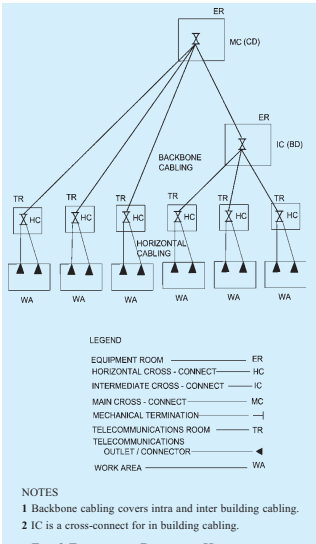
2.4 Backbone — A high-capacity facility (for example, pathway, cable or conductors) which acts as a major pathway within a network from which further smaller capacity facilities get distributed.
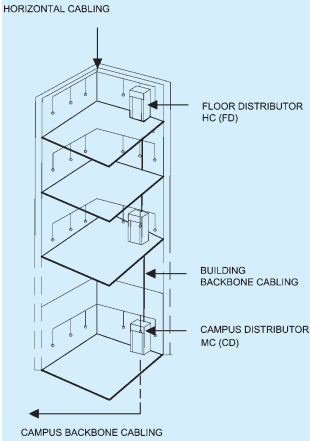
2.5 Backbone Cabling Media Distribution and Building Pathway — A part of a building premises telecom cable distribution system that provides connection between telecommunications spaces. It typically provides building connections between floors in multi-storeyed buildings as well as campus connections in multi-building environments.
2.6 Building Management System — It is a low voltage automation or remote control system installed for managing different building sub-systems like, heating, ventilation, lighting, air conditioning, fire protection, access control, etc.
2.7 Bus Bar — It refers to thick strips of copper or aluminium, in electrical power distribution that conduct electricity within a switchboard, distribution board, substation, or other electrical apparatus.
2.8 Coaxial Cable — A type of wire that consists of a centre wire surrounded by insulation and then a grounded shield of braided wire. The shield minimizes electrical and radio frequency interference.
2.9 Consolidation Point (CP) — A location for interconnection between horizontal cables extending from building pathways and horizontal cables extending into furniture pathways.
2.10 Cross-Connect — A facility enabling the termination of cable elements and their interconnection or cross-connection.
2.11 Direct to Home (DTH) — The direct reception of satellite programs using small dish (personal dish) placed on a roof or window of a house.
2.12 Frequency — The measurement of the number of times that a repeated event occurs per unit of time.
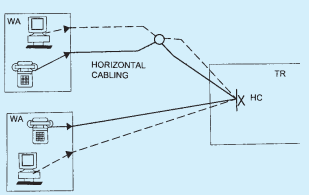
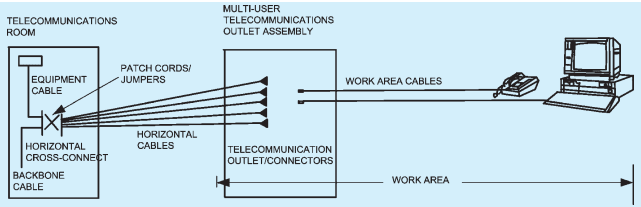
2.13 Horizontal Cabling — It includes, (a) the cabling
between and including the telecommunications outlet/connector and the horizontal cross-connect, and (b) the cabling between and including the building management system outlet or the first mechanical termination of the horizontal connection point and the horizontal cross-connect.
2.14 Horizontal Cabling Media Distribution and Building Pathway — It consists of the horizontal cabling in the building, the horizontal pathways supporting the horizontal cabling, and the telecommunications spaces that support the horizontal pathways. The use of the term horizontal in the name of the element does not require that the elements be placed or installed parallel to the ground or floor.
2.15 Horizontal Cross-Connect (HC) — A cross-connect of horizontal cabling to other cabling, for example, horizontal, backbone, and equipment.
2.16 Inside Plant (ISP) — Telecommunications infrastructure designed for installation, interior to the buildings.
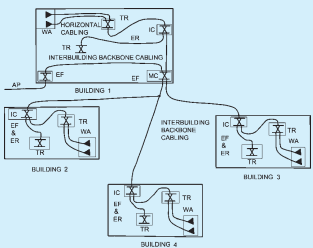
2.17 Intermediate Cross-Connect (IC) — A cross-connect between first level and second level backbone cabling. First level backbone is a cable between a main cross-connect (MC) and intermediate cross-connect (IC) or horizontal cross-connect (HC). Second level backbone exists between an intermediate cross-connect (IC) and horizontal cross-connect (HC).
2.18 Internet of Things (IoT) — A network of all physical objects connected to internet primarily using M2M communication technologies.
2.19 Local Multipoint Distribution System (LMDS) — A broadband radio service designed to provide two-way transmission of voice, high-speed data and video (wireless cable TV) digitally through microwave.
2.20 Local Area Network (LAN) — A computer network covering a local area, like a home, office or small group of buildings.
2.21 Machine to Machine (M2M) Communication — It is a set of wired/wireless communication technologies which enable machine/device (for example sensor, meter, etc) to capture an event (for example temperature, motion, meter reading, etc) and relay through communication network to an application that translates the data from device to a meaningful information.
2.22 Main Cross-Connect (MC) — A cross-connect for first level backbone cables, entrance cables, and equipment cables.
2.23 Main Distribution Frame (MDF) — A structure where all the copper wires, fibre or coaxial cables for a
network terminates for patching/cross-connection on separate or composite frames.
2.24 Metropolitan Area Network (MAN) — A network designed to carry data over an area larger than a campus, such as an entire city and its outlying area.
2.25 Multichannel Multipoint Distribution System (MMDS) — A method of delivering multiple voice/data/television signals digitally by microwave transmission to subscriber households.
2.26 Multi-User Telecommunications Outlet Assembly (MUTOA) — A grouping in one location of several telecommunications outlet/connectors.
2.27 Optical Fibre — It refers to the medium and the technology associated with the transmission of signals/information as light pulses along a glass fibre.
2.28 Optical Distribution Frame (ODF) — Optical fibre distribution frame where ends of optical fibre terminates for further patching/cross-connection.
2.29 Outside Plant (OSP) — Telecommunications infrastructure designed for installation, exterior to the buildings.
2.30 Propagation Delay — In a communications system, it refers to the time lag between the departure of a signal from the source and the arrival of the signal at the destination.
2.31 Public Mobile Network — A network that is established and operated by a telecom service provider for the specific purpose of providing mobile telecommunications services to the public using technologies such as GSM, CDMA and LTE.
2.32 Radio Frequency — A frequency range from 20 kHz and above, used for transmitting/receiving text, data, audio, or video signals.
2.33 Server — Any computer on a network that contains data or applications shared by users of the network on their client terminals.
2.34 Splicing — The process of permanent joining of bare fibre end to another fibre by means of splicing tools.
2.35 Smart City/Building/Home — An innovative city/building/home that uses information and communication technologies, and other means to improve quality of life, efficiency of operation and services and competitiveness, while ensuring that it meets the needs of present and future generations with respect to economic, social and environmental aspects.
2.36 Telecommunication Spaces — The rooms and areas where telecommunications cabling systems are terminated, cross-connected and interconnected to installed telecommunications equipment. Various examples of these
6
based on the function and areas, are equipment room (ER), telecommunications room (TR), entrance facilities (EF) and telecommunication enclosures (TE).
NOTE — The definitions of telecommunication spaces and workspace (see 2.44) are used for calculation of infrastructure requirements, facilities, etc. This does not inhibit the utilization of space for any other purpose. Depending upon the requirements, number of telecommunication spaces in a given building may vary for the same area.
2.37 Telecom Service Provider (TSP) — A service provider who is authorized to operate telecom services by Government of India. It includes telecom Infrastructure Providers (IPs) also.
2.38 Telecom Tower — A vertical structure for installation of antenna(e) that provide radio frequency air interface for telecommunications services. It can also be in the form of mast or multiple poles of varying height. Poles may be located at different points typically on the roof.
2.39 Telecommunication Media and Connecting Hardware — It consists of cables, equipment cords, patch cords, and connecting hardware components. All balanced twisted-pair, optical fibre, coaxial cabling and wireless systems are made up of such components. These cabling components and resulting cabling systems are used in outside plant (OSP) and premises cabling [also known as inside plant (ISP)] environments of the building telecommunication infrastructure.
2.40 Underground Cable Vault (UCV) — An underground cable vault (part of an underground duct system) used to facilitate placing, connecting, and maintaining telecommunications cables and associated equipment. It collectively refers to manholes, hand holes, and pull holes.
2.41 Very Small Aperture Terminal (VSAT) — It usually refers to satellite terminal used to transmit and receive signal from satellites with an antenna installed in user premises.
2.42 Wide Area Network (WAN) — It is a network that is capable of spanning a geographical area larger than a city.
2.43 Workstation — An electronic device that performs some information processing or display function and connects to the communications network. Typically, this may be a desktop computer with keyboard and display or laptop computer, but might also be a telephone, a printer, an access control terminal, or some data-gathering device.
2.44 Workspace — Any location and the space around where a workstation may be located. Typically there can be several workspaces in a room.