This Code (Part 6/Section 6) covers the structural design aspects of steel structures in buildings.
This Section covers the use of hot-rolled structural steel sections and steel tubes in buildings. It covers the design by limit state method and plastic theory, and also enables design by working stress method.
This Section is based on IS 800 : 2007 ‘Code of practice for general construction in steel (third revision)’ and IS 806 : 1968 ‘Code of practice for use of steel tubes in general building construction (first revision)’.
This Section was first published in 1970 and was subsequently revised in 1983 and 2005. In the 2005 version, the detailed design provisions were not included as IS 800 : 1984 ‘Code of practice for general construction in steel (second revision)’ was under revision at that time. This Section, therefore, then referred to the 1984 version of IS 800 with the remarks that the latest version would prevail, as and when published. It, however, covered the philosophical aspects of limit state design which was being introduced in the revision of IS 800. IS 800 was subsequently revised and published as IS 800 : 2007 and hence, became the prevailing version for use under this Section.
In the revision of IS 800 in 2007, in view of the development and production of new varieties of medium and high tensile structural steels in the country, the scope of the standard was modified permitting the use of any variety of structural steel provided the relevant provisions of the standard were satisfied. IS 800 : 2007 makes reference to the latest Indian Standards available for rivets, bolts and other fasteners. The standard is based on limit state method, reflecting the latest developments.
This revision of the Section is intended to bring it in line with the revised version of IS 800 : 2007 read with its Amendment No. 1 and to take care of further improvements and incorporations required. In this revision, therefore, the following major modifications have been made:
a) The table on tensile properties of structural steel products has been updated by including yield stress values of bolts of sizes 3.6 to 6.8 mm as per IS 1367 (Part 3) ‘Mechanical properties of fasteners made of carbon steel and alloy steel – bolts, screws and studs (fourth revision)’ and aligning the corresponding provisions of the table with those given in IS 2062 : 2011 ‘Hot rolled low, medium and high tensile structural steel (seventh revision)’.
b) Provisions relating to mechanical properties of structural steel have been elaborated.
c) Provisions related to effective wind pressure on exposed circular tube members have been included.
d) Provisions related to requirement of temperature stress analysis have been updated.
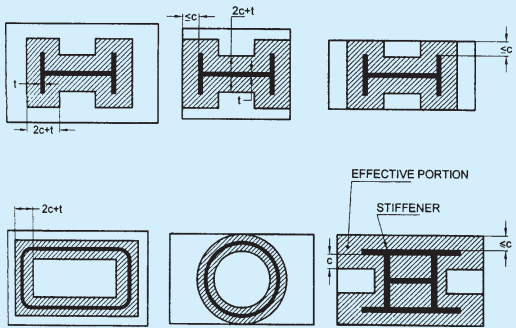
e) Provisions related to slender cross-sections have been updated, with the inclusion of two new figures on effective sections of slender members under pure and flexural compression.
f) The table on deflection limits has been suitably updated with respect to the load nomenclature of the load and their combinations.
g) The term ‘imposed load’ has been substituted for ‘live load’ in coherence with the use of terminology in other published standards.
h) Warping restraint conditions in the table on effective lengths for simply supported beams have been clarified.
j) The provision on assessment of conditions under which fatigue assessment is to be done, is covered comprehensively in 19.2.1.2 ‘Necessity for Fatigue Assessment’, which takes care of 13.5.1 of IS 800 : 2007 as well.
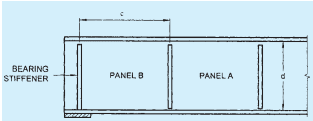
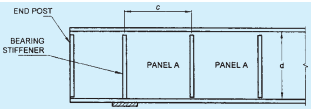
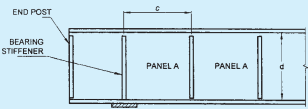
k) Provisions related to design of end panels in stiffened web panels have been updated.
m) Provisions related to design for earthquake loads relating to load and load combinations, response reduction factor for various types of frames, connections in the critical zones of frames, and bracing members have been updated.
n) The nominal bearing pressure between the column base plate and the support has been updated to bring
it line with the corresponding provisions of IS 456 : 2000 ‘Code of practice for plain and reinforced concrete (fourth revision)’.
p) Provisions related to design of single angle struts loaded through one leg have been revised.
q) Provisions related to non-ductile braced and moment resisting frames have been included.
r) Provisions on ductile designing with respect to column base connections have been updated.
s) Reference design conditions under fatigue for S-N curve have been modified.
t) Provisions on clearances related to fabrication procedures have been updated.
u) Sketches of the restraint conditions under table on effective lengths of single stepped columns have been updated.
w) Certain terminologies, symbols and figures have been updated based on the changes incorporated.
y) List of Indian Standards cross-referred in this Section has been updated.
The revised Section will enhance the confidence of designers, engineers, contractors, technical institutions, professional bodies and the industry and will open a new era in safe and economic construction in steel.
In the earlier versions of this Code, the provisions relating to the use of steel tubes in general building construction was based on IS 806 : 1968 ‘Code of practice for use of steel tubes in general building construction’, which was complementary to IS 800. The design using tubular steel in structural applications may be carried using the limit state design provisions in this Section until IS 806 is revised as per limit state design method.
The design of cold-formed steel members is based on the provisions of IS 801 : 1975 ‘Code of practice for use of cold formed light gauge steel structural members in general building construction’. The standard is currently under revision to be based on the limit state design practice. Until the revised IS 801 is published, the cold formed steel members may be designed using the current IS 801, based on the working stress method.
All standards, whether given herein above or cross-referred to in the main text of this Section, are subject to revision. The parties to agreement based on this Section are encouraged to investigate the possibility of applying the most recent editions of the standards.
For the purpose of deciding whether a particular requirement of this Section is complied with, the final value, observed or calculated, expressing the result of a test or analysis, shall be rounded off in accordance with IS 2 : 1960 ‘Rules for rounding off numerical values (revised)’. The number of significant places retained in the rounded off value should be the same as that of the specified value in this Section.
Section 6 Steel
SECTION 6(a) GENERAL