This Code (Part 6/Subsection 5A) covers the structural design aspects of plain and reinforced concrete.
The Section 5 of Part 6 of the Code covers plain and reinforced concrete and also the prestressed concrete. The Section has been subdivided into the following subsections:
5A Plain and Reinforced Concrete
5B Prestressed Concrete
This Subsection 5A was first published in 1970 as Subsection 5A of SP 7 (Part 6) and was subsequently revised in 1983 and 2005, to bring it in line with revised version of IS 456 : 1978 and IS 456 : 2000, respectively on which this chapter was based.
The second revision (NBC 2005) incorporated a number of important changes. The major thrust being:
a) In recent years, durability of concrete structures have become the cause of concern to all concrete technologists. This has led to codify the durability requirements world over. In this revision of the Code, in order to introduce in-built protection from factors affecting a structure, earlier clause on durability has been elaborated and a detailed clause covering different aspects of design of durable structure has been incorporated.
b) Sampling and acceptance criteria for concrete have been revised. With this revision acceptance criteria has been simplified in line with the provisions given in BS 5328 (Part 4): 1990 'Concrete: Part 4 Specification for the procedures to be used in sampling, testing and assessing compliance of concrete'.
Some of the significant changes incorporated in the 2005 version were: inclusion of all the three grades of ordinary Portland cement, namely 33 Grade, 43 Grade and 53 Grade and sulphate resisting Portland cement in the list of types of cement used (in addition to other types of cement); modification of the permissible limits for solids in water keeping in view the durability requirements; modification of the clause on admixtures in view of the availability of new types of admixtures including superplasticizers; inclusion of grades higher than M 40 in Table 2 'Grades of Concrete'; recommendations regarding minimum grade of concrete to be not less than M 20 in reinforced concrete work (see also 5.1.3); revision of the formula for estimation of modulus of elasticity of concrete; specification of workability only in terms of slump, in the absence of proper correlation between compacting factor, vee-bee time and slump, modification of the clause on 'Durability' to include detailed guidance concerning the factors affecting durability; modification of the table on 'Environmental Exposure Conditions' to include 'very severe' and 'extreme' exposure conditions, also covering requirements for shape and size of member, depth of concrete cover, concrete quality, requirement against exposure to aggressive chemical and sulphate attack, minimum cement requirement and maximum water cement ratio, limits of chloride content, alkali silica reaction, and importance of compaction, finishing and curing; incorporation of a clause on 'Quality Assurance Measures' to give due emphasis to good practices of concreting; introduction of proper limits on the accuracy of measuring equipments to ensure accurate batching of concrete; modification of the clause on 'Construction Joints'; and modification of the clause on 'Inspection' to give more emphasis on quality assurance.
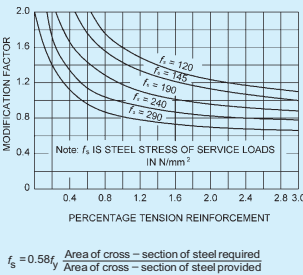
The significant changes incorporated in Section 5A (C) of the 2005 version were: detailing of requirements for ‘Fire Resistance’; modification of the figure for estimation of modification factor for tension reinforcement used in calculation of basic values of span to effective depth to control the deflection of flexural member; addition of recommendations regarding effective length of cantilever; addition of recommendations regarding deflection due to lateral loads; inclusion of recommendations for adjustments of support moments in restrained slabs; introduction of stability index in the determination of effective length of compression members, to determine sway or no sway conditions; inclusion of recommendations for lap length of hooks for bars in direct tension and flexural tension; modification of recommendations regarding strength of welds; modification in recommendations regarding cover to reinforcement; prescription of cover based on durability requirements for different exposure conditions; introduction of the term ‘nominal cover’; and prescription of the cover based on durability requirement as well as for fire requirements.
The significant change incorporated in Section 5A (D) of the 2005 version included modification of the clause on walls. The modified clause includes design of walls against horizontal shear.
In Section 5 of the 2005 version on limit state method, a new clause was added for calculation of enhanced shear strength of sections close to supports. Some modifications were also made in the clause on Torsion. Formula for calculation of crack width were added (separately in Annex F).
Working stress method was added in Annex A so as to give greater emphasis to limit state design. In this annex, modifications regarding torsion and enhanced shear strength on the same lines as in Section 5 have been made.
Whilst the common methods of design and construction have been covered in this code, special systems of design and construction of any plain or reinforced concrete structure not covered by this code may be permitted on production of satisfactory evidence regarding their adequacy and safety by analysis or test or both (see 18).
In this Code it has been assumed that the design of plain and reinforced cement concrete work is entrusted to a qualified engineer and that the execution of cement concrete work is carried out under the direction of a qualified and experience supervisor.
In this third revision of this Subsection, the following major modifications have been incorporated:
a) All the 4 amendments so far issued to IS 456 : 2000 ‘Code of practice for plain and reinforced concrete (fourth revision)’ have been incorporated.
b) Provisions relating to use of mineral admixtures, their effects on properties of fresh and hardened concrete have been elaborated, including precautions associated therewith.
c) Aggregates from other than natural sources, including iron slag aggregate, steel slag aggregate, copper slag aggregate, bottom ash from thermal power plant, and aggregate derived from construction and demolition waste, have been included through cross reference to the revised IS 383, namely IS 383 : 2016 ‘Specification for coarse and fine aggregate for concrete (third revision)’.
d) Provisions relating to stripping time of forms for beams and slabs have been modified, also emphasizing the need for immediate replacement of props have been included.
e) The stripping time in case of the concrete made using cement other than OPC or using cementitious materials like fly ash and slag, has been specified, also giving guidance on minimum cube strength requirements of concrete before removal of formwork in case provision of stripping time applicable for concrete made using OPC, is to be used.
f) Provisions related to self compacting concrete (SCC) and high performance concrete (HPC) have been included as part of special concretes.
g) Design provisions related to steel fibre reinforced concrete have been included as part of special concretes.
h) Provisions related to shear stress for coupled shear walls have been included.
j) Comprehensive provisions on ductile detailing have been included from IS 13920 : 2016 ‘Code of practice for ductile detailing of reinforced concrete structures subjected to seismic forces (first revision)’ to help extensive implementation of ductile detailing provisions in all relevant structures.
k) List of Indian Standards referred as good practice has been updated, especially in view of formulation of a number of new/revision of Indian Standards relating to concrete.
This Subsection is largely based on the following Indian Standards:
IS 456 : 2000 Code of practice for plain and reinforced concrete (fourth revision)
IS 13920 : 2016 Code of practice for ductile detailing of reinforced concrete structures subjected to seismic forces (first revision)
All standards, whether given herein above or cross-referred to in the main text of this Subsection, are subject to revision. The parties to agreement based on this Subsection are encouraged to investigate the possibility of applying the most recent editions of the standards.
For the purpose of deciding whether a particular requirement of this Subsection is complied with, the final value, observed or calculated, expressing the result of a test or analysis, shall be rounded off in accordance with IS 2 : 1960 ‘Rules for rounding off numerical values (revised)’. The number of significant places retained in the rounded off value should be the same as that of the specified value in this Subsection.
(a) General