For the purpose of this Subsection, the following definitions shall apply, and for other terms those given in the accepted standard [6-3A(1)] shall apply.
2.1 Structural Purpose Definitions
2.1.1 Beam, Built-Up Laminated — A beam made by joining layers of timber together with mechanical fastenings, so that the grain of all layers is essentially parallel.
2.1.2 Beam, Glued-Laminated — A beam made by bonding layers of veneers or timber with an adhesive, so that grain of all laminations is essentially parallel.
2.1.3 Bressummer — A beam, across broad opening, sustaining super structure.
2.1.4 Diaphragm, Structural — A structural element of large extent placed in a building as a wall, or roof, and made use of to resist horizontal forces such as wind or earthquakes-acting parallel to its own plane.
2.1.5 Duration of Load — Period during which a member or a complete structure is stressed as a consequence of the loads applied.
NOTE — Timber is stronger under loads of brief duration than under permanently applied loads.
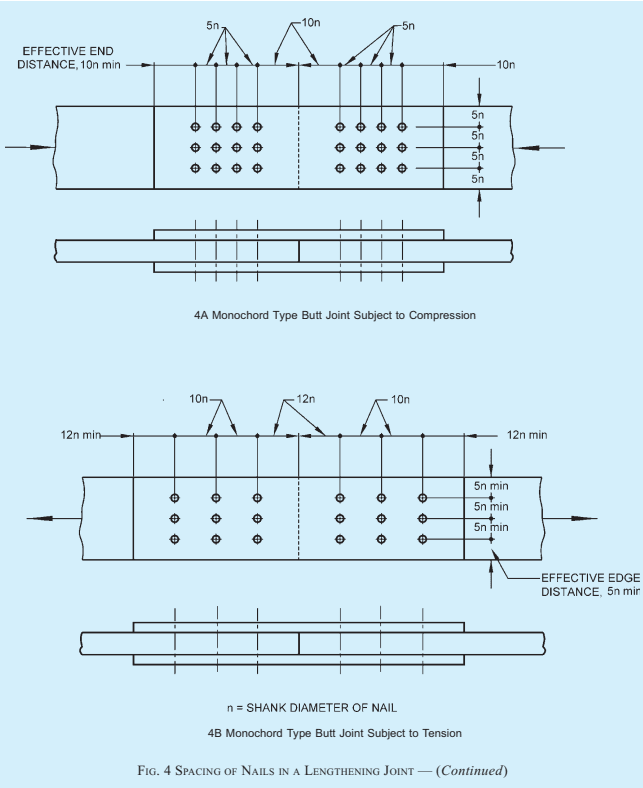
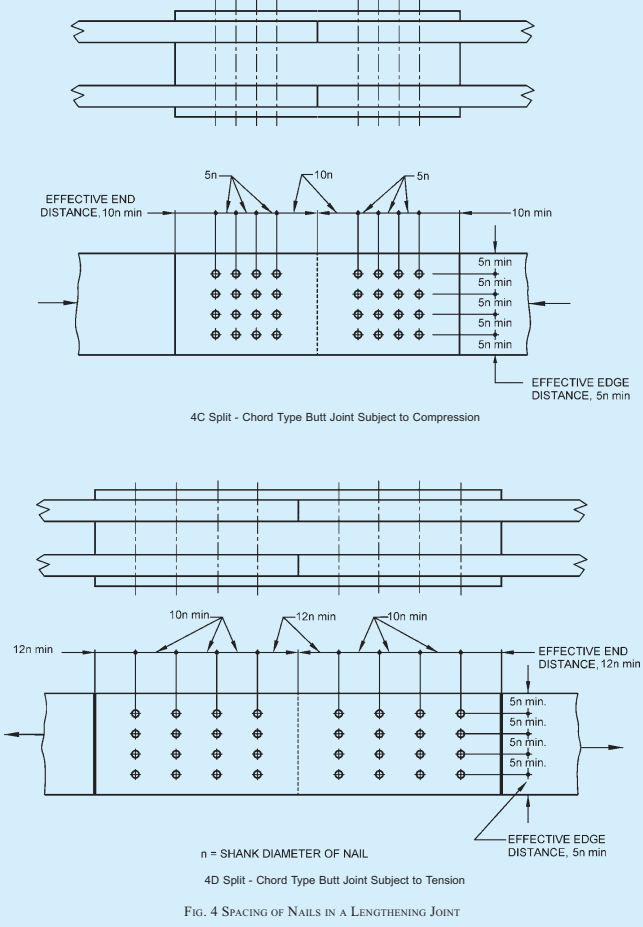
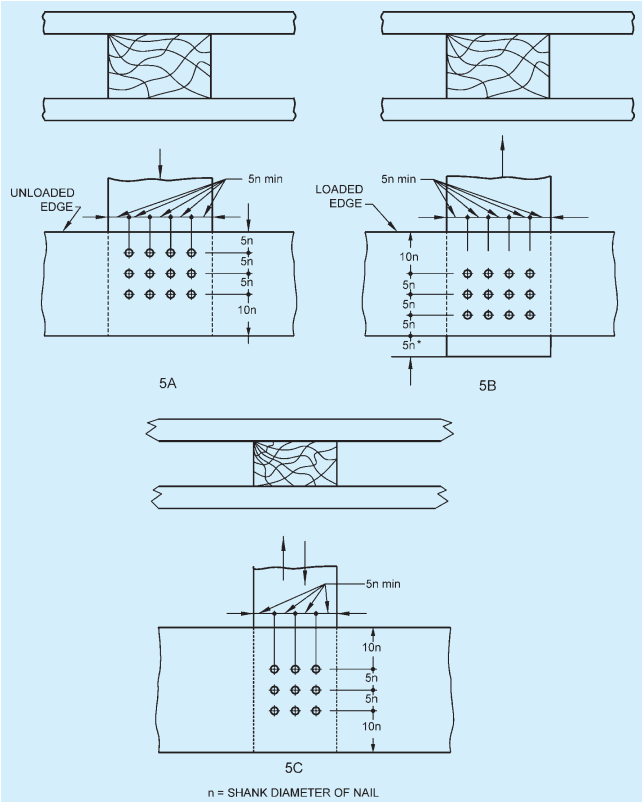
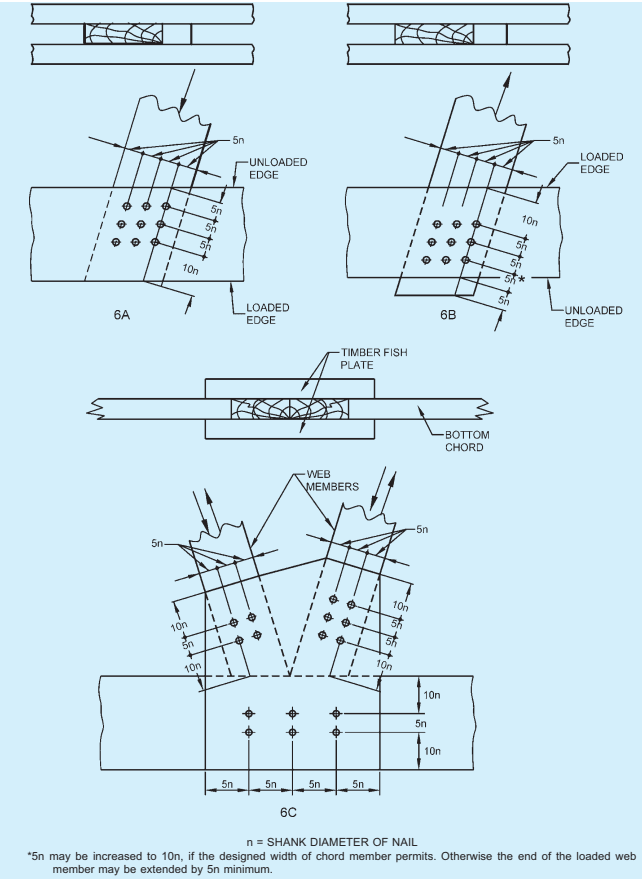
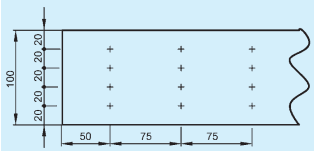
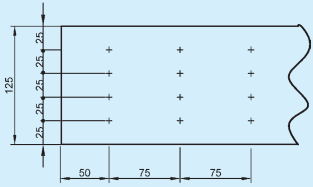
2.1.6 Edge Distance — The distance measured perpendicular to grain from the centre of the connector to the edge of the member.
2.1.7 End Distance — The distance measured parallel to grain of the member from the centre of the connector to the closest end of timber.
2.1.8 Finger Joint — End joint formed by machining a number of similar, tapered, symmetrical fingers in the ends of timber member, which are then bonded together.
2.1.9 Finger Jointed Timber — Timber containing adhesively bonded finger joints spaced at manufacturers specified minimum spacing.
2.1.10 Fundamental or Ultimate Stress — The stress which is determined on small clear specimen of timber, in accordance with accepted standards [6-3A(2)]; and does not take into account the effect of naturally occurring characteristics and other factors.
2.1.11 Glue — A substance capable of holding materials together by surface attachment.
2.1.12 Glued Laminated (Glulam) — A wood structural element comprising of sawn wood lamination bonded together with adhesives and in which the grains of all laminations are parallel longitudinally.
2.1.12.1 Glued laminated, horizontally — Glued laminated timber where gluing planes are perpendicular to the largest dimension of the transverse section, that is, in cross-wise direction.
2.1.12.2 Glued laminated, vertically — Glued laminated timber where gluing planes are perpendicular to the smallest dimension of the transverse section.
2.1.13 Inside Location — Position in buildings in which timber remains continuously dry or protected from weather.
2.1.14 Isoptera — An order of social insects consisting of the termites.
2.1.15 Lamella Roof— A roof or frame, made up of relatively short members, called lamellas, forming a network of framing timbers. This network forms a barrel-like structure of mutually braced and stiffened units, arching over the building between supports, and together with the sheathing forms a diaphragm for resistance of vertical and lateral loads.
2.1.16 Laminations — Thin elements of wood of appreciable width and length which, when superimposed on each other and fastened together with their grains essentially parallel make up cross section of considerable depth or width.
2.1.17 Laminated Veneer Lumber — A structural composite made by laminating veneers, 1.5 to 4.2 mm thick, with suitable adhesive and with the grain of
veneers in successive layers aligned along the longitudinal (length) dimension of the composite.
2.1.18 Latewood — The portion of the wood that is formed in the later part of growth season and consists of thicker walled cells.
2.1.19 Loaded Edge Distance — The distance measured from the centre to the edge towards which the load induced by the connector acts, and the unloaded edge distance is the one opposite to the loaded edge.
2.1.20 Location — A term generally referred to as exact place where a timber is used in building.
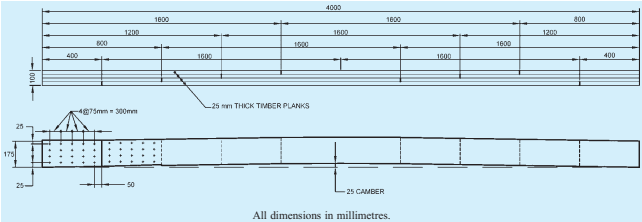
2.1.21 Mechanically Laminated — A wood structural element comprising of laminations which are not glued but which are held together with mechanical fastenings such as nails or bolts and in which all laminations have the grains approximately parallel longitudinally.
2.1.22 Outside Location — Position in buildings in which timbers are occasionally subjected to wetting and drying as in the case of open sheds and outdoor exposed structures.
2.1.23 Permissible Stress — Stress obtained by applying factor of safety to the ultimate stress.
2.1.24 Sandwich, Structural — A layered construction comprising a combination or relatively high-strength facing material intimately bonded to and acting integrally with a low density core material.
2.1.25 Spaced Column — Two column sections adequately connected together by glue, bolts, screws or otherwise.
2.1.26 Stressed Skin — A form of construction in which the outer skin, in addition to its normal functioning of providing a surface covering, acts integrally with the framing members contributing to the strength of the unit as a whole.
2.1.27 Structure, Permanent — Structural units in timber which are constructed for a long duration and wherein adequate protection and design measures have initially been incorporated to render the structure serviceable for the required life.
2.1.28 Structure, Temporary — Structures which are erected for a short period, such as hutments at project sites, for rehabilitation, temporary defence constructions, exhibition structures, etc.
2.1.29 Structural Element — The component timber members and joints which make up a resulting structural assembly.
2.1.30 Structural Grades — Grades defining the maximum size of strength reducing natural characteristics (knots, sloping grain, etc) deemed
permissible in any piece of structural timber within designated structural grade classification.
2.1.31 Structural Timber — Timber in which strength is related to the anticipated in-service use as a controlling factor in grading and selection and/or stiffness.
2.1.32 Stud — One of a series of slender wood structural members placed vertically as supporting members in a wall partition, or similar structural unit.
2.1.33 Termite — An insect of the order Isoptera which may burrow in the wood or wood products of a building for food or shelter.
2.1.34 Wet Location — Position in buildings in which timbers are almost continuously damp or wet in contact with the earth or water, such as piles and timber foundations.
2.2 Definitions of Defects in Timber
2.2.1 Check — A separation of fibres extending along the grain which is confined to one face of a piece of wood.
2.2.2 Compression Wood — Abnormal wood which is formed on the lower sides of branches and inclined stems of coniferous trees. It is darker and harder than normal wood but relatively low in strength for its weight. It can be usually identified by wide eccentric growth rings with abnormally high proportion of growth latewood.
2.2.3 Dead Knot — A knot in which the layers of annual growth are not completely intergrown with those of the adjacent wood. It is surrounded by pitch or bark. The encasement may be partial or complete.
2.2.4 Decay or Rot — Disintegration of wood tissue caused by fungi (wood destroying) or other microorganisms.
2.2.5 Decayed Knot — A knot softer than the surrounding wood and containing decay.
2.2.6 Diameter of Knot — The maximum distance between the two points farthest apart on the periphery of a round knot, on the face on which it becomes visible. In the case of a spike or a splay knot, the maximum width of the knot visible on the face on which it appears shall be taken as its diameter.
2.2.7 Discolouration — A change from the normal colour of the wood which does not impair the strength of the wood.
2.2.8 Knot — A branch base or limb embedded in the tree or timber by natural growth.
2.2.9 Knot Hole — A hole left as a result of the removal of a knot.
2.2.10 Live Knot — A knot free from decay and other defects, in which the fibres are firmly intergrown with those of the surrounding wood. Syn. ‘Intergrown Knot’; cf. ‘Dead Knot’.
2.2.11 Loose Grain (Loosened Grain) — A defect on a flat sawn surface caused by the separation or raising of wood fibres along the growth rings; cf. ‘Raised Grain’.
2.2.12 Loose Knot — A knot that is not held firmly in place by growth or position, and that cannot be relied upon to remain in place; cf. ‘Tight Knot’.
2.2.13 Mould — A soft vegetative growth that forms on wood in damp, stagnant atmosphere. It is the least harmful type of fungus, usually confined to the surface of the wood.
2.2.14 Pitch Pocket — Accumulation of resin between growth rings of coniferous wood as seen on the cross-section.
2.2.15 Sap Stain — Discolouration of the sapwood mainly due to fungi.
2.2.16 Sapwood — The outer layer of log, which in the growing tree contain living cells and food material. The sapwood is usually lighter in colour and is readily attacked by insects and fungi.
2.2.17 Shake — A partial or complete separation between adjoining layers of tissues as seen in end surfaces.
2.2.18 Slope of Grain — The inclination of the fibres to the longitudinal axis of the member.
2.2.19 Sound Knot — A tight knot free from decay, which is solid across its face, and at least as hard as the surrounding wood.