10.1 Introduction
Chandigarh’s sectoral grid has a well-designed system of piped water supply and sewerage disposal. Under the city’s Water Byelaws, every planned dwelling unit has to have water and sewerage connections. With the formation of U.T in 1966, all the works for the city’s physical infrastructure were handled by the respective departments of the Chandigarh Administration. After creation of the Municipal Corporation of Chandigarh in 1994, the city’s water supply, sewerage system, storm water drainage, solid waste management & sanitation, have been transferred to the Municipal Corporation. The Ministry of Urban Development (MOUD) has formulated benchmarks for service delivery in four areas as mentioned in Table at ANNEXURE-P.1. The purpose of formulating these benchmarks is to shift the focus from infrastructure creation to service delivery.
Water supply - sources of water
When Chandigarh was planned, the good availability of sub soil water was considered adequate for meeting the city’s requirements as the yield of tubewells was sufficient. With increase in the city’s population, many tubewells started drying up. It was decided to tap surface water of the Bhakra Main Line flowing at a distance of 27.5 Kms. from Chandigarh to meet the city’s growing water requirements. The first phase of augmentation of water supply from the canal was commissioned in 1983. It was decided by the Government of India that this quantity of water will be shared by Punjab, Haryana, Chandigarh Administration and Chandimandir Cantonment in the following ratios:
Union Territory Chandigarh : 29 cusecs. (14.5 mgd)
Punjab (for Mohali) : 5 cusecs ( 2.5 mgd)
Haryana (Panchkula) : 3 cusecs ( 1.5 mgd)
Chandimandir Cantonment : 3 cusecs ( 1.5 mgd).
Present availability of water
At present the city has access to 87 MGD of water which includes 20 MGD from 200 tube wells and 6 MGD and 3 MGD water share of Haryana and Chandimandir respectively.
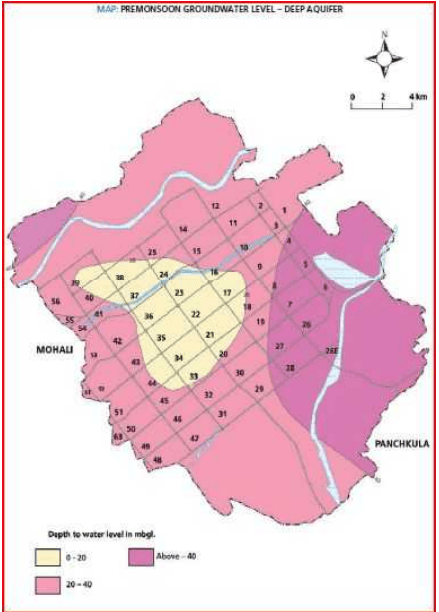
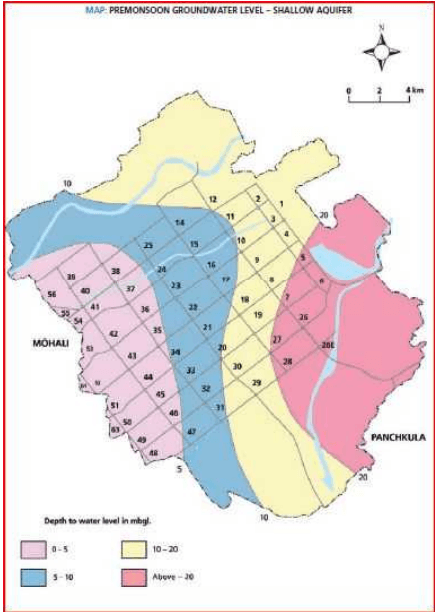
The city taps groundwater from the deep confined aquifers, which do not get naturally recharged. Hence recharging these aquifers is a must. At present Chandigarh is pumping out more water from its aquifers than is being recharged. However, the city not only has a declining deep water table but also has a rising water table in shallow aquifers in the southern sectors creating problems and water logging conditions as per Plan for shallow acquifers at P2 and deep acquifers at P3. (Source: Rainwater harvesting plan for Chandigarh, Centre for Science and Environment, New Delhi, 2011).
To meet the city’s future requirements of water, under JNNURM, Government of India had approved Phases V & VI of water supply scheme from Kajauli. The Punjab Government had initially agreed to release 40 mgd raw water out of which U.T’s share was to be 29 mgd. However, Government of Punjab now wants to use this water exclusively for Mohali area themselves and yet another phase of bringing more water to Kajauli is being negotiated.
With continuously increasing demand for water and uncertainty and disputes plaguing augmentation of canal water supply, Chandigarh needs to develop a comprehensive rain water harvesting plan to ensure long term sustainability of water sources for the city.
Existing Transmission, Distribution and Storage Capacities
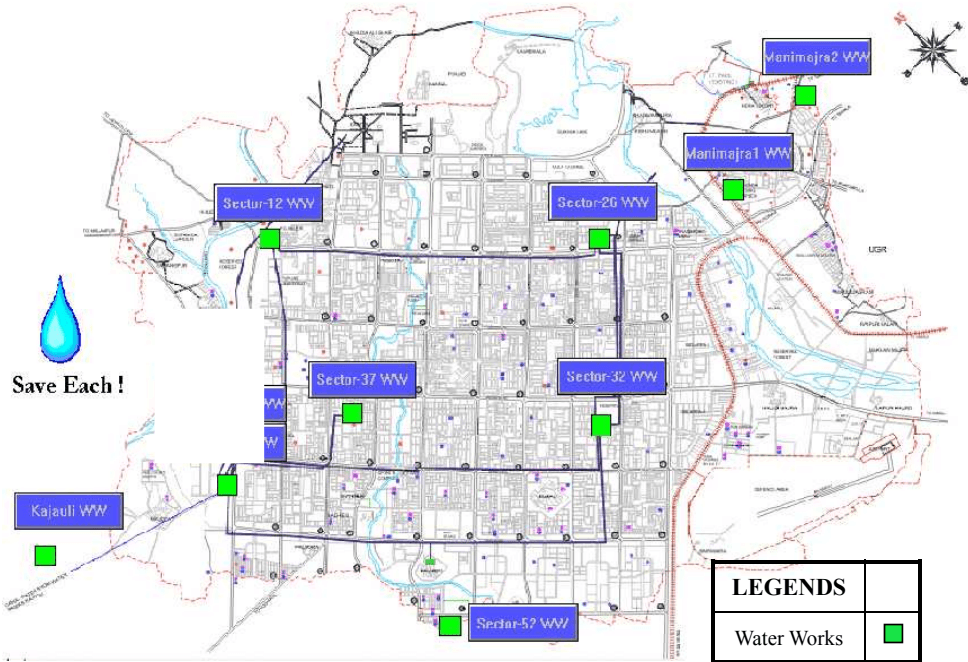
The transmission mains carry water from the raw water source Kajauli, Punjab to the Water Treatment Plant in Sector 39, Chandigarh. The water pumped to the treatment plant is treated, disinfected and stored. This is further pumped to five distribution water works which in turn pump the clear water to the city’s distribution system for use by the consumers. The performance indicators for maintaining the water supply are mentioned at ANNEXURE-P.2.
MAP M1 –
PREMONSOON GROUND WATER LEVEL DEEP ACQUIFERS
MAP M2 –
土
PREMONSOON GROUND WATER LEVEL SHALLOW ACQUIFERS
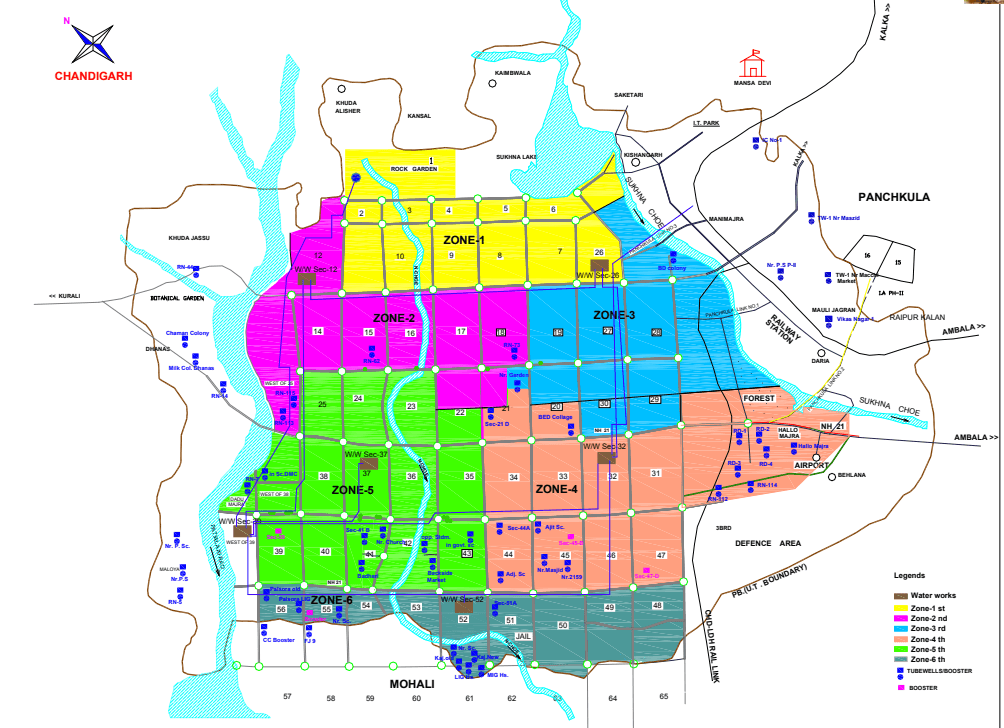
PLAN P1 - ZONING PLAN OF WATER SUPPLY DISTRIBUTION
土
PLAN P2 - WATER WORKS LOCATION PLAN
土
Distribution of water supply in Chandigarh and Manimajra
The city has been divided into 7 zones for the purpose of distribution including the town of Manimajra. The zoning of the city has been done keeping in view the north to south slope of the land. Each zone has a headwork named after its sector. A plan showing the location of tube wells and boosters in the city is at Plan 3 and the plan showing the water supply network is at Plan 4.
Manimajra area
Manimajra is mainly dependent on tubewells for water supply. The two water works at Manimajra are fed by 25 tubewells and canal water from Sector 26 Waterworks ,Chandigarh.
Recycling of waste water
The Government of India has agreed to the proposal of Chandigarh Administration for recycling of treated wastewater. Institutions like PGI, colleges, schools, technical institutions and Punjab University have been asked to disconnect the potable water supply from irrigation of lawns and obtain connection of tertiary treatment water to save precious potable water. The Municipal Corporation has received good response to the proposal. Accordingly, MC has executed a project under JNNURM for supply for treated tertiary water having biochemical oxygen demand (BOD) less than 10 mg/l. Further efforts are being made to utilize tertiary treated water in all green belts and houses having area of over one kanal (500 square yards).