4.1 Species of Bamboo
More than100 species of bamboo are native to India and a few of them are solid but most of them are hollow in structure. Physical and mechanical properties of 20 species of bamboo so far tested in green and dry conditions in round form are given in Table 1.
4.1.1 Grouping
Sixteen species of bamboo found suitable for structural applications and classified into three groups, namely, Group A, Group B and Group C are given in Table 2.
The characteristics of these groups are as given below:
Limiting Strength Values (in Green Condition)
| Modulus of Rupture (R')N/mm² | Modulus of Elasticity (E) in Bending10³ N/mm² | |
|---|---|---|
| (1) | (2) | (3) |
| Group A | R' > 70 | E > 9 |
| Group B | 70 ≥ R' > 50 | 9 ≥ E > 6 |
| Group C | 50 ≥ R' > 30 | 6 ≥ E > 3 |
4.1.2Bamboo species may be identified using suitable methods.
NOTE — Methods of identification of bamboo through anatomical characters have not been perfected so far. Identification through morphological characters could be done only on full standing culm by experienced sorters.
4.1.3 Dendrocalamus strictus and Bambusa arundinacea are the two principal economic species of which the former occupies the largest area and is the most common owing to the vast expanse and suitability as a raw material for industrial uses.
4.2 Species of bamboo other than those listed in the Table 2 may be used, provided the basic strength characteristics are determined and found more than the limits mentioned therein. However, in the absence of testing facilities and compulsion for use of other species, and for expedient designing, allowable stresses may be arrived at by multiplying density with factors as given below:
Allowable Long-Term Stress (N/mm2) per Unit Density (kg/m³)
| Condition | Axial Compression (no buckling) | Bending | Shear |
|---|---|---|---|
| Green | 0.011 | 0.015 | — |
| Air dry (12%) | 0.013 | 0.020 | 0.003 |
NOTE — In the laboratory regime, the density of bamboo is conveniently determined. Having known the density of any species of bamboo, permissible stresses can be worked out using factors indicated above. For example, if green bamboo has a density of 600 kg/m3, the allowable stress in bending would be 0.015 × 600 = 9 N/mm2.
4.3 Moisture Content in Bamboo
With decrease of moisture content (M) the strength of
| Table 1 Physical and Mechanical Properties of Indian Bamboos (in Round Form)(Clauses 4.1 and 5.1.2) | |||||||||
| Sl No. | Species | Properties | |||||||
| In Green Condition | In Air Dry Conditions | ||||||||
| Density kg/m3 | Modulus of Rupture N/mm2 | Modulus of Elasticity 103N/mm2 | Maximum Compressive Strength N/mm2 | Density kg/m3 | Modulus of Rupture N/mm2 | Modulus of Elasticity 103N/mm2 | Maximum Compressive Strength N/mm2 | ||
| (1) | (2) | (3) | (4) | (5) | (6) | (7) | (8) | (9) | (10) |
| i) | Bambusa auriculata | 594 | 65.1 | 15.01 | 36.7 | 670 | 89.1 | 21.41 | 54.3 |
| ii) | B. balcooa | 783 | 65.4 | 7.31 | 46.7 | — | — | — | — |
| iii) | B. bambos (Syn.B.arundinacea) | 559 | 58.3 | 5.95 | 35.3 | 663 | 80.1 | 8.96 | 53.4 |
| iv) | B. burmanica | 570 | 59.7 | 11.01 | 39.9 | 672 | 105.0 | 17.81 | 65.2 |
| v) | B. glancescens (Syn.B.nana) | 691 | 82.8 | 14.77 | 53.9 | — | — | — | — |
| vi) | B. nutans | 603 | 52.9 | 6.62 | 45.6 | 673 | 52.4 | 10.72 | 47.9 |
| vii) | B. pallida | 731 | 55.2 | 12.90 | 54.0 | — | — | — | — |
| viii) | B. polymorpha | 619 | 28.3 | 3.12 | 32.1 | 659 | 35.5 | 4.40 | — |
| ix) | B. tulda | 658 | 51.1 | 7.98 | 40.7 | 722 | 66.7 | 10.07 | 68.0 |
| x) | B. ventricosa | 626 | 34.1 | ||||||
4.4 Grading of Structural Bamboo
4.4.1 Grading is sorting out bamboo on the basis of characteristics important for structural utilization as under:
a) Diameter and length of culm,
b) Taper of culm,
c) Straightness of culm,
d) Inter nodal length,
e) Wall thickness,
f) Density and strength, and
g) Durability and seasoning.
One of the above characteristics or sometimes combination of 2 or 3 characteristics form the basis of grading. The culms shall be segregated species-wise.
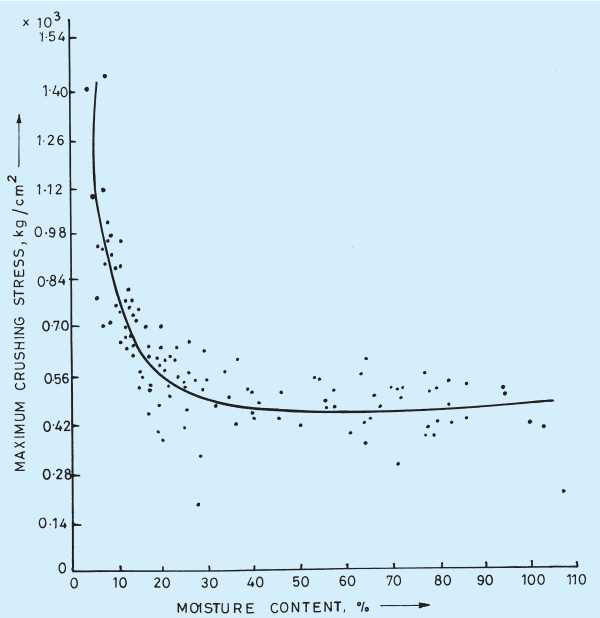
FIG. 1 MOISTURE STRENGTH RELATIONSHIP BAMBUSA NUTANS (BAMBOO)
4.4.2 Diameter and Length
4.4.2.1 Gradation according to the mean outer diameter
For structural Group A and Group B species, culms shall be segregated in steps of 10 mm of mean outer diameter as follows:
4.5 Durability and Treatability
4.5.1 Durability
The natural durability of bamboo is low and varies between 12 months and 36 months depending on the species and climatic conditions. In tropical countries the biodeterioration is very severe. Bamboos are generally destroyed in about one to two years’ time when used in the open and in contact with ground while a service life of two to five years can be expected from bamboo when used under cover and out of contact with ground. The mechanical strength of bamboo deteriorates rapidly with the onset of fungal decay in the sclerenchymatous fibres. Split bamboo is more rapidly destroyed than round bamboo. For making bamboo durable, suitable treatment shall be given.
4.5.2 Treatability
Due to difference in the anatomical structure of bamboo as compared to timber, bamboo behaves entirely differently from wood during treatment with preservative. Bamboos are difficult to treat by normal preservation methods in dry condition and therefore treatment is best carried out in green condition in accordance with good practice [6-3B(2)].
4.5.2.1 Boucherie Process
In this process of preservative treatment, water borne preservative is applied to end surface of green bamboo through a suitable chamber and forced through the bamboo by hydrostatic or other pressure.
4.5.2.2 Performance of treated bamboo
Trials with treated bamboos have indicated varied durability depending upon the actual location of use. The performance in partially exposed and under covered conditions is better.
4.5.2.3 For provisions on safety of bamboo structures against fire, see Part 7 ‘Constructional Practices and Safety’.