This section covers the approach and methodology to ensure efficient and equitable water distribution across PMR through demand assessment, provision of land reservation for physical infrastructure and water conservation strategies. PMR water demand assessment is carried out considering the recommended rate of water supply and population projections. The details of the water management are provided below.
Water Demand
The 18 Urban Growth Centres comprise 233 villages while the 8 Rural Growth Centres comprise 8 villages. The total projected population of the Growth Centres is 40.74 lakh and that of the rural villages is 13 lakh. Demand for the said population is worked out based on MWRRA guidelines. Accordingly, the rate of water supply for urban and rural areas varies. The rate of water supply adopted for Growth Centres is 90 LCPD while that of rural is 55 LPCD.
However, as per the same guidelines, 30% of recycled water (27 LPCD) is considered while calculating the total water demand. The recycled water could be used for non-drinking uses such as agriculture, gardening, car washing, etc. After reducing the demand by considering recycled water, the fresh water requirement works out to be 62 LPCD. Nonetheless, 15% losses are added to the fresh water requirement which sums up to 72.45 LPCD for the Growth Centre villages. After adding the 30% recycled water to the fresh water requirement, the total rate of
water supply works out to be 90 LPCD. In case of rural villages, although the rate of water supply is 55 LPCD as per the MWRRA guidelines, 15% losses are factored in, resulting in a total of 63.25 LCPD for rural villages.
Following is the total water demand for PMR based on 72.45 LCPD for Growth Centre villages and 63.25 LCPD for rural villages
| Villages | Population | Rate | of Water Supply Wa | ter Demand (mm3) |
|---|---|---|---|---|
| Growth Centre | 241 | 4094823 | 72.45 LCPD | 108.35 |
| Rural Villages | 573 | 1335311 | 63.25 LCPD | 30.82 |
| Total | 814 | 5430134 | 139.17 (4.9TMC) |
Water Sources:
Reservoirs in PMR are classified into major, medium and minor categories using the guidelines provided by the State Water Resource Department. These reservoirs are the key source for different water needs such as drinking water, domestic use, agriculture and industrial use. While devising water supply strategies for PMR, it has been noted that certain water sources have limitations of use due to prior commitments. However, the sources identified are available within PMR and its immediate surroundings to provide an efficient and cost effective system. Similarly, although Chaskaman dam, Bhatghar dam, Nira-Deodhar and Ghod Dam are situated outside PMR, they are considered as water sources for PMR. Currently, 35 sources have been identified serving the 814 villages.
The data regarding sanctioned water and availability of water from the live storage of each dam is collected from various divisions of WRD by the appointed consultant, and water supply planning is done accordingly. Water availability data is dynamic in nature, as many entities depend on the same sources of water. In order to carry out a well informed water supply plan, the data is collected and captured until 31st May 2021.
Water supply Strategies:
-
Decentralised system is adopted for assigning villages to the source along with an integrated approach while planning for the water supply system, to reduce on the capital cost.
-
Topography is the prime criteria, where villages are divided based on ridges.
-
Utilisation of gravitational force for flow of water is key to identifying villages, reducing the requirement of pumping and thus providing for energy saving.
-
The principles of River Basins viz. Sub-basins like Mutha sub basin, Mula sub basin, Pawana sub basin, Indrayani sub basin, Andra sub basin, Bhama sub basin and so on are considered while planning, then following the revenue boundaries. It is rational, logical & technically viable to follow this concept simply because any natural water course follows the basin rules.
-
Villages within watersheds for that particular source are identified and water demand is fulfilled accordingly.
-
In most of the cases, water supply to Growth Centres is provided from major and medium size projects based on availability and proximity.
-
Only local villages within the immediate vicinity of the M.I. tanks are considered as dependent for that particular M. I. Tank.
-
Temghar, Khadakwasla, Vadiwale and Varasgaon are the four dams whose water allocation is already planned for, thus these dams are excluded from the list of water sources. However, the villages edging the submergence line are considered depending on these dams.
-
Detailed planning & design of the bulk transmission lines will be done at the stage of detailed DPR.
-
Equitable and incremental water demand: The equitable water distribution philosophy shall be adopted which will overcome the issue of water scarcity. The rate of water supply shall be in incremental basis based on the financial viability and recovery strategies
-
Renewable energy for pumping and other electric requirements to be promoted
-
It is also desirable to promote recycling of at least 30% of Wastewater and reuse facilities so that the irrigation and the non-domestic water demand can be fulfilled from the recycle source.
-
Implement the SCADA system for ease in operation and maintenance of the water supply, conveyance and treatment system.
Chapter 16: Proposed Utility
Water Supply Plan
Water Zones:
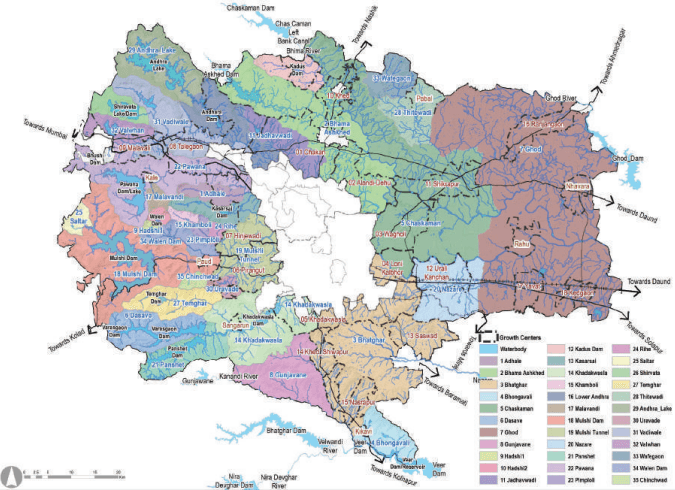
Based on above strategies, 35 sources which include major, medium dams and M. I. Tanks are proposed as part of the Water Supply Plan. Thus, 35 such zones are planned surrounding each source, indicating the number of villages- urban and rural, depending on that particular source. Figure 16.1 and Table 16.2 lists the source and the dependent villages. Also, increase in urbanisation would lead to reducing land under agricultural activities. Additionally, by using advanced technology for use of water in agricultural usage, would help in mitigating irrigation water demand.
As per the proposed Water Supply Plan, Bhatghar, Chaskaman and Mulshi Tunnel reservoirs will supply 48% of the water demand of PMR. Ghod Dam (98 villages) followed by Bhatghar (75 villages), Chaskaman (76 villages), Pawana Dam (63 villages) and Bhama Asked (56 villages) serve 45% of PMR.
Figure 16.1: Water Supply Plan- Zones
| Name of Source / Zone | Type of Source | No. of Villages covered | Storage Details | Sanc-tioned Reserva-tion | Year (2031) | Year (2041) | No. of Villages of Growth Centre | |||
| Total | Quantity(mm3) | Popula-tion | Annual Water Demand(mm3) | Popula-tion | Annual Water Demand(mm3) | UGC | RGC | |||
| Khadakwasla | Major | 44 | 85.91 | 271628 | 6.91 | 370469 | 9.39 | |||
| Temghar | Major | 15 | 107.96 | 7919 | 0.18 | 8149 | 0.19 | |||
| Warasgaon/Dasave | Major | 21 | 375.36 | 32947 | 0.76 | 33211 | 0.77 | |||
| Panshet | Major | 26 | 310.61 | 9886 | 0.23 | 10269 | 0.24 | |||
| Total | 879.84 | 424.89 | 10 | 1 | ||||||
| Chaskaman | Major | 76 | 241.69 | 26.44 | 679143 | 17.47 | ||||
Water Treatment Plants:
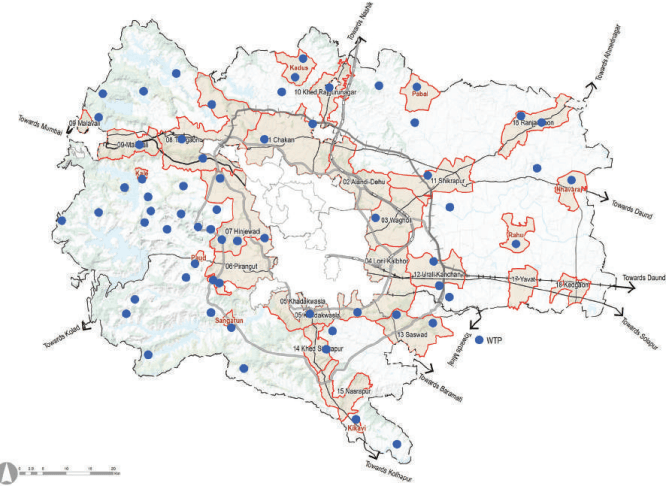
As discussed earlier, reservoirs are considered as the primary source of drinking water. PMR is divided into 35 zones considering river basins in the region. Water treatment plant (WTP) locations are considered near the source but at a higher elevation and also within each of the Growth Centre, accentuating the decentralised water supply system, making each Growth Centre self-sufficient. Availability of water in these reservoirs have led to varying numbers of villages in different zones. The design parameters for water supply system components are based on the CPHEEO manual reference guidelines. Area allocation for each WTP is done based on URDPFI guidelines. Elevated Storage Reservoir (ESR) or Ground Storage Reservoir could be proposed during the detailed project report stage based on gravitational force and water demand.
26 WTPs are proposed in Growth Centres, each with an area ranging from 0.2 to 1 ha, while 8 are proposed within Rural Growth Centre. Further details are available in Table 16.3. Figure 16.2 shows the location of WTPs, reservoirs and zones as part of the Water Supply Plan.
Figure 16.2: Water Supply Plan- WTP locations
Modular and efficient systems
PMRDA is adopting modular (i.e. scaling up capacity as and when required) approach for setting up of WTPs so as to reduce upfront capital investment, avoid underutilisation of facility and to provide flexibility in terms of scaling up the capacity in future.
Feasibility of using the existing water supply system would be checked and proposals for augmentation to the same would be prepared during the DPR stage for long term sustainability. Further, the system components of each WTP will be designed considering minimisation of operation and maintenance and efficient working in the remote areas, case to case and demand basis.
Non- Revenue Water (NRW): The NRW comprises physical losses and financial losses in the water supply system. The proposed plan intends to promote use of automation systems like SCADA for bulk supply along with smart water metering and laying of closed pipe conduits, in order to reduce the rate of NRW to 15% level. In the initial year the baseline of NRW could be established through water audits and sample surveys. Then the annual targets could be set to achieve the benchmark of 15% NRW.
Water Conservation Strategy:
Balancing reservoirs: Quarry areas hold the opportunity for developing some of the non-functional quarries into water reservoirs. Due to the quarrying activity for extracting stones and other construction materials, natural water containers are formed. These containers are lined by impermeable surface, providing a good opportunity for developing them as balancing reservoirs. These cases would be implemented, after detailed study of its feasibility, within existing quarries in Chakan, Alandi and Wagholi Growth Centres, by lifting water from the Indrayani River and refilling these reservoirs. Some of these reservoirs are at higher elevation, water could be drawn through gravitational force.
Augmentation of existing sources: The existing M.I. tanks are based on the FRL received from the State Water Resources Department. Periodic desilting of the tank would be required. However, in case the water requirement increases, water holding capacity of certain M.I tanks, after detailed study, could be increased by raising the height of Waist Weir Bar. In order to provide for the raise in height, provision is made by proposing green belt skirting the M.I. tanks.
Developing barrages: Certain rivers like Bhima, where excess water is available, barrages could be developed across certain cross-sections of the river. This would aid in arresting and utilising the excess water as an alternative water source. It could only be done in concurrence with the State Water Resources Department, also by aligning with the Interstate Water Distribute Tribunals.
Preservation of Shivkalin lakes: PMR has a rich heritage and certain lakes are part of it. Few ‘Shivkalin’ lakes are observed in PMR, specially in Daund Taluka. It is proposed that these lakes could be re-utilised and maintained further by lifting water from near-by water sources and filling these lakes. These would act as additional water sources for the local villages surrounding the lakes.
Rainwater harvesting: As per U-DCPR, rainwater harvesting is promoted with incentives for newer developments. However, rainwater harvesting could also be taken up by individual Grampanchayat, creating a local water source for the village, making it self sufficient. This could be readily done in the Western Ghat villages, where rainfall is heavy and high water-run off. These percolation tanks could be proposed within the proposed afforestation zone at foothills.
Catchment Treatment Plan/ Increase in Ground-water: Ground water table within PMR is depleting rapidly. In order to increase the percolation of rainwater and augment the ground-water table, Catchment Treatment Plan (CTP) could be proposed. It involves certain majors such as creating bunds across nalas, trenching, constriction of Gabion walls, dense plantation of indigenous trees along slope, reducing the downhill water force, could be proposed. Deepening and widening of streams, construction of earthen stop dams and digging of farm ponds are few other steps which could be further taken up.
Storm-water Management Plan: The urbanised areas in PMR are facing serious issues of stormwater and surface runoff management due to diversion of the natural runoff pattern, encroachment on the natural streams, and inefficient surface runoff management. The issue of flooding in some parts of the rural areas is observed in the region on the southern and northern side. The effective runoff management, defining the correct runoff intensity and runoff management with rain water harvesting mechanism could overcome the present situation. It is thus recommended that a Storm Water Management Plan could be prepared considering effective guidelines of CPHEEO, GIS analysis and Sewer GEMS.