This chapter covers the Vision Framework for PMR. It consists of the vision, goals and strategies to guide the development of the Pune Metropolitan Region over the next 20 years. Five goals form the fundamental pillars of the proposed vision. The objective behind the formulation of the vision framework is to inform the downstream planning process and execution.
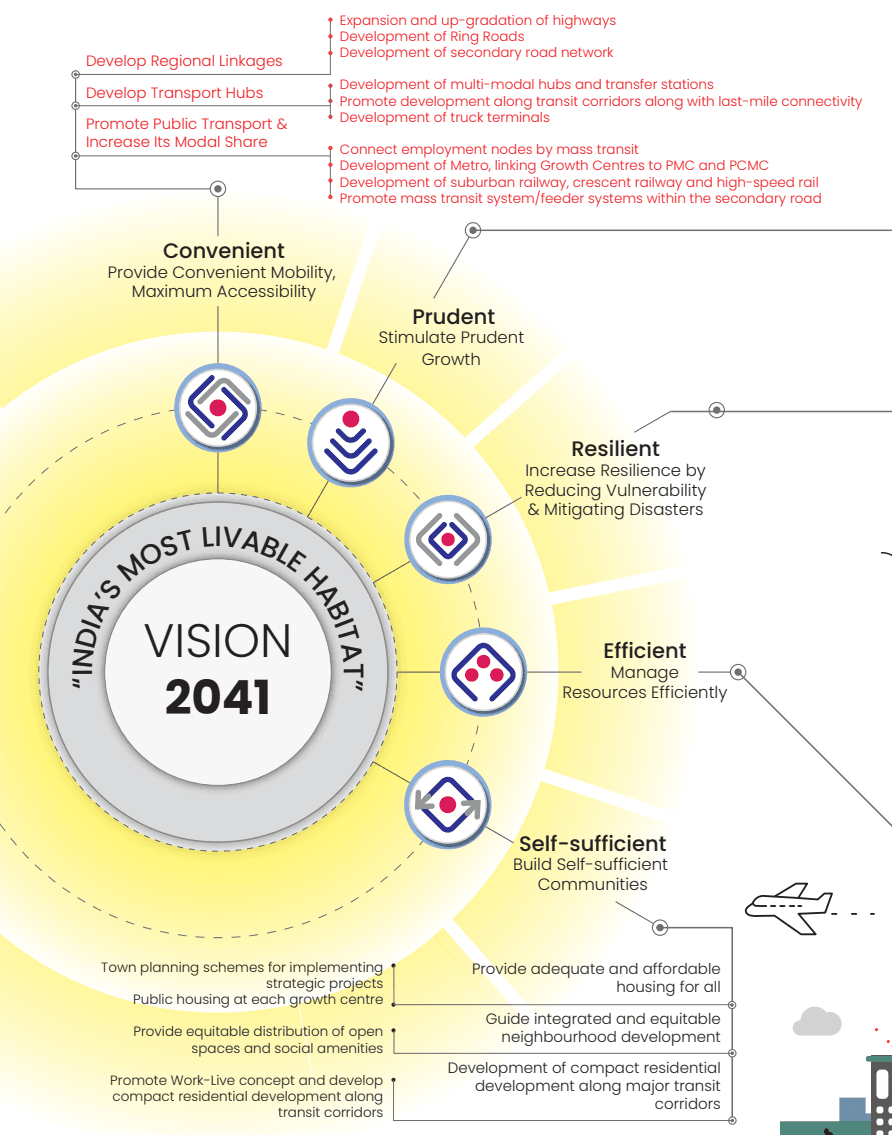
By 2041, the Study Area is envisaged to become India’s most livable habitat through setting up and realisation of five goals: Convenient (Mobility), Prudent (Economy), Resilient (Environment), Efficient (Infrastructure) and Self-sufficient (Housing and Amenities). The vision is synchronised with PMRDA’s mission to make PMR a premium international investment destination - ultra-modern and futuristic.
12.1Background
A bold and clear vision is needed to convey an overarching planning intent along with quantifiable goals and strategies to precisely guide the downstream development. Five goals - Resilient (Environment), Efficient (Infrastructure), Convenient (Mobility), Prudent (Economy) and Self-sufficient (Housing and Amenities) are fundamental pillars of the development of PMR. These five goals will guide strategic actions to implement the proposed vision.
The proposed vision for the Study Area takes into consideration its world-view and core competencies.
The World-view
‘Queen of the Deccan’ is a world view of Pune, primarily attributed to its green setting. A substantial part of the Study Area is covered by the Western Ghats that creates this setting. Its green setting shall underpin PMR’s vision.
Core Competencies
Proximity to Mumbai, robust industrial ecosystem and education base with potential for expansion, relatively cheaper land values and commutable size are core competencies of PMR. Key regional development projects such as new international airport, ring roads, railway up-gradation, and metros are expected to boost PMR’s regional economic competitiveness further.
Relatively safe environment, scenic recreational destinations and culturally vibrant Pune city is also a unique combination that PMR offers compared to other metropolitan regions. Excellent natural setting endowed by the Western Ghats, which is omnipresent all across the PMR, truly sets it apart from its peers.
12.2Proposed Vision
Vision 2041 “india’s Most Livable Habitat”
Globally, the assets mentioned above are considered as basic parameters to define the livability of a place. Considering the increasing stress on urban livability, the Study Area shall proactively harness these assets to become India’s most Livable Metropolitan Habitat (Metropolitan Region). It shall ensure livability by implementing five Goals as illustrated subsequently in this chapter.
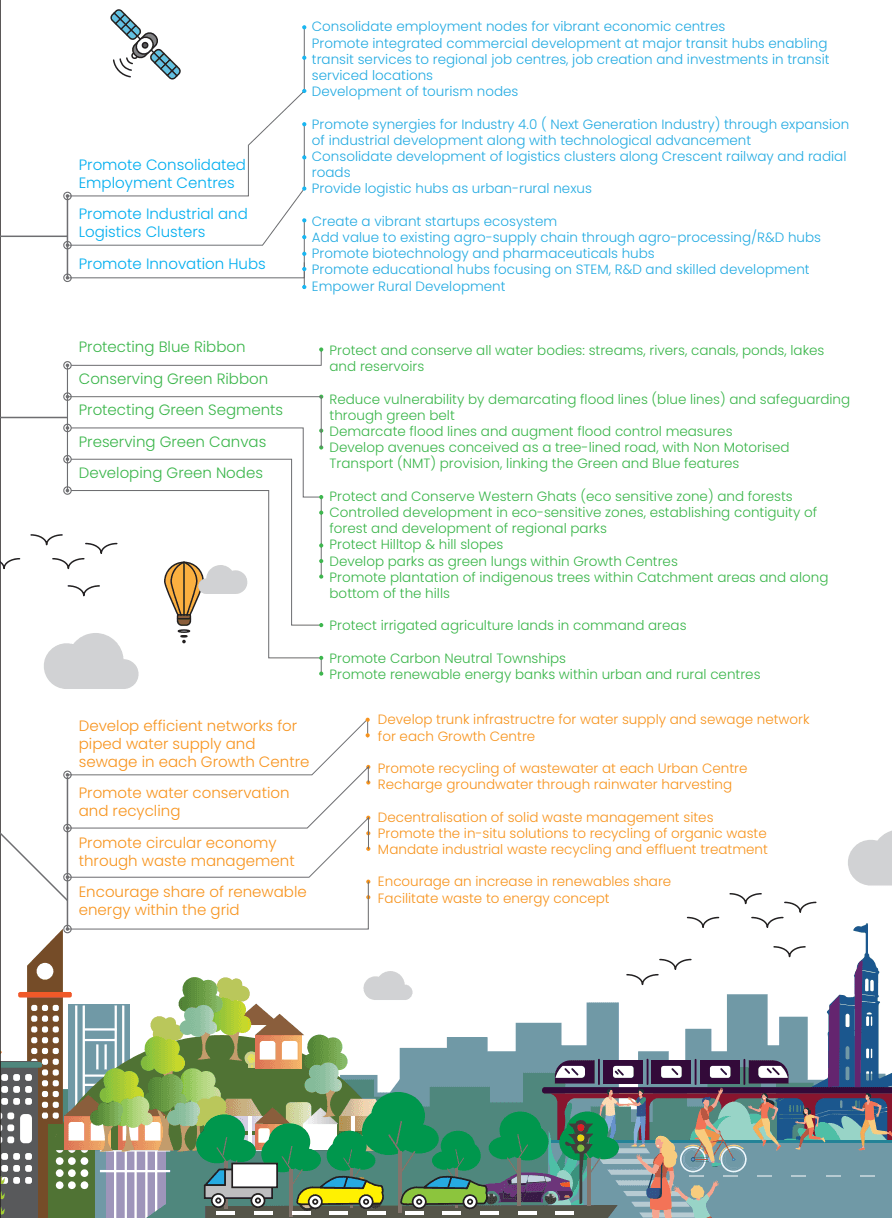
Consolidate employment nodes for vibrant economic centres Promote integrated commercial development at major transit hubs enabling transit services to regional job centres, job creation and investments in transit serviced locations Development of tourism nodes
Promote Consolidated Employment Centres
Promote Industrial and Logistics Clusters
Promote Innovation Hubs
Conserving Green Ribbon
Protecting Green Segments
Preserving Green Canvas
Promote synergies for Industry 4.0 ( Next Generation Industry) through expansion of industrial development along with technological advancement Consolidate development of logistics clusters along Crescent railway and radial roads Provide logistic hubs as urban-rural nexus
Create a vibrant startups ecosystem Add value to existing agro-supply chain through agro-processing/R&D hubs Promote biotechnology and pharmaceuticals hubs Promote educational hubs focusing on STEM, R&D and skilled development Empower Rural Development
Protect and conserve all water bodies: streams, rivers, canals, ponds, lakes and reservoirs
Reduce vulnerability by demarcating flood lines (blue lines) and safeguarding through green belt
Demarcate flood lines and augment flood control measures Develop avenues conceived as a tree-lined road, with Non Motorised Transport (NMT) provision, linking the Green and Blue features
Protect and Conserve Western Ghats (eco sensitive zone) and forests Controlled development in eco-sensitive zones, establishing contiguity of forest and development of regional parks Protect Hilltop & hill slopes Develop parks as green lungs within Growth Centres Promote plantation of indigenous trees within Catchment areas and along bottom of the hills
Develop efficient networks for piped water supply and sewage in each Growth Centre
Promote water conservation and recycling
Promote circular economy through waste management
Develop trunk infrastructre for water supply and sewage network for each Growth Centre
Encourage share of renewable energy within the grid
Promote recycling of wastewater at each Urban Centre Recharge groundwater through rainwater harvesting
Promote Carbon Neutral Townships Promote renewable energy banks within urban and rural centres
Decentralisation of solid waste management sites Promote the in-situ solutions to recycling of organic waste Mandate industrial waste recycling and effluent treatment
Encourage an increase in renewables share Facilitate waste to energy concept
Protect irrigated agriculture lands in command areas
Goals, Objectives and Actions
Goal 1 - Convenient: Provide Convenient Mobility, Maximum Accessibility
The convenient goal aims to facilitate complete ease of access to transit facilities, thereby inducing people to use public transportation over the private mode of transport and prefer to walk. In order to achieve the ‘Convenient’ goal, the following strategies and actions are proposed:
Objective
Actions
Develop Regional Linkages
Action 1: Expansion and up-gradation of highways
Action 2: Development of Ring Roads
Action 3: Development of secondary road network
Develop Transport Hubs
Action 4: Development of multi-modal hubs and transfer stations
Action 5: Promote development along transit corridors along with last-mile connectivity
Action 6: Development of truck terminals
Promote Public Transport and Increase Its Modal Share
Action 7: Connect employment nodes by mass transit
Action 8: Development of Metro, linking Growth Centres to PMC and PCMC
Action 9: Development of suburban railway, crescent railway and high-speed rail
Action 10: Promote mass transit system/feeder systems within the secondary road
Goal 2 - Prudent: Stimlate Prudent Growth
The prudent goal aims at delivering a stimulus to the economy and employment through following strategies and actions:
Objectives
Actions
Promote Consolidated Employment Centres
Action 1: Consolidate employment nodes for vibrant economic centres Action 2: Promote integrated commercial development at major transit hubs enabling transit services to regional job centres, job creation and investments in transit serviced locations Action 3: Development of tourism nodes
Promote Industrial and
Action 4: Promote synergies for Industry 4.0 ( Next Generation Industry) through expansion of industrial development along with technological advancement Action 5: Consolidate development of logistics clusters along Crescent railway and
Logistics Clusters
radial roads Action 6: Provide logistic hubs as urban-rural nexus
Promote Innovation Hubs
Action 7: Create a vibrant startups ecosystem Action 8: Add value to existing agro-supply chain through agro-processing/R&D hubs Action 9: Promote biotechnology and pharmaceuticals hubs Action 10: Promote educational hubs focusing on STEM, R&D and skilled development Action 11: Empower Rural Development
Chapter 12: Vision Framework
Goal 3 - Resilient: Increase Resilience by Reducing Vulnerability and Mitigating Disasters
The resilient goal aims to mitigate disasters through appropriate measures, which would help reduce the vulnerability of PMR to both natural and human-made disasters. In order to achieve the ‘Resilient’ goal, the following strategies and actions are proposed:
Objectives
Actions
Protecting Blue Ribbon
Action 1: Protect and conserve all water bodies: streams, rivers, canals, ponds, lakes and reservoirs
Conserving Green Ribbon
Action 2: Reduce vulnerability by demarcating flood lines (blue lines) and safeguarding through green belt Action 3: Demarcate flood lines and augment flood control measures Action 4: Develop avenues conceived as a tree-lined road, with Non Motorised Transport (NMT) provision, linking the Green and Blue features
Protecting Green Segments
Action 5: Protect and Conserve Western Ghats (eco sensitive zone) and forests Action 6: Controlled development in eco-sensitive zones, establishing contiguity of forest and development of regional parks Action 7: Protect Hilltop & hill slopes Action 8: Develop parks as green lungs within Growth Centres Action 9: Promote plantation of indigenous trees within Catchment areas and along bottom of the hills
Preserving Green Canvas
Action 10: Protect irrigated agriculture lands in command areas
Developing Green
Action 11: Promote Carbon Neutral Townships
Nodes
Action 12: Promote renewable energy banks within urban and rural centres
Goal 4 - Efficient: Manage Resources Efficiently
The efficient goal aims to ensure availability and sustainable water and sanitation management through improved physical infrastructure and balanced distribution of natural resources. In order to achieve the ‘Efficient’ goal, the following strategies and actions are proposed:
Objectives
Actions
Develop efficient systems for water supply and sewage in each Growth Centre
Action 1: Develop trunk infrastructure for water supply and sewage network for each Growth Centre
Promote water conservation and recycling
Action 2: Promote recycling of wastewater at each Urban Centre
Action 3: Recharge groundwater through rainwater harvesting
Promote circular economy through waste management
Action 4: Decentralisation of solid waste management sites
Action 5: Promote the in-situ solutions to recycling of organic waste
Action 6: Mandate industrial waste recycling and effluent treatment
Encourage share of renewable energy within the grid
Action 7: Encourage an increase in renewables share
The self-sufficient goal aims at inclusive and equitable distribution of amenities, ensuring healthy lives and promoting well-being for all. In order to achieve the ‘Self Sufficient’ goal, the following strategies and actions are proposed:
Objectives
Actions
Provide adequate and
Action 1: Town planning schemes for implementing strategic projects
affordable housing for all
Action 2: Public housing at each growth centre
Guide integrated and
equitable neighbourhood
Action 3: Provide equitable distribution of open spaces and social amenities
development
Development of compact
residential development
Action 4: Promote Work-Live concept and develop compact residential development
along major transit
along transit corridors
corridors
In summary, the vision and its implementation strategy are detailed in the above structure incorporating 45 actions. The livability of the region would largely depend on the successful implementation of the strategies stated above and corresponding representative actions.
12.3Structure: Translating Goals into Physical Planning Strategies
Proposed zoning ensures that the sectoral development goals are clearly conveyed through it. For brevity, proposed sectoral goals and their corresponding physical planning strategies are mentioned in Table 12.1.
Table 12.1Goals and Physical Planning Strategies
Goal
Development Sector Addressed
Physical Planning Strategies
Convenient
Roads and Mass Transport
Movement Lattice
Prudent
Employment and Housing
Work- Live Hubs
Resilient
Reducing Vulnerability and Mitigating Disasters
Green-Blue Connectors
Efficient
Infrastructure and Utilities
Decentralised Resource Management
Self- sufficient
Public Facilities
Walkable Neighbourhoods
Subsequent sections elaborate on each of the goals, strategies and translation of sectoral development goals into appropriate zoning plans.
Movement Lattice Concept
In order to provide maximum accessibility and flexibility for the use of public transport and ease of movement, a grid network is proposed. Thus the concept ‘Movement Lattice’ is proposed to develop a robust network of roads and mass transit.
‘Convenient’ goal would be addressed by developing a strong road network so that all the developable areas would be conveniently accessible
It would also provide alternative routes to congested areas, thus inducing smoother traffic flows
Reduce the average time spent commuting to work
Intermodal integrations that are creating transport nodes within the lattice
It implies a lattice (a grid) formed by the existing/proposed roads following maximum spacing of 300 m - 500 m. This would ensure that road density in a Growth Center would increase (> 1km/sqkm) to make it accessible and improve its carrying capacity
Movement lattice concept also includes a web of mass transit corridors running across Growth Centers to encourage >50% of the residents to use mass transport for their daily commute
Chapter 12: Vision Framework
Work-Live Hub Concept
The Work-Live concept is a physical planning strategy required to facilitate the realisation of the ‘Prudent’ goal. It aims to reduce the distance between work locations and homes. The concept implies living closer to the workplace. Consolidated urban development would be based on the Work-Live concept.
Planning intent here is to:
Avoid daily commute/external trips to reduce congestion
• Save commuting time to reinvest in recreation
Foster local employment
In the next 20 years, the promotion of new work hubs, their integration with the city through ring and radial mass transport corridors and allocating sufficient residential areas around it along with public amenities shall be the top priority.
Following are the key planning strategies as part of the Work-Live Hub:
Plan each urban node with ‘Work Hubs’, i.e. employment-generating zones that would be complementary to the envisaged economic role for an urban area located at a strategic location with the highest accessibility
Promoting ‘Live Hubs’, i.e. compact residential development within a distance of 5 km from Work Hubs
Employ at least 30% of the resident workforce within an urban node
Connect remaining 70% of resident workforce to other urban nodes utilising a mass transport system based on the hub-and-spoke network model, i.e. develop a mass transport interchange within each Growth Centre to serve its residents and connect such interchange with each other and with municipal corporations through mass transport corridors
Promote compact residential developments along the mass transport routes/interchanges
Green Blue Connectors
Within the concept of Green-Blue-Connectors, ‘Green’ refers to protecting forests, slopes, river biodiversity corridors, wilderness areas, ‘Blue’ refers to the protection of water bodies and ‘Connector’ refers to proposed avenues and streams/canals. The goal also aims to make these features accessible for passive recreation to cover the existing deficit of recreational spaces. It is translated into the plan by employing the Green Blue Connector strategy. It implies a more sustainable living for PMR. The milestones and targets of a roadmap for PMR to achieve carbon neutrality will further enable the implementation of the ‘Resilient’ goal.
Protecting the ‘blue’, i.e. rivers and water bodies, ‘green’, i.e. hills and forests and green canvas, which is agriculture and ecologically sensitive areas, will help PMR transit to a low-carbon green economy and contribute to sustainability and resilience.
As per the roadmap for Carbon-Neutral PMR, the milestones and targets are divided into two main parts: Carbon sequestration and Emission reduction. Carbon Sequestration or increase in carbon sinks can be achieved through mainly protecting and enhancing green cover, ecological restoration, storing carbon dioxide and reducing emission gaps using technology, as explained in the strategies and actions of the Resilient goal.
Emission reduction deals with formulating alternatives to systems that emit carbon dioxide. This can be achieved through increasing the renewable energy capacity of PMR, promoting NMT corridors and electric mobility, use of renewable energy in utility infrastructure, integration of energy-efficient guidelines for buildings and modular green townships designed for low carbon footprint and smart sustainability.
Decentralised Resource Management
Achieving an ‘Efficient’ goal would mean successful management of natural resources and implementation of proposed physical infrastructure network and utility sites. Attaining cost-effectiveness for efficient water supply, electricity supply and collection of sewerage, stormwater, and solid waste through decentralised systems of treatment plants and waste management sites is the concept of decentralised resource management. It also promotes recycling and reuse of waste.
Smart Cities Mission’s framework prescribes a set of guidelines to transform the city or planning area into a smart area. Since decentralised resource management focuses on the utility framework and governance, smart systems related to these topics are proposed as key strategies.
Following are the key physical strategies:
Hub and spoke system for utility development
Promoting systems using smart metering, renewable energy and SCADA systems
Decentralisation of treatment plants
Clustering of villages for solid waste management
Common utility corridors within urban areas
Water-Energy nexus (promoting the use of renewables for pumps and other electronic devices, adopting energy efficiency measures)
Recommending the use of data repository centre, monitoring mechanism and digital citizen engagement platforms
Walkable Neighbourhood
The ‘Self-sufficient’ goal is set to increase the livability index of PMR. The Walkable Neighbourhood concept entails providing essential services such as education, health, sports and recreation within the neighbourhood so that residents can have easy access to them on foot.
Key physical strategies:
Propose amenities within 500 m distance
Delineate amenities based on URDPFI standards/ planning norms
Provide amenities adjacent to mass transit corridors
Consider the implementation strategies of amenities while proposing them
Provide opportunities for well planned Town Planning Schemes