Urbanisation, industrial development, population growth and increase in area under irrigation have resulted in increased water demand over the past few decades. Sustainability of the urban water supply is one of the core issues, followed by sanitation, solid waste management and stormwater management. This chapter analyses water supply, wastewater, solid waste and stormwater systems in the region. This analysis aims to understand the current status of infrastructure provision by identifying the supply-demand gap. It would help devise appropriate planning strategies to mitigate the gap and optimise the usage of natural resources for the efficient delivery of infrastructure in the sub-sectors mentioned above.
7.1Water Supply
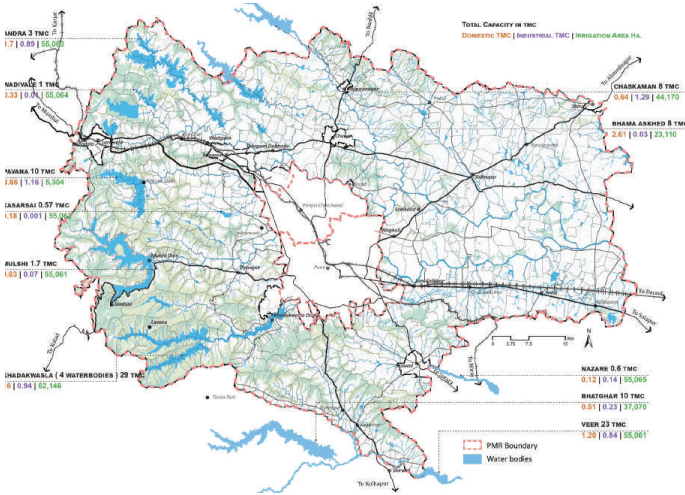
PMR falls within the Bhima basin, formed by the Bhima River, which originates in Bhimashankar of Khed taluka. Bhima, Mula, Mutha, Indrayani, Pavana, Bhama, Andra are the major rivers flowing through the region. Dams, reservoirs, weirs, lakes and groundwater cater to the water requirement of the region.
Water for domestic use is supplied to municipal corporations and municipal councils through dams and reservoirs developed by the State Irrigation Department. MIDC areas are provided water through dams built by the State Irrigation Department as well as private dams. Current municipal water supply and distribution systems cover certain rural areas within PMR. For villages not covered under this water supply and distribution system, the residents depend on private wells and water supplied by tankers for their domestic use.
Institutional Framework
Multiple agencies are involved in the process of planning, designing and developing water supply and distribution systems in the region. These agencies are collectively responsible for developing sources, bulk water supply systems and water distribution systems, resource allocation and assessment and monitoring of groundwater sources. The State Irrigation Department is responsible for source development. It develops dams, reservoirs and weirs. Maharashtra Jeevan Pradhikaran (MJP) and Zilla Parishad are responsible for providing water to rural areas by developing regional and individual water supply schemes. The Ground Water Survey and Development Agency monitors groundwater abstraction status and also develops groundwater supply schemes. Municipal corporations and municipal councils are responsible for developing bulk water supply and distribution systems within their jurisdictions. For smaller municipal councils, MJP also assists in planning, designing and implementing water supply networks. MIDC develops its own water source, bulk water supply and distribution systems. For Kirkee, Pune and Dehu cantonment boards, Pune Municipal Corporation is responsible for developing bulk water supply systems. The cantonment boards themselves develop the distribution systems.
Surface Water Sources
Major Basins
Subbasin wise studies were conducted from the northern side to the southern, and analysis is as follows:
1. Bhima Subbasin
It is an uppermost basin in PMR. Bhima River, a left-bank tributary of Krishna River in the Krishna basin, originates in Bhimashankar hill in Khed taluka outside PMR. The entire basin is in Maharashtra and receives rainfall between 500 mm to 750 mm except for a small area upstream of Chaskaman Dam.
2. Bhama Subbasin
Bhama River originates in Sahyadri hills in Rajgurunagar village of Pune district. It is a right-bank tributary of River Bhima and is a small river with an interception of a dam at village Askhed. The dam supplies water to 36 villages within the basin, out of which ten are downstream but in close vicinity. The remaining villages are upstream and within the submergence.
3. Andhra Subbasin
Andra River is a small left-bank tributary of River Indrayani. Andra originates in the village Sawale situated at
Sahyadri hills. Tata Power Company constructed a dam on this river near village Kiwale during the fifties for hydroelectric power generation. This reservoir supplies water to 30 villages, out of which 16 villages lie upstream within the submergence, and 14 villages are downstream.
4. Indrayani Subbasin
Indrayani River is revered as a holy river. Sacred sites of Alandi and Dehu are settled on the left bank of this river in Khed taluka. It is a left-bank tributary of the Bhima River. All medium dam projects on this river, such as Vadivale, Shiravata, Valvan and Lonavala, have comparatively more yield. However, Tata Power Company owns all dams except Vadivale.
5. Pawana Subbasin
Pawana river originates in the Sahyadri ranges on the west side of PMR in Mawal taluka. It is a small basin, and the river confluences with River Mula near Pune city. It is a left-bank tributary of the River Mula.
6. Mula Subbasin
River Mula originates in Sahyadri ranges on the westward of PMR. It flows towards the east and meets River Mutha in Pune city. After that, this merged flow is known as the Mula-Mutha River. Tata Power Company constructed a dam on this river near Mulshi in 1927. Almost all water is diverted to the Konkan region for hydropower generation at Bhira Power House. Thus storage of Mulshi dam is not considered here for domestic supply except for villages situated upstream of the dam. Twenty-five villages in the catchment of Mulshi dam have been availing the domestic water supply from this dam since its opening.
7. Mutha Subasin
It is one of the largest sub-basins in PMR. The Mutha River originates near the village Tamhini (Bk) in Sahyadri ranges located west of PMR. Mosi and Ambi rivers are two tributaries of the Mutha River, and they originate to the south of its origin. Three dams are constructed in the initial reaches of these rivers: The first dam is near village Panshet on the Ambi River. The second dam is near the village of Warasgaon on the Mosi River. The Mutha river is dammed for the third time near the village of Temghar. Panshet dam is currently used as a drinking water source for Pune city. Water released from these three dams is dammed again near the village of Khadakwasla on the Mutha river. All these four dams together form the Khadakwasla Complex group, a lifeline for drinking water of Pune Metropolis.
8. Nira Subbasin
Nira basin is the southernmost basin in PMR. The actual area wise contribution of this basin is minimal. There are four reservoirs in Nira valley, namely Nira Deoghar, Bhatghar, Chapet and Vir.
9. Karha Subbasin
A small part of the Karha basin also falls within PMR. River Karha originates in the hills of Purandar fort. Flowing towards the east side, it merges with River Nira from the left side. River Karha flows seldom, and there is an acute shortage of water in this area. There is no major or medium project constructed in PMR on this river.
Major Reservoirs
Various rivers originating in the Western Ghats, i.e. westerns parts of PMR, flow through PMR boundaries. The region currently has 19 major and medium reservoirs and 16 minor irrigation tanks. This section provides an analysis of various surface water sources in the region.
Table 7.1Surface Water Sources in PMR - Key Reservoirs
No.
Name of Source
Type of Source
River Name
Storage Details of Reservoir
Sanctioned Reservation for use of water
Live
Dead
Total
Quantity (mm3)
1
Khadakwasla
Major
Mutha
55.91
30
85.91
2
Temghar
Major
Mutha
105.01
2.95
107.96
3
Warasgaon/Dasave
Major
Mose
363.13
12.23
375.36
4
Panshet
Major
Ambi
301.61
9
310.61
Total
825.66
54.18
879.84
424.89
5
Chaskaman
Major
Bhima
214.5
27.19
241.69
26.44
Chapter 7: Public Utility
6
Bhama Ashkhed
Major
Bhama
217.13
13.52
230.65
144.11
7
Ghod
Major
Ghod
137.99
31.31
169.3
12.62
8
Pawana Dam
Major
Pawana
240.97
31.15
272.12
285.77
9
Bhatghar
Major
Velvandi
665.57
7.08
672.65
29.73
10
Gunjawane
Major
Gunjawani
104.48
0.21
104.69
0
11
Mulshi Dam
Major
Mula
522.76
13
Status of Piped Water Supply at Village Level
MJP, Zilla Parishad and GSDA have developed regional and individual water supply schemes in the region using surface water and groundwater. Piped water is supplied to district villages through these schemes. Municipal corporations are mandated to provide water supply to villages within 5 km of corporation limits. Currently, PMC and PCMC are providing water supply to these villages through tankers. About 45 regional water supply schemes and 700 individual water supply schemes have been developed in the Pune district to cater to the water requirements of the district. Of the 814 villages, only 428 villages are served through water supply schemes by MJP, ZP or GSDA system. The rest of the villages are served through groundwater abstraction from wells or bore wells.
Key Observations
The total water available in the region considering 35 water sources as mentioned in Table 7.1, is 142 TMC.
Major and medium irrigation projects has a capacity of 98% of the total storage. Minor projects serve locally.
Out of the 142 TMC water storage, 38 TMC (27%) is only sanctioned reserved for use of water.
Surface water is used for domestic, industrial and irrigation purposes through dams, reservoirs, weirs and canals.
Groundwater is monitored by the Ground Water Development Authority and is abstracted via bore wells and dug wells. For rural areas, groundwater plays a major role in providing domestic and irrigation water.
It is observed that currently, total water supplied to ULBs is much higher than the estimated demand and the NRW is also high in the range of 30-48%.
Water supplied to the rural area is significantly less compared to its estimated demand. Water deficit in rural areas can be covered with suitable reallocations of current water quantity supplied to urban and rural areas and reduced NRWs at ULBs.
At the village level, 428 villages are covered through regional and individual piped water supply schemes.
7.2Sewerage Systems
Sewerage systems are a core element of physical infrastructure that determines the environmental status of any settlement and requires minute planning, development and management.
As per the 74th amendment to the constitution, Maharashtra Municipal Corporations Act and Maharashtra Municipal Councils Act, municipalities are mandated to collect, remove, treat, and dispose of sewage. The MJP was mandated for wastewater treatment in rural areas. However, no such function is currently carried out by MJP.
Villages within PMR currently have inadequate sanitation facilities. The untreated sewage is discharged into the natural sewer or low lying areas or directly into rivers/water streams. Thus, the river pollution level has breached the threshold levels. Poor sanitation facilities in remote areas are posing serious environmental damages due to the discharge of untreated sewage and open defecation to a certain extent. The peri-urban areas around PMC and PCMC limits are seeing increased housing demand. It is mandatory to obtain pre and post-construction environmental clearances as per the Ministry of Environment and Forest guidelines. Many residential/commercial developments are observed wherein decentralized treatment facilities are developed or under development in surrounding areas.
MIDC is solely responsible for water supply, effluent collection and treatment for their industrial estates at Chakan, Ranjangaon, Kurkumbh, Bhigwan, etc. Simultaneously some industrial areas are not developed in demarcated
industrial areas. However, industries have obtained the approvals for establishment and consent to operate from the Maharashtra Pollution Control Board and other authorities. These industries are responsible for developing the effluent treatment facility and maintaining the outlet parameters. There is no institutional framework set up for monitoring the outlet parameters and the efficiency of the plants.
Existing Situation
Sewerage network and sewage treatment plants currently exist in PMC and PCMC, while there is a negligible sewerage network and no sewage treatment plants in PMR. For villages in the Study Area that are not covered under a sewage network, some sewage is discharged into soak pits/septic tanks. In some areas, the sewage is discharged into water bodies or open spaces without any treatment.
Table 7.3Status of Waste Water Management at ULB level
535.76
0
12
Upper Andhra Lake/ Thokarwadi
Major
Andra
363.7
0
363.7
0
13
Shirwata
Major
Indrayani
212.97
0
212.97
0
14
Vadiwale
Medium
Kundali-Indrayani
30.39
10.48
40.87
8.62
15
Kasarsai
Medium
Pawana
16.06
1.32
17.38
3.91
16
Lower Andra Lake
Medium
Andra
82.75
0.55
83.3
66.3
17
Mulshi Tunnel Project
Medium
Mula
46.61
0
46.61
25.96
18
Nazre
Medium
16.64
5.68
22.32
7.25
19
Valwan
Medium
On Catchment (Sarovar)
72.12
0
72.12
0
20
Adhale
Minor
On Catchment
0.97
0.3
1.27
0
21
Malvandi
Minor
On Catchment (Pawana)
3.28
0.41
3.69
0
22
Jadhavwadi Dam
Minor
Sudha river
11.61
0.51
12.12
1.07
23
Pimploli
Minor
Kaparganga Nala
1.41
0.13
1.54
0
24
Khamboli
Minor
Kaparganga Nala
1.84
0
1.84
0
25
Rihe
Minor
Kaparganga Nala
1.27
0.34
1.61
0
26
Hadshi 1
Minor
Walki river
2.97
0.1
3.07
0
27
Hadshi 2
Minor
Walki river
1.3
0.11
1.41
0
28
Walen
Minor
Walki river
5.07
0.04
5.11
0
29
Uravade
Minor
On Catchment
1.89
0.11
2
0.44
30
Chinchwad
Minor
1.46
0
1.46
0
31
Saltar
Minor
On Catchment
1.3
0
1.3
0
32
Bhongvali
Minor
Nira
3.06
0.16
3.22
0
33
Kadus
Minor
Kumandala
2.26
0.36
2.62
0
34
Wafegaon
Minor
Vel
2.69
0.42
3.11
0.005
35
Tithewadi
Minor
Vel
7.1
0.76
7.86
0
3819.78
199.42
4019.2
1037.115
Note: *These projects, although outside PMR, are in the vicinity of PMR, should be considered for water planning. Source: Engineering Department, PMRDA
Pune Metropolitan Region falls under the Deccan trap volcanic groundwater province, which proves to be a good aquifer given that the rock is highly weathered. However, the interflow horizons such as red boles tend to become clayey and sometimes reduce the aquifer properties.
Groundwater is a major source of irrigation, accounting for about half of the net irrigated area as of 2011. Irrigation Data 2010-11 indicates that the total area irrigated using groundwater source in the Pune district is 1,45,500 ha. In contrast, area by irrigation accounts for 1,22,400 ha. The net irrigated area by all sources stands at 3,20,000 ha. Further, there were 91,699 dug wells/tube wells in the district for irrigation as of 2010-11. Additionally, groundwater is also an important source of rural water supply.
Lower penetration of piped water supply to many villages has resulted in a high water abstraction in many of these villages. Table 7.2 data represents groundwater development in PMR talukas between 2008-09 and 2011-12. It shows that groundwater development has increased for most talukas. It has reached critical levels in Purandar and Shirur talukas and is approaching a critical stage in Daund and Khed. It shows the need for the conservation of groundwater sources.
Table 7.2Stage of Groundwater Development (%) in PMR
Taluka
2008-09
2011-12
Bhor
40.35
45.84
Daund
81.39
74.6
Haveli
54.9
53.7
Chapter 7: Public Utility
Khed
66.3
79.3
Mawal
13.5
19.6
Mulshi
13.04
13.87
Purandar
83.95
92
Shirur
81
89.5
Velhe
6.09
7.9
Source: Report on Dynamic Groundwater Resources of Maharashtra - 2008-09, 2011-12
Location
W MaLsDtewater Collection System
Per-centage Cover(%)
Treatment Capacity (MLD)
Percent-age Treat- Disposal ed (%)
PMC
898.4 Piped system
98
527
Mula-71 Mutha river
PCMC
431.2 Piped system
83
333
76
Alandi MC
2.88 Septic tanks
0
0
Shirur MC
4.3 Underground Sew., Septic tanks
90
6
100
Lonavala MC
16 Septic tanks
3.6
30
Rajguru MC
22.4 Septic tanks
64.75
0
0
Chakan MC
5.6 Septic tanks
0
0
0
Talegaon
12.4 Septic tanks
0
0
0
Saswad MC
3.76 Underground Sew., Septic tanks
100
2
40
Source: ULB officials, DPRs of proposed projects
Wastewater Quantification
Pune Metropolitan Region includes both urban and rural areas. In rural areas, apart from various townships developed in the region, there is no underground sewerage network and sewage treatment plants in the region. Estimated wastewater generated in the region based on 2011 numbers and piped water supply in the Planning Area is presented in Table 7.4.
Table 7.4Estimated Wastewater Generation
Taluka
Water Supplied (MLD) (based on 55 LPCD)
Wastewater Generated (80% of Water Sup-plied) (MLD)
Bhor
3.75
3
Daund
9.2
7.36
Haveli
23.34
18.67
Khed
16.18
12.94
Mawal
13.59
10.87
Chapter 7: Public Utility
Mulshi
9.37
7.49
Purandar
3.07
2.45
Shirur
14.13
11.30
Velhe
1.47
1.17
Total
94.13
75.3
Source: MWRRA notification, Census 2011
Table 7.5 shows the percentage of households in PMR with individual toilets or have access to individual toilets, which contains flush/pour-flush latrines, pit latrines, and percentage of households without any latrine facilities that are dependent upon public toilets or defecate openly.
According to Census 2011, approximately 68.78% of PMR households have individual toilets, and 31.22% of households depend on either public toilets or defecate openly. Even though public/individual toilets are present in the region, there is a lack of sanitation collection, conveyance and treatment facilities. Primary treatment is in the form of septic tanks that exist in the areas. The sullage in rural areas is drained out into open nalas or open drainage systems, which flows beside residential areas and discharge pollutants into the natural courses. There are some villages in the region where open defecation still persists.
Table 7.5Number of Households with Latrine Facility - Census 2011
Taluka
Piped Sewer System
Septic Tank
Other
Total/Percentage Households with Latrine Facility (%)
Bhor
2.49%
37.44%
41.14%
81.07%
Daund
4.59%
32.86%
11.05%
48.50%
Haveli
57.09%
19.55%
5.46%
82.10%
Khed
6.19%
43.64%
20.87%
70.70%
Mawal
9.44%
43.69%
11.20%
64.33%
Mulshi
11.26%
36.12%
21.75%
69.13%
Purandar
8.12%
22.10%
28.64%
58.86%
Shirur
2.47%
39.39%
20.13%
61.99%
Velhe
2.16%
14.39%
40.41%
56.96%
Total
18.92%
33.82%
16.04%
68.78%
Key Observations
Total wastewater generated in the region, considering the estimated existing water supply, is approximately 75.3 MLD.
The sullage from soak pits, septic tanks and STPs are disposed of into nearby rivers through nalas and gutters.
Currently, no provisions exist for reusing treated water even from STPs for irrigation or industrial purposes.
With proper treatment at the ULB level, at least 30% of the wastewater can be reused for irrigation and industrial purposes.
The rural areas have soak pits, septic tanks and open drains in place for the collection of wastewater. It is necessary to look into treating the sullage generated through septic tanks and open drains.