Efficacious solid waste management in PMR is crucial due to the scale and quantum of solid waste generated by the rapidly urbanising region. Current challenges in solid waste management range from collection issues, waste segregation and safe disposal. Poor solid waste management has direct implications on the region’s environmental health, with a considerable bearing on the standard of living.
Overview of Solid Waste Management in PMR
Different types of waste generated in PMR include municipal solid waste, bio-medical waste, hazardous waste and e-waste. The central government has published rules for the management of each type of waste, namely:
-
Municipal Solid Waste Management Rules
-
Bio-Medical Waste Management Rules
-
E-Waste Management Rules
-
Hazardous and other waste Rules
Table 7.6 contains details of different agencies in place for bio-medical waste, e-waste and hazardous waste management in PMR.
| Type of waste | Facilities In the region |
|---|---|
| Biomedical | Bio-medical waste incinerator facility provided by M/s Passco (PMC), M/s MIMER Medical |
| waste | College (Talegaon), M/s Yashwantrao Chavan Memorial hospital (PCMC) |
| E-Waste | Waste generated is recycled and reused in local markets or sent to MMR |
| Hazardous | All hazardous waste generated is collected, transported and disposed of at the Common |
| waste | Hazardous Waste Treatment Storage and Disposal facility at MEPL, Ranjangaon. |
Existing Status of Solid Waste Management - ULB level
As per Municipal Solid Waste Management Rules, municipal corporations and municipal councils are responsible for the collection, transportation, treatment and disposal of municipal waste. These provisions are aligned with the functions of municipal corporations and councils as stipulated under 74th and 73rd amendment to the Constitution and Municipal Corporations and Councils Act. However, there is no authorised agency for managing the waste generated in rural areas.
In urban areas, the waste is generally dumped outside houses or at a common collection site. It is left for municipal authorities to transport it to a common dumping ground. Despite having a door-to-door waste collection system in some areas, garbage dumps are mostly seen in depression or open grounds, creating a severe hazard for health and sanitation. Table 7.7 summarises the status of solid waste management at the ULB level.
| Location | Waste generated (Ton / Day) | Waste Collect- ed (%) | Waste Treated (%) | Current Treatment Facility | Dumping site | Current proposals |
|---|---|---|---|---|---|---|
| Pune | 1,678 | 100% | 51 | Composting, Vermicomposting Biomethanation, Waste to Energy plant | Fursungi, Devachi Uruli, Hadapsar, Ramtekadi, Aundh | Waste to energy plant, Waste incinerators, E-waste Recycling centers, New Landfill |
| Pim-pri-Chinchwad | 800 | 91% | 94 | Composting, Vermicomposting Plastics to Fuel, SLF | Moshi-Treatment and disposal | Waste to Energy, Hotel Waste to Biogas, Sanitary Landfill Site |
Chapter 7: Public Utility
| Alandi | 18 | 83% | NA | No Treatment | Gut No.193 | NA |
|---|---|---|---|---|---|---|
| Shirur | 11 | NA | 0 | No Treatment | Nagpur-Pune Road Municipal dumping site | Segregation at source, E-waste Management Facilities, Centralized Windrow Composting Facility, MRF |
| Lonavala | NA | NA | NA | Composting | Warsoli Kachra depot | NA |
| Rajgurunagar | 23 | NA | 0 | No Treatment | Kharabwadi Quarry Landfill | Centralized composting and Material Recovery Facility |
| Chakan | 20 | NA | 0 | No Treatment | Kharabwadi stone fill -Rache alandi road | NA |
| Talegaon | 25 | 95% | 0 | No treatment, Partial Material Recovery by Kabadiwalas | 221 | Segregation at Source, Construction of Sanitary Landfill, Compost Depot |
| Saswad | 12 | 100% | NA | Composting | Kumbharwalan | NA |
| Pune CB | 30 | 100% | 34 | Vermicomposting | Hadapsar | NA |
| Dehu CB | 8 | NA | 50 | Composting | Nigdi | NA |
| Kirkee CB | 32 | NA | 31 | Composting, Vermicompost | Kasarwadi | NA |
Source: Consultations with ULBs, MPCB Swachh Bharat Mission Implementation Status report, 2017
Figure 7.2: Solid Waste Quantity at ULB Level
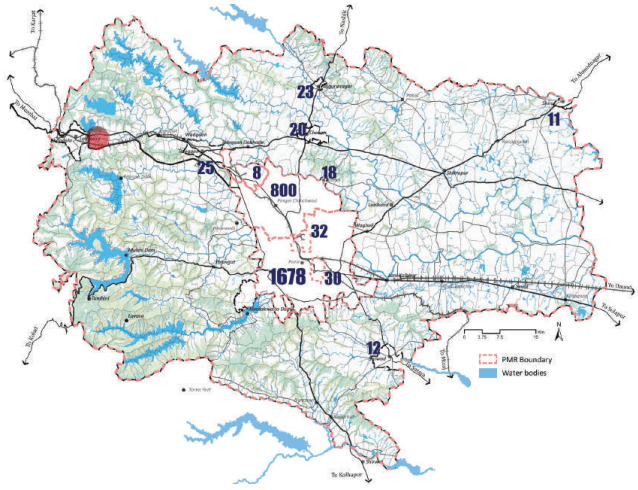
Source: Consultation with ULB’s, MPCB, Swachh Bharat Mission Implementation Study Report’ 2017
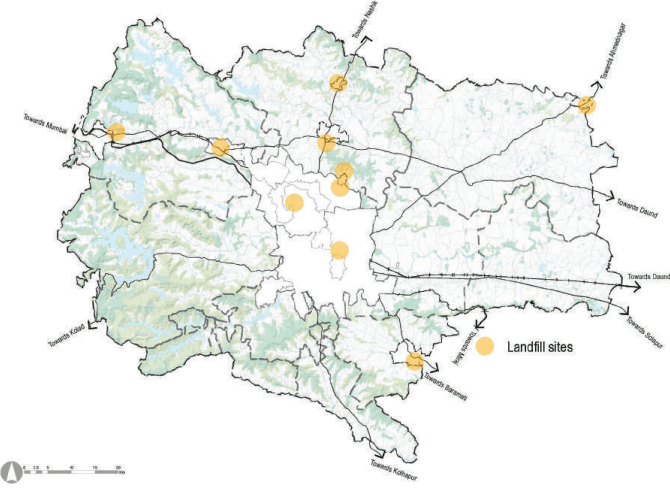
Most dumping sites in the region are not lined to protect groundwater from leachate percolating into it. Most of the population disposes of waste in the open space, rivers and water bodies, etc. Figure 7.2. shows locations of landfill sites and dumping sites at ULB level.
Existing Status of Solid Waste Management in Rural Area
PMRDA has published the Draft Development Control Promotion and Regulation Rules (DCPR), Part VIII-Special Provision in certain Buildings. Regulation 34 provides guidelines for the development of buildings and townships in the region. According to these rules, the provisions for solid waste management in the region are as following:
-
All housing complexes, commercial establishments, hostels, hospitals with aggregate built-up area more than 4,000 sqm or more; and all three-star or higher category hotels to have a dedicated solid waste management system to treat 100% wet waste and home-compostable plastic being generated in the building.
-
Wet waste treatment shall be done through organic waste composters/vermicomposting pits or other similar technologies of suitable capacity installed through reputed vendors.
-
The disposal of dry waste, e-waste and hazardous waste shall be carried out through authorized recyclers or any other system specified by the Metropolitan Commissioner.
While the DCPR stipulates waste management rules, there is no agency in place for the collection, transportation, treatment and disposal of waste.
According to the Central Pollution Control Boad Data, the standard waste generated is 0.3-04 kg per capita per day. Considering this norm, the total waste generated in rural areas is 513.39 tons per day. Table 7.8 provides further details on total waste generated in the PMR Planning/Study Area.
Figure 7.3: Location of Landfills and Dumping Sites
Chapter 7: Public Utility
| Taluka | Population (2011) | Estimated Waste Generated (Tons) (0.3 kg/ person/day) |
|---|---|---|
| Bhor | 68,320 | 20.49 |
| Daund | 1,67,351 | 50.2 |
| Haveli | 4,24,428 | 127.32 |
| Khed | 2,94,213 | 88.26 |
| Mawal | 2,47,123 | 74.13 |
| Mulshi | 1,70,366 | 51.1 |
| Purandar | 55,902 | 16.77 |
| Shirur | 2,56,923 | 77.07 |
Key Observations
Presently a number of deficiencies exist in solid waste management systems in PMR:
Both urban and rural areas in PMR face several challenges in solid waste management. While at the ULB level, municipal corporations and councils undertake the collection and transportation of waste, there are still gaps in storage facilities, treatment and disposal of waste. In smaller municipal councils, the waste collected is directly dumped at an identified site without any treatment. Most of these municipal councils have prepared DPRs for solid waste management, which proposes developing facilities for the treatment of waste. However, the implementation is still pending. In addition, there is no proposal in place for the development of scientific landfill sites.
-
Due to land shortage, some portion of municipal solid waste is dumped in areas outside municipal jurisdiction.
-
There is a lack of solid waste management systems in rural areas of PMR. The institutional capacity of Gram Panchayats is inadequate to manage a solid waste management system.
-
Some landfill sites are located in environmentally sensitive areas/near watercourses (e.g. Varsoli dumping site located on the north of Indrayani river).
-
No allocated land for waste disposal: There is no land earmarked for solid waste disposal in most of the region, neither as a landfill site nor for disposal through other techniques.
-
Household-generated hazardous waste such as medicines; batteries do not get recycled or addressed.