Regional Plan 1997
Regional Plan 1997 planned for tourism activities to cater to increasing demand from tourists for tourism amenities, encourage tourism growth and provide for it on a planned basis to ensure that unplanned sprawls do not disfigure or unregulated activities do not spoil the environment. Understanding the tourist attraction potential and possibility of development on the lines of Lake District in England, strategies were proposed for the development and promotion of tourism facilities mainly along lakes.
The area between 100-500 metre belt from FSL/HFL lines of lakes was considered special tourism development zones for active and passive tourism activities, around lakes in Mawal, Mulshi, Bhor, Velhe, Khed and Haveli talukas. The plan proposed no development within 100m from the edge of the water at HFL, except for the boathouse, jetty, etc. Farmhouses are not permitted within 200 m from HFL of major irrigation projects, and where they are in the vicinity of lakes, they should not be allowed without ensuring that sullage and garbage disposal will not pollute lake waters. However, for the development in the tourism development zone within the 500 m belt around lakes, FSI should be 0.10 with ground floor structures only with height restricted to 5 m. If a project by local residents is in the form of an extension of his existing building, the total FSI allowed, including the existing built-up area, should not exceed 0.15. The maximum area of a plot for tourist resort development should be 2 acres in which ground and first-floor construction with a maximum height of 9m should be permitted.
Afforestation zoning within the 500 m to 1500 m belt around lakes was proposed, with a possibility for low-density development, similar to forest house type development. This low-density development was suggested by the Pune Regional Planning Board, with only ground floor structure may be considered on a plot with a minimum area of 1 ha, instead of 6 ha suggested in draft rules. Another RP proposal was to consider lands falling beyond 200m from boundaries of protected monuments and archaeological features, including forts and temples and extending up to 1.5 km as a Tourism Development Zone. Low-density development was also proposed in all hilly areas with high good forest cover and a belt of lands lying between 500 m to 1500 m from HFLs of major lakes.
Region Plan 1997 recommended the following projects as part of the tourism proposal:
-
Infrastructure development: development of a civic airport, road access to lakes and tourist spots, provision of bus services to tourist spots
-
Projects enhancing tourist attraction: International Industrial Exhibition at Pune, light and sound show at Sinhgad and Parvati, arts and crafts village at Katraj, Regional Park/Wildlife sanctuary near Katraj and Panchgaon Kuran, Riverfront development on banks of Mula-Mutha River, Ropeway projects
-
Religious importance: project for all-round development of Dehu-Alandi, provision for Yatri Niwas and water supply facilities
-
Nature-based tourism: development of bird sanctuary and bird watching facilities along specified lakes, rivers and forest areas
-
Development of viewpoints over hilltops near Lonavala
-
Institutions for imparting training in mountaineering should be promoted at appropriate locations within the Tourism Development Zone
-
Development of Natural History Museum at appropriate locations in Tourism Development Zone, residential zones in Lonavala Wadgaon belt/forest parks developed by the forest department
-
Eco-conservation: increase tree cover, slopes above 30 degrees need to be taken for afforestation, slopes between 15-30 degrees suitable for horticulture, slopes over 10 degrees not suitable for terracing and environmental awareness
Maharashtra Tourism Policy 2016
PMR’s tourism proposal is aligned with Maharashtra’s Tourism Policy 2016, and the highlights of this policy are presented below.
As per the Maharashtra Tourism Policy 2016, it is expected to generate fresh investments in the tourism sector to the tune of INR 30,000 crore and create 1 million additional jobs in the sector by 2025. It focuses on promoting private investments and accelerating the implementation of projects through public-private partnership models. Maharashtra Tourism Development Corporation, the nodal agency for promoting tourism in the state, is steering Maharashtra’s ambitious plans and programs to attract a large number of tourists to the state. MTDC is driven by the Tourism policy 2016.
Chapter 8:Tourism
Out of the 11 high priority projects that MTDC is keen to undertake on PPP/JV mode, none are planned specifically for PMR. The special tourism districts identified under the policy are Sindhudurg, Aurangabad and Nagpur, and it does not include Pune district as a special tourist destination/district. Nonetheless, while proposing the tourism plan for PMR, the tourism themes identified within the policy are required to be abided by. The themes identified in the policy are: sustainable tourism, rural tourism, caravan tourism, MICE, film tourism, theme based tourism, religious tourism, heritage tourism, beach tourism, cruise tourism, culinary tourism (events and festivals), nature tourism, tiger eco-tourism, education tourism (exchange programs and excursions), hill station tourism, adventure tourism, tourism festivals part of Visit Maharashtra 2017, medical tourism.
The policy’s implementation plan includes setting up institutional arrangements, single-window clearance for hospitality and live events, investor facilitation cell, PPP transaction advisory cell, promotion and marketing, tourism police and smart ticketing system.
The policy provides fiscal incentives for mega projects based on fixed capital investment and direct employment generated. Fiscal incentives are given to large projects and MSME units too. The incentives are given over the eligibility period, tax exemptions, electricity concession, stamp duty and registration charges exemption, FSI, licenses and clearance. Special incentives are proposed for key strategic interventions.
Pune District Tourism Plan
District tourism plans are formulated based on types of tourism activity and state tourism policy. Pune district’s current tourism plan is prepared for a period of twenty years from 2012 to 2032. It identified 59 principal tourism assets in Pune district, out of which half are located within PMR. In 2012, Pune saw a footfall of about 10% (1.5 crore) of total domestic tourists that visited Maharashtra and about 10% (1.7 lakh) of foreign tourists arriving in Mumbai. District plan has assumed an annual CAGR of 9-10% to project tourist arrivals for the next 20 years. Accordingly, the district plan estimated domestic tourists in Pune at 2.35 crore, 3.69 crore, and 9.10 crore in 2017, 2022 and 2032. Foreign tourists are estimated at 2.59 lakh, 3.94 lakh, 9.12 lakh in 2017, 2022 and 2032.
In terms of focus areas of tourism development, three broad tourism themes are identified for domestic tourists: religious, cultural and heritage tourism; leisure and recreational tourism; monsoon tourism.
Similarly, seven broad tourism themes are identified for foreign tourists: eco-tourism; wildlife tourism; cultural tourism; health tourism; heritage tourism; adventure tourism; fairs and festivals. Further, thematic circuits aimed at extending tourist stays are identified and thereby contributing to the local economy: pilgrim circuit; fort and heritage circuit; nature tourism circuit; leisure and adventure tourism circuit; educational tour circuit.
In order to strengthen the circuits, road improvements are proposed that includes: Pabal to Malthan road (37 km); Pirangut to Tamhini Ghat (50 km); Shirur to Ghod dam (28 km); Inamgaon to Ranjangaon (7 km); Paud to Morve village (44 km); Panshet to Sinhagad (40 km); Nasrapur to Baneshwar (10 km); access road to Purandar fort (4 km); Kalewadi to Malhargad (5 km).
Figure 8.1: Existing Tourism Assets in Pune District
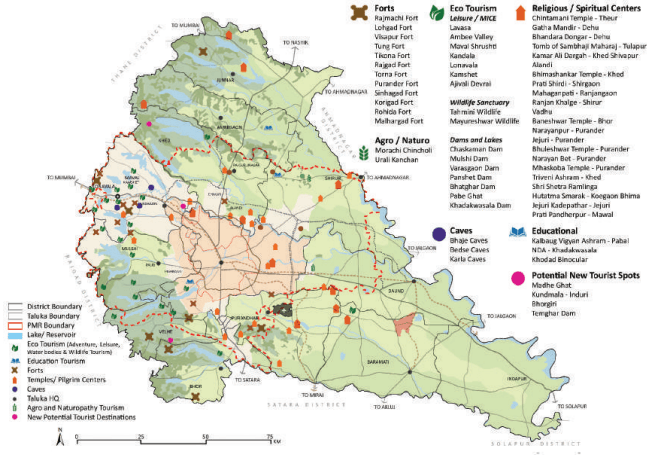
Source: Pune District Tourism Plan 2012-2032.