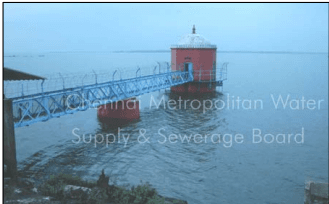
One of the major problems faced in CMA is the inability of the administration to keep pace with the increasing need for utility services particularly water supply and sewerage. This problem is not unique to Chennai alone and almost all the rapidly growing cities in India share the same.
7.02 In Chennai City, Chennai Municipal Corporation was responsible for construction, operation and maintenance of water supply system till August 1978. It was transferred to the (then newly formed) CMWSSB with all assets and liabilities. The major supply sources viz. Poondi reservoir, Cholavaram lake and Redhills lake are under the control of the State PWD (Irrigation); further the PWD (Ground Water Cell) is responsible for the investigation of ground water resources within CMA to augment supplies.
7.03 In the cases of large-scale neighbourhood developments made by TNHB such as Anna Nagar, K.K. Nagar, J.J. Nagar, Ashok Nagar, South Madras Neighbourhood schemes etc., water supply facilities within the area had been provided by TNHB (usually with ground water sources or extending the city water supply) and after installation, maintenance had been transferred to CMWSSB. The same is the case in cases of large-scale TNSCB developments also.
7.04 In the rest of the CMA, construction and water supply schemes were undertaken mostly by TWAD Board at the cost of the local body concerned and after completion, transferred to the local body for future operation and maintenance. CMWSSB is now planning to cover these areas with water supply and sewerage services.
City System
7.05 Chennai City water supply is drawn from the Red hills lake located about six km. from City in the northwest along the GNT Road. This lake mainly receives its supply from the Kosasthalaiyar River across which a dam was constructed to create reservoir at Poondi. The anicut constructed in its downstream at Tamaraipakkam diverts the flow through the upper supply channel to Cholavaram Lake; from there it flows to Redhills Lake. A separate lined channel from Poondi reservoir connects the upper supply channel which prevents any possible loss of transmission through dry beds of the river. The flow into these sources is seasonal.
7.06 A number of small lakes are also connected in the northwest of CMA to the Redhills Lake and the run-off in the catchment areas of these lakes are fed to the Redhills Lake.
7.07 Water tapped from the Redhills Lake is filtered enroute, conveyed through closed conduits to Kilpauk Water Works, treated therein and distributed to various parts of the City.
7.08 Nucleus of the protected surface water supply system now in existence in Chennai City was formed in 1872 while major inputs including filtration and pumping commenced in 1914. The scheme as it exists today consists of the surface storages at Poondi, Cholavaram and Redhills lakes with a total capacity of 183 million cubic metres fed by the Kosatalaiyar river. The maximum water levels of Redhills and Cholavaram lakes were raised in 1972 and the irrigation rights under the lakes had also been acquired by the Government. The lakes are mostly fed by North East monsoon, which is active only for a few months in a year between October and December.
7.09 A statistical analysis of the combined storage of the lakes for a period of thirty years has indicated that the safe potential from the lakes at 95% probability is only 142 mld. As the lakes are shallow, evaporation losses are as high as 43% at present.
Ground Water Regulation
7.14 To regulate and control the extraction, use or transport of ground water and to conserve ground water, the Chennai Metropolitan Area Ground Water (Regulation) Act, 1987 was enacted. The preamble of the Act is extracted below:
"There is often acute scarcity of water due to consecutive failure of monsoon rains; the available water in the Poondi, Cholavaram and Red Hills reservoirs, which are the main sources of supply of water to the Chennai City, is inadequate to meet the requirements for drinking and other domestic purposes of the people in the Chennai City;
The United Nations Mission, which investigated the possibility of supplementing water supply to Chennai, has recognized that a better economic answer might lie in the development of groundwater potential and had identified the Minjur, Duranallur-Korteliyar basin, the Poondi, Korteliyar Flood Plains and Kannigaipper aquifers and also Poonamallee-Porur aquifer in Cooum-Adayar basin as having groundwater for extraction;
The United Nations Development Programme which conducted pre-investment studies on improving water supply and sewerage systems of chennai concurred with the estimation of the Geological Survey of India that groundwater can be extracted from the twenty kilometre stretch of the coastal zone between South Madras and Kovalam;
The Madras Metropolitan Water Supply and Sewerage Board has reported that all other possibilities of augmenting water supply to the Chennai City have been exhausted and that it is necessary to regulate and control the extraction and use of ground water in any form and to conserve the same in the City of Chennai and the district of Chengalpattu and to regulate and control the transport of groundwater;
Based on the United Nations Development Programme studies, a scheme for artificial re-charge of the Arni-Korteliyar basin with excess flood water flowing into the sea is to be taken up by interlinking Arni and Korteliyar at two or more feasible points and also by constructing sufficient number of check dams at the appropriate places in the Korteliyar river course;
Such re-charge will enable optimum utilisation of ground water and formation of a hydraulic barrier against seawater intrusion;
The Government have, after careful examination of all aspects, decided that it is necessary in the public interest to regulate and control the extraction and use of
groundwater in any form and to conserve the groundwater in the City of Chennai and certain revenue villages in the district of Chengalpattu and to regulate and control the transport of groundwater." The Government of Tamil Nadu has enacted the Act viz. Madras Metropolitan Area Ground Water (Regulation) Act 1987.
7.15 The Act is being enforced by the CMWSSB in the Chennai City and the District Collector in the rest of CMA, and it provides for grant of permit to sink wells in the scheduled areas, registration of existing wells and use of ground water in the area, license for extraction, use or transport of ground water etc.
7.16 The entire area within the Chennai City has potential for restricted drawal through shallow open wells, and tube wells, and these types of wells are predominant in the premises within the City. Though unprotected, it helps to supplement the limited quantity of protected water available from the public system. Assuming a conservative figure of drawal of 50 lpcd of ground water, for the population of Chennai about 45 million in 2005, estimated drawal will be in the order of 225 MLD. Details on TDS level in ground water in Chennai are given in the Annexure VI-A. The level of TDS of sample wells varied from 500 ppm to 2500 ppm.
7.17 Estimated safe yield and average yield at various sources for water supply to Chennai in the year 2004 is given below:
Table
No.7.03 Safe Yield from d
ifferent sources 2004
Sl.No.
Source
Average yield in MLD
Safe yield in MLD
1.
Surface Water including I stage Krishna
17.89
500
2.
New Veeranam Project a) Veeranam Lake b) Neyveli Aquifer
148.4250.56
18065
3.
Well fields
85.23
100
4.
Distance Source
63.16
100
5.
Porur Wells
2.96
3
6.
Southern Coastal Aquifer Total
2.12370.34
4952
Source: CMWSSB
7.18 The sources of water supply to Chennai in the year 2004 is given in the Table below. The areas served by it are the Chennai City, adjoining urban areas (10 sq.km.) and industries at Manali.
Table No.7.04 Sources of Supply of Water to Chennai, 2004
Source (in ML) for the whole year 2004
Veeranam Lake
14,842
Redhills Lake
4,155
Rain water
1,691
Chembarambakkam
133
Erattai Eri
207
Well fields
31,195
Southern Coastal Aquifer
776
R.O. Plants
182
TWAD Source
275
Porur Wells
210
Neyveli Aquifer
5,966
Distance Source
21,357
Total
80,988
Source: CMWSSB
7.19 When there was acute scarcity of water in 2004 to the City due to monsoon failure and it could not be supplied through pipe, CMWSSB had ably managed the crisis by supplying through tanker lorries and the water supply through tankers were 9,930 nos./day (average) from January, 2004 to June, 2004 and 9,003 nos./day (average) from July to December, 2004.
Supply Levels
7.20 The average water supply in Chennai city is 90 lpcd. In slums within the City the level of water supply is 25 lpcd. The current water supply from all the sources is of the order of 550 MLD. However, during the summer season, in times of reduced storage, the supply levels would be as low as 300 MLD. In addition, CMWSSB also provides bulk water to the surrounding municipalities to supplement the other sources.
Ground Water System
7.10 The ground water sources are ground water from well fields, coastal aquifer; brackish water based Reverse Osmosis Plants, Neyveli Aquifer etc.
7.11 During 1960s & 70s three aquifers at Minjur, Panjetty and Tamaraipakkam located in the north and northwest of the City and the aquifers along the coastal belt from Thiruvanmiyur to Kovalam were identified and tapped. The area North East of the City was taken up for extensive hydro- geological study as part of a UNDP aided project to assess the potential for development of a ground water source. Studies have identified a 'buried channel', which should have been the course of Palar river thousands of years back. In this course, a well field was identified extending to a stretch of about 50 km. length and 5 km. average width hydro geologically suitable for extraction of ground water. The following well fields have been developed.
Table No.7.01 Details of Well Fields
Well Fields
Year of Commission
No. of wells
Yield MLD during design
Average yield from Dept. wells in 2005
Tamaraipakkam
1969
2 out of 30
50
1.60
Panjetty
1969
1 out of 13
41
0.08
Minjur
1969
5 out of 9
34
3.10
Poondi
1987
4 out of 12
27
1.20
Flood Plains
1987
0 out of 5
14
0
Kannigaiper
1987
0 out of 5
14
0.01
Total
12 out of 74
180
5.99
Source: CMWSSB
7.12 Above table clearly brings out the depletion of ground water source during the last 30 years in that area due to increase in demand resulting in overdrawal of ground water. In addition, due to severe scarcity, CMWSSB has hired private agricultural wells from 2000 to augment water supplies. The average yield from such sources during 2005 is to the tune of 77 MLD.
Details of hiring of Private Agricultural Wells
Sl.No.
Year
Average Yield in MLD
1
2001
37
2
2002
45
3
2003
55
4
2004
70
5
2005
77
7.13 In the recent past the agriculture activity in the ayacut areas of Chembarambakkam tank has been reduced drastically because of conversion of lands for urban uses and for reasons of uneconomical production costs. Now the Chembarambakkam tank (located about 12 km. from the City in the west) is also used as one of the main sources of water supply to the City. Veeranam tank (located about 230 km. from the City in the south) has been identified as an additional source of water supply to Chennai.
Table No.7.02 Characteristics of Existing Surface Reservoirs
Reservoir
Maximum Water Elevation (Metre)
Drawl of elevation (Metre)
Maximum usable volume (million)
Full Area surface (million sq.ft.)
Mean Depth (Metre)
Catchment Area (Sq.km.)
Poondi
42.67
34.14
91.44
376.74
8.53
1983
Cholavaram
19.66
14.22
24.93
55.76
5.44
28.49
Redhills
15.30
8.59
87.02
195.15
6.71
60.00
Chembarambakkam
26.03
18.72
103.15
711.18
7.31
357.00
Veeranam
14.48
12.34
37.61
2.14
422.40
Total
306.54
2850.89
Treatment Capacities
7.21 The availability of treatment capacities at 750 MLD is much more than the current supply levels. The treatment capacity appears to be high as the current supply is lower than the anticipated levels and would suffice the current requirement if a full supply is envisaged. The location and capacities of treatment plants is presented in Table No.7.05.
View of Redhills Reservoir
Table No. 7.05: Treatment Capacities
Sl. No
Location
Capacity-MLD
1.
Kilpauk
270
2
Red hills
300
3
Veeranam
180
Total
750
Source: CMWSSB
7.22 In addition, a 530 MLD capacity treatment plant at Chembarakkam is currently under construction taking the total capacity to 1280 MLD. This is constructed in anticipation of full realization of Krishna Water to the City, which would augment the existing supply levels.
Distribution System and Storage Capacity
7.23 The distribution network in Chennai City covers a length of 2,582 Km and is divided into 159 Divisions. About 98% of the population of the City is covered through piped supply and the balance is through water tankers. The water is distributed through 27 main and subsidiary water distribution stations comprising Over Head Tanks and Under Ground Tanks. The combined storage capacities are of the order of 322 ML. The per capita supply in Chennai Corporation area, as of July 2006, is 105 lpcd. The Chennai City water supply distribution network has been divided into 16 Zones with independent water supply distribution stations and distribution network with feeder mains. In 12 Water Distribution Stations and 11 distribution network zones, improvement works have been completed and the supply level is almost equitable. For balance 4 Water Distribution Stations and 5 zonal distribution networks, improvement works have been proposed under JNNURM funding, since the earlier attempt to include in the World Bank assisted projects had not been finalised. On completion of the improvement works in the balance 4 Water Distribution Stations and 5 distribution network systems, the supply level will be almost equitable.
7.24 The ULBs manage their own storage capacity, the present supply levels are low and would need augmentation in the future.
Master Plan for Water Supply- Distribution System
7.25 A master plan for the management of the water supply and sewerage for the City, which was prepared in the year 1978, was revised in the year 1991 in order to receive and utilize the water for City supply under Telugu Ganga Project from Andhra Pradesh and later updated in 1997. The master plan contemplated the construction of additional water treatment plant, water distribution stations, laying of additional transmission mains and strengthening of the existing distribution system. The master plan envisages
re-organizing the existing distribution system network to the 16 zones and adequate infrastructure to ensure equitable distribution of water supply. The implementation of the master plan has been taken up in stages for water supply management in Chennai city to utilise the Krishna water received from Andhra Pradesh.
7.26 The size of the pipes constituting the distribution system ranges from 100 mm to 1500 mm in diameter with a total length of about 2,582 km. The existing system largely consists of C.I. pipes. In some specific areas PVC mains exist. Of the total length, 85% is estimated to be of diameter 200 mm and less. Also, about 50% of the smaller sized distribution pipelines are estimated to be of age 50 years or more. Ageing of pipeline, incrustation due to intermittent supply and other factors have contributed to the reduction in the capacity of the distribution system resulting in low pressure in the distribution system. More than 50% of the total system is estimated to have zero residual head. Chennai City has been expanding at a fast rate and because of this, it is found difficult to meet the demand, especially at the tail end areas. The 300 MLD capacity Water Treatment Plant was constructed at Red hills with World Bank assistance under the first Chennai Water Supply Project and 3 Nos. of transmission mains were also laid to facilitate the treated water to different water distribution stations located in the City.
Coverage in Slums
7.27 About 3.5 lakhs population of Chennai in slums comprising of 58,631 households are covered through piped supply, tankers and public fountains. CMWSSB supplies water through 8,916 public fountains and 3,542 mini tanks to augment the piped water supply. About 2/3rd of these facilities cater to low income and slum population. Ground water for supplementation purposes is also drawn through 7,726 India Mark II pumps.
Second Chennai Project
7.28 The Second Chennai Water Supply Project was taken up by CMWSSB during February 1996 with the World Bank Assistance at a cost of Rs.778.79 crores and most of the works contemplated under this project has been completed. Some of the major works such as construction of Water Distribution stations (7 nos.), Laying of Clear Water Transmission mains (36 km.), and Strengthening of Water Distribution system in 11 zones (660 km.) out of 16 zones were taken up, including leak detection rectification works covering about 70% of Chennai City Area. Benefits attained due to the implementation of the above project are:
(a) Piped water supply availability has been increased resulting in reduction in defective streets with improved service level and pressure in the mains.
(b) Reduction in the radius of the water distribution station resulted in increased piped water supply availability with reduced quantity of supply.
(c) The level of unaccounted for water has been reduced resulting in additional water availability to the Chennai citizens.
7.29 Due to the construction of additional water treatment plant of 300 MLD capacity at Red Hills in 1996, the work of refurbishment of the existing Kilpauk Water Treatment Plan of capacity 270 MLD was taken up at a cost of Rs.24.57 crores and all the works were completed.
Chennai City Water Supply Augmentation Project-I
7.30 Chennai Water Supply Augmentation Project-I (to add 180 MLD water to Chennai City water requirement) was taken up by CMWSSB in 2004 at a cost of Rs.720 crores. It is to draw 190 MLD of raw water from Veeranam Lake near Sethiathope, situated in Cuddalore District at about 230 km. from Chennai City, pump the raw water to about 20 km. through the pipeline to Vadakuthu for treatment, pump the treated water from Vadakuthu for a distance of about 8 km. to the Break Pressure Tank at Kadampuliyur ridge point and then convey the water from this ridge point by gravity for about 200 km. to the Water Distribution Station at Porur in Chennai and distribute to the public through the distribution network system.
Chennai City Water Supply Augmentation Project-II
7.31 The Government on 27.2.2004 has accorded the revised administrative approval for the Chennai Water Supply Augmentation Project-II (CWSAP-II) at an estimated cost of Rs.124.00 crore. The objective of this project is to augment water supply to the City by intercepting the rainwater runoff into the sea by the construction / rehabilitation of check-dams across Cooum, Adyar and Palar rivers. The water thus collected from the Vayalur check-dam and the available water in Kolavoy lake will be treated in the proposed Water Treatment Plant at Mangalam and will be transmitted to the City. The aim of the project is to tap 20 MLD of water from different sources.
7.32 The following are the components of work to be implemented under the CWSAP-II:
(1) Construction of check-dam at Vayalur across Palar river.
(2) Infrastructure for drawal of 20 MLD from Checkdam at Palar (drawal and conveyance).
(3) Treatment Plant at Vayalur and laying pumping main upto Pallipattu with an intermediate pumping at Tiruporur.
(4) Construction of check-dams across Manapakkam, Nandampakkam, Anakaputhur and Cowl Bazaar.
(5) Improvements to two Check-dams across Cooum at Paruthipattu and Kannapalayam.
This project is scheduled to be completed by end of 2007.
Telugu Ganga Project
7.33 Under this project 12 TMC of water from Krishna River will be received and stored in Poondi, Redhills, Cholavaram and Chembarambakkam lakes.
Construction of 530 MLD capacities Water Treatment Plant at Chembarambakkam
7.34 In order to treat additional water to be drawn under the Telugu Ganga Project additional treatment plant with capacity of 530 MLD is constructed at Chembarambakkam with an estimated cost of Rs134.90 crores with assistance from the French Government and a transmission main at a cost of Rs.90.00 Crores.
Desalination Plant
7.35 Keeping in view, the chronic problem of water scarcity in Chennai and adjoining areas due to frequent failure of the monsoons, Government decided to set up a desalination plant for supply of potable water to the residents of Chennai and adjoining areas. Accordingly CMWSS Board has proposed to construct a 100/200 MLD Sea Water Desalination Plant at Minjur on Design-Build-Own, Operate and Transfer (DBOOT) basis. The required land of 120 acres has also been identified near Minjur. The project is scheduled to be completed in 18 months time and is expected to be commissioned by 2007.
Third Chennai Project
7.36 CMWSSB has proposed to take up further systematic improvement projects in water supply, both for Chennai City and adjacent Urbanised Local Bodies as "Third Chennai Project" with World Bank assistance at a cost of Rs.750 crores. In order to improve the sources, works are proposed for deepening and desilting of Ambattur tank, Korattur tank and Madhavaram tank and for rehabilitation of Porur tank besides formation of check-dams. It is also proposed to install water meters to all the consumers to achieve sustainable revenue. The following are some of the major works envisaged under the proposed Third Chennai Project.
(a) Strengthening of water Distribution system in the left out 5 zones:
Under Second Chennai Project, out of 16 zones, works on strengthening of water distribution system was taken up and completed in only 11 zones. Due to the benefits achieved under Second Chennai Project, it is now proposed to take up the strengthening of the distribution system in the remaining 5 zones also viz. Anna Poonga, Kilpauk,
Triplicane, Southern Head works and KK Nagar. The total length of pipelines to be laid is about 305 km. at a total cost of Rs.150 Crores.
(b) Infrastructure facility to draw additional ground water from A.K. Basin:
Under the Second Chennai Project, the consultancy study to reassess the ground water potential in Araniar Kortalayar Basins is under way and will be carried over into the Third Chennai Project after ascertaining the sustainable yield.
Rest of CMA
7.37 Potable water supply system exists almost in all the municipalities with CMA. Alandur, Pallavaram, Tambaram, Anakaputhur and Pammal Municipalities have water from Palar River as source, and other municipalities have CMWSSB bulk supply or the ground water as source. Water supply in Panchayat areas are concerned, it is by local wells and public taps.