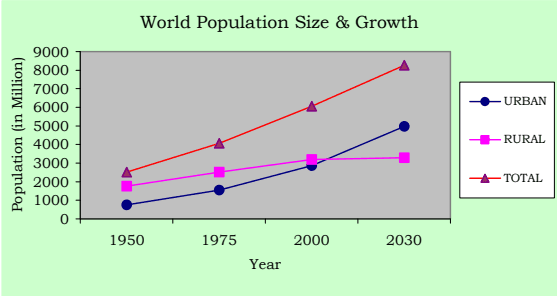
History of the world during the last century has shown that the process of urbanisation and economic growth progress are mutually reinforcing. Cities are the loci and motors of economic and social change. According to United Nations Projections, the World's urban population will grow from 2.86 billion in 2000 to 4.98 billion by 2030 and the World's annual urban growth rate is projected as 1.8 per cent in contrast to the rural growth rate of 0.1 per cent. About 60 per cent of the World's population will live in cities by 2030.
| Table No.3.01: World Population Size and Growth, Urban and Rural | |||||||
| Mid-year population size (million) | Population growth rate (percent) | ||||||
| 1950 | 1975 | 2000 | 2030 | 1950-75 | 1975-00 | 2000-30 | |
| Urban | |||||||
| World Total | 751 | 1543 | 2862 | 4981 | 2.9 | 2.4 | 1.8 |
| High-income countries | 359 | 562 | 697 | 825 | 1.8 | 0.9 | 0.6 |
| Middle and low income countries | 392 | 981 | 2165 | 4156 | 3.7 | 3.2 | 2.2 |
| Rural | |||||||
| World Total | 1769 | 2523 | 3195 | 3289 | 1.4 | 0.9 | 0.1 |
| High-income countries | 219 | 187 | 184 | 139 | -0.6 | -0.07 | -0.9 |
| Middle and low income countries | 1550 | 2336 | 3011 | 3151 | 1.6 | 1 | 0.2 |
Note: High-income countries have gross national income per capita of US$9266 or more based on World Bank estimates.
Source: National Research Council, 2003, P.85.
1 The state of the World’s cities 2004-05 Globalisation and Urban Culture, published by Earth scan in 2004