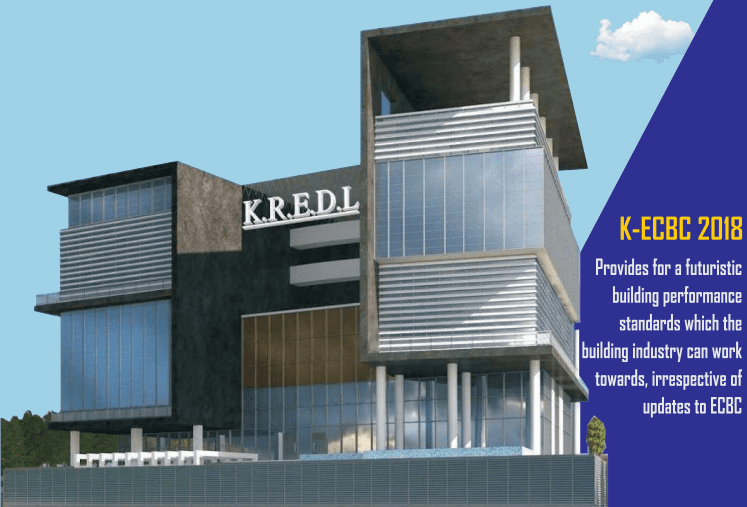
K-ECBC 2018 Provides for a futuristic building performance standards which the building industry can work towards, irrespective of updates to ECBC
Issued by goqa,mεqmα ENERGY DEPARTMENT, GOVERNMENT OF KARNATAKA

godugcda
uuomcu uyomα
DEPARTMENT OF ENERGY
GOVERNMENT OF KARNATAKA
omBou oαgoα2018
KARNATAKA ENERGY CONSERVATION BUILDING CODE 2018
m 3 g
oaoauuua uuu,uu&,uoooo g o ua
u uo ooe αog ou.. ,,乳, ηαo η, εα,B uα, B S 乳Bu 乳 乳,乳
Bou乳uoo ~ So yαo qu,eu o乳u,y.α u αo 乳 qu&,uyoηαco αu Cgαu O5&UUU,αGOC OuηUηOU.
Bo o α o, Bo oα o乳ou,,yoαyyau,o “Bo oαy o"ou,α °uηo2(.B.B),BooCo, α ηα α αα.
,αBouoα亂yuo2U o Uα cuα g o αou ,u乳U~ q g,eu 乳o ou yo乳u Ug oαou乳o, qu, 0~a-B~&~-2014 Gu ~,αiB~~-2018 Gu ,U, .
,α-~-2018,, ,α-~~-2018η α ooα ou αo e. 30-50α α Bo乳亂o ou. Bou Bduo αlB~~ ogoy,ααu sααy,uomα 乳 u αα Bαu 乳ηuy,乳~αo UOyUUOyOoI CUOyUNGc~,αUOηu quUUya*BOU uu”qoU,乳UguC uuOuC HOAAU.
8.8q.oa0ba uau,uueuooeco gs Bou uuua.
Foreword
Indian economy has expanded aggressively in the last few decades and it is poised for greater growth in the future. However, our progress is accompanied with unique local and global challenges. Rapid economic growth, urbanization and expanding pollution have imposed a great strain on energy supply resources. Our economic development policies and international commitments to climatic change mitigation are centered on the twin targets of surprising rapid market growth with minimal environmental impact.
The building sector consumes one third of the total annual electrical energy consumption in the State and is one of the largest contributors to Green House Gas emissions. The rate of growth in commercial building sector is amongst the highest andthe sector needs to bemade more efficient in its energy consumption. Thus, the Bureau of Energy Efficiency (BEE) introduced the Energy Conservation Building Code (ECBC) under the Energy Conservation Act (EC ACT) 2001 to reduce the adverse impact of buildings on the environment.
The Act started with taking up this initiative in commercial building spaces to roll out best practice of Energy Efficiency as one of the key strategy adopted by the State Government. Initially, the State had notified Karnataka Energy Conservation Building Code (KECBC-2014) on 27th November 2014 in the official State Gazette for enforcement.
In alignment with current market scenario, to catch up with the curve of advanced technology maturation and to setup higher benchmarks for the Building Energy Efficiency, Karnataka ECBC 2014 has been revised [as per the provision under Section 15(a)] in-line with BEE ECBC 2017. As per the provisions in EC Act 2001, under Section (18) the Karnataka Energy Conservation Building Code (KECBC) 2018 was notified in the Karnataka State Gazette on 28th May 2020.
The Code is mandatory and the enforcement of the Code came into effect in the State from the date of notification for efficient use of energy in the Commercial Buildings.
In this newly developed Code, additional parameters included are related to Renewable Energy integration, ease of compliance, inclusion of passive design strategies and flexibility for the designers.
The application of these norms lowers the buildings energy requirement without affecting the function, comfort, health or productivity of the occupants. Adoption of ECBC 2018 shall lead to about 30%-50% of energy savings in commercial building sector which in addition results to CO reduction. 2
Barriers and challenges for implementation of ECBC vary in terms of technical & design aspects, market barriers, policy and enforcement issues. For the effective implementation of KECBC -2018 in the State, the Roles and Responsibilities of the Implementing Departments are well definedin the Code. In addition, the Long-term success of the ECBC will depend heavily on the collaborative role of various stakeholders who would play towards the development, adoption and implementation of Building Code. Proper implementation of this Code augurs well for energy adequacy and environmental sustainability in our State. 10